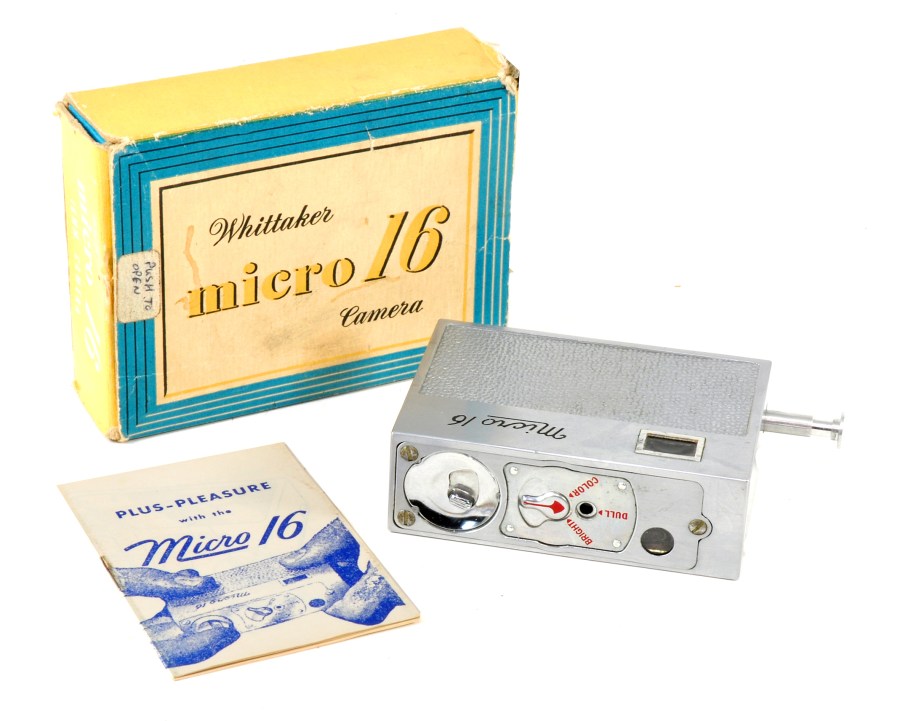
Although the first 16mm film camera, called the Mini-Fex, was launched in 1932, it wasn’t until the 1950s that the idea took off in a big way, and then it lasted into the 1960s with 16mm versions of just about every type of camera. The Micro 16, made by the Whittaker company in Los Angeles, appeared even earlier. Measuring just 70x50x25mm, it was smaller than a packet of cigarettes and the right shape to fit inside one, making it ideal for clandestine photography. Consequently the camera sold remarkably well to American police departments and detective agencies.
- Launched: 1947, Price at launch: about £12, Guide price now: £25-50 (used)
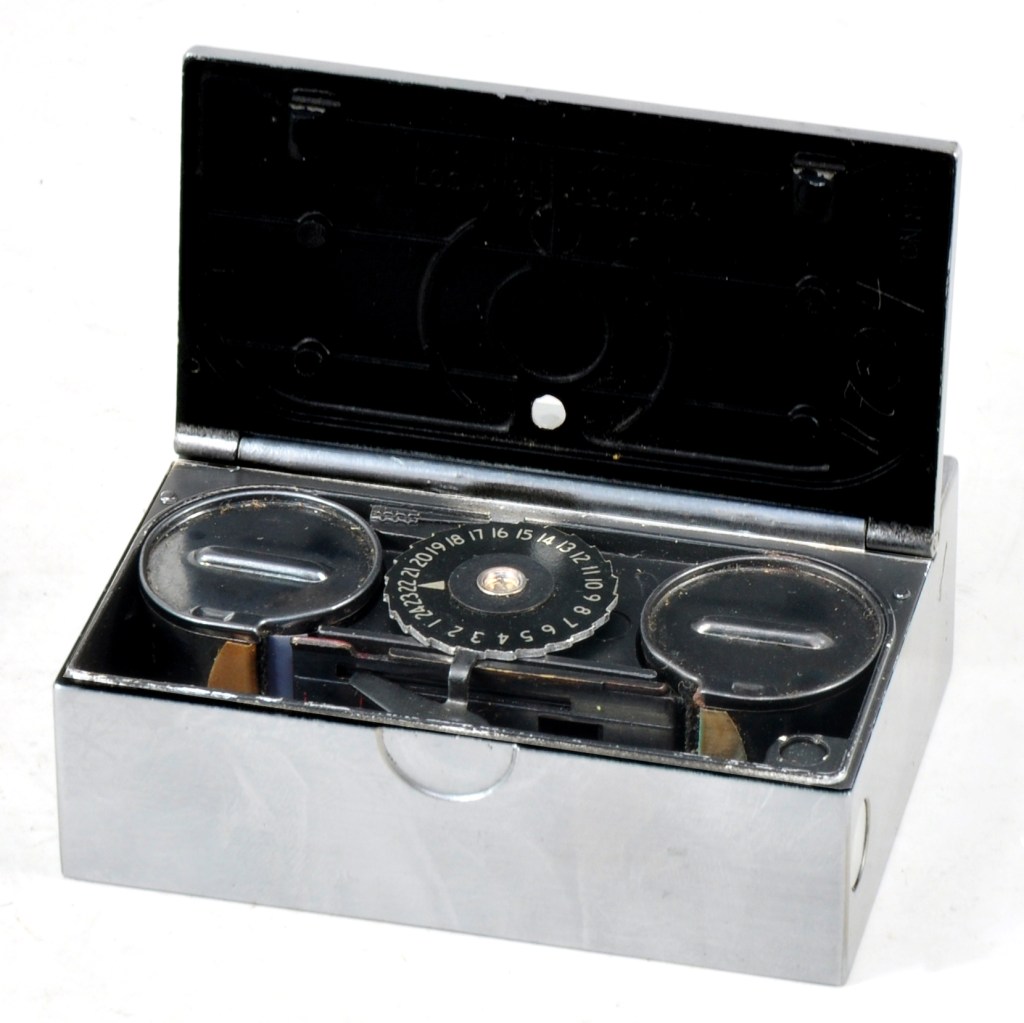
The Micro 16 shoots 24 exposures on 16mm film held in its own twin cassettes. It has a single speed shutter, probably of around 1/50sec, and an f/6.3 lens which is stopped down to f/8 and f/11 by means of a small lever beside the lens that indicates apertures as ‘bright’, ‘dull’ and ‘color’.
The shutter is released by lifting a recessed lever on the front and allowing it to spring back. Pushing a small button inset into and flush with the side of the body causes a plunger to pop out. Pushing it in again advances the film as a claw mechanism inside pulls the film from one cassette and pushes it into the other. Then the plunger springs out ready for the following film wind. When the camera is turned upside down and the plunger pressed in, a gravity-assisted latch locks it in place until it is next needed.
A small square viewfinder window on the top of the body reflects an image from a circular lens at the base of the camera’s front plate. It’s a bit tiny for easy use, but a special accessory sports finder was originally available to provide easier eye-level viewing.
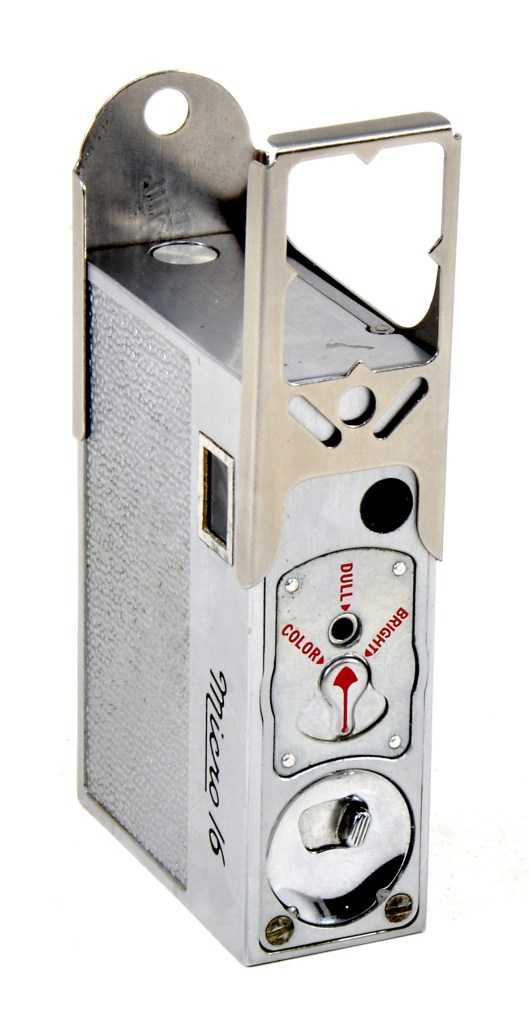
For users, the Micro 16 is still practical today for those prepared to buy 16mm cine film and preload the cassettes in a darkroom or changing bag. For collectors, there’s an appeal in the polished aluminium body that can be found in chrome, black, blue, green and grey colours.
What’s good
- Well-made body, easy to conceal, extremely quiet shutter.
What’s bad
- The lens was reputed to be mediocre, film wind prone to failure.
Related reading:
- The classic Boltavit I – a tiny German film camera
- Best 35mm film: these are my favourite colour and B&W 35mm film stocks
- Classic film cameras the Pentacon FM was built like a tank
Follow AP on Facebook, Instagram, YouTube, TikTok, and IRYS.