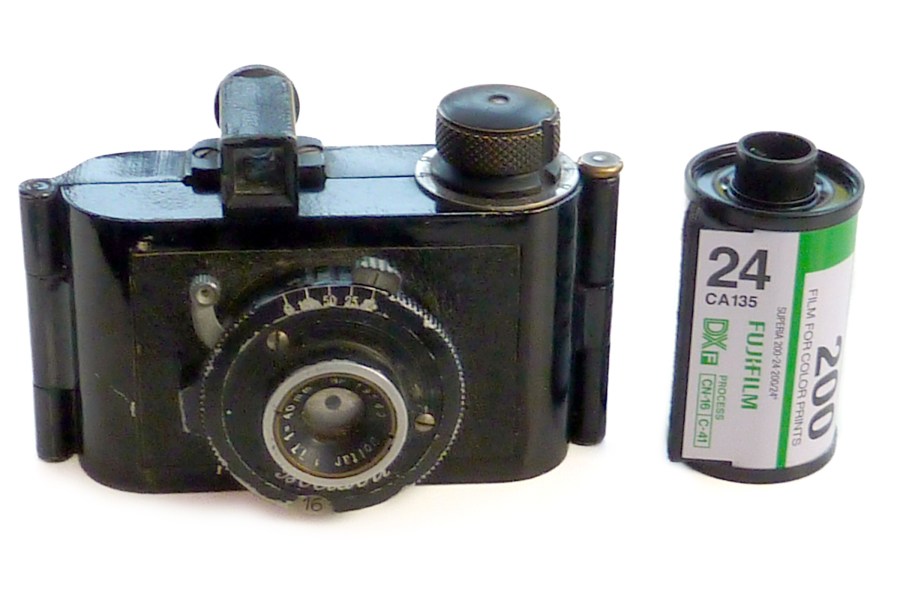
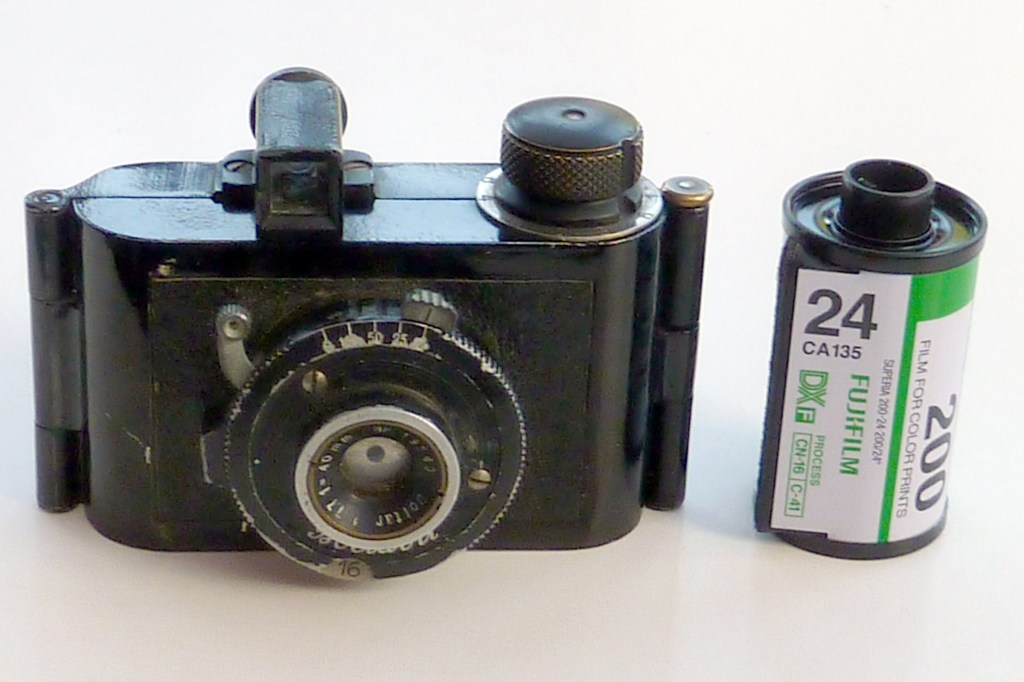
The Boltavit is a funny little camera, with the emphasis on the little, as seen in this photo showing it alongside a 35mm cassette. Bolta GmbH, the company who made the camera, started in Nuremberg in 1921, and was named after its founder Johann Bolten. Interestingly, they initially made combs and other hair accessories before diversifying into cameras in 1935.
It’s basically a roll film camera, using unperforated 35mm on a backing paper, much like 828 film which was quite popular, especially in the USA, in the 1940s and 50s. The Boltavit I, which is the version that I have, was the first of the series. The specs are very simple, a 40mm f/7.7 lens with a three-speed shutter and Waterhouse stops for f/11 and f/16. The lens is mounted on a metal tube which retracts into the body when not in use, making this little camera even smaller. The little black die-cast box looks decidedly scruffy, but searching online throws up a lot of similar looking examples, so I suspect the paint was particularly vulnerable to flaking. Either that or there was a craze for using them in a bizarre variation of conkers!
Not long after the range was launched, the name was changed to Photavit, and over the next couple of decades, an ever more sophisticated series of successors evolved. The last of these was the Photavit V in 1951, by which time there was an f/2.9 lens and a shutter with speeds from 1sec to 1/300sec. Though the cameras had grown slightly in size, they were still very compact. The Photavit name was then applied to a more conventionally sized 35mm rangefinder camera which took interchangeable lenses, a far cry from the little black box of 20 years earlier.
My Boltavit came from eBay in 2011. I can’t remember what I paid for it, but it won’t have been very much. It came with a roll of film, which I optimistically shot and developed. I wasn’t at all surprised to find that it was completely black, most likely having been exposed to light by a curious browser at some time during its 70-year journey from Nazi Germany to Sheffield. This old film was noticeably thicker than current stock, and it was very tightly curled after its long hibernation. In a way it was a blessing that it was blank, as scanning this recalcitrant coil would have been quite a challenge. The positive thing was that this provided me with a roll of backing paper and a couple of spools, which I was easily able to reload with some unperforated 35mm film, a commodity which now seems very scarce.
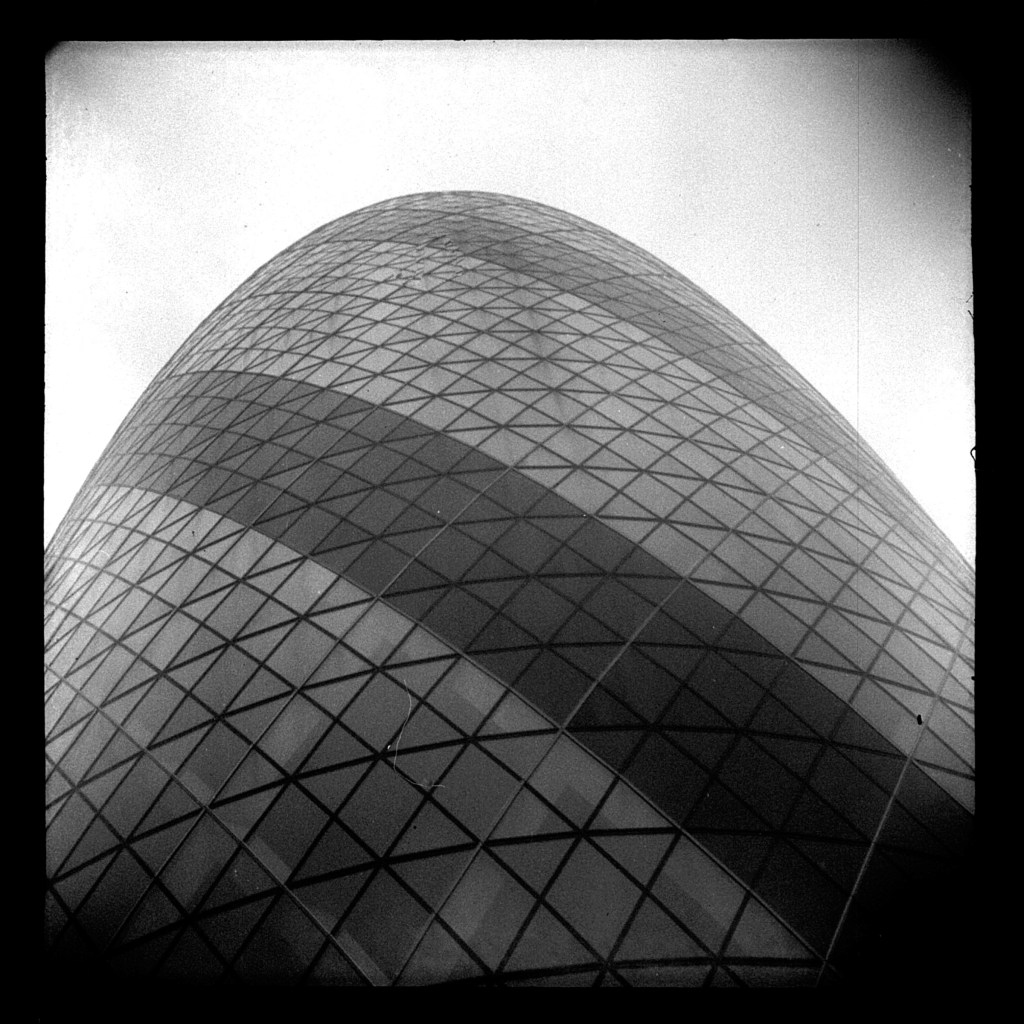
Simple specs mean there is little to go wrong, and I found it performed as it was intended to. As a fan of the square format, I was happy to go out in search of some suitable subjects. I slipped it in my pocket on a day trip to London, where I was unable to resist photographing The Gherkin.
See more of Tony’s photos on Instagram @tonykemplen or search on Flickr
Related reading:
- Best 35mm film cameras
- Classic film cameras the Pentacon FM was built like a tank
- Ignore the haters, film photography is alive and kicking in 2026 – Analogue in the Age of Digital
Follow AP on Facebook, Instagram, YouTube, TikTok and Irys.