The size and value of the disposable camera market is growing year on year – and forecast to keep growing. Currently worth $1.15 billion, estimates suggest it could grow to $2.6 billion within a decade. Against all odds and technological advances, it appears the single use camera is very much back.
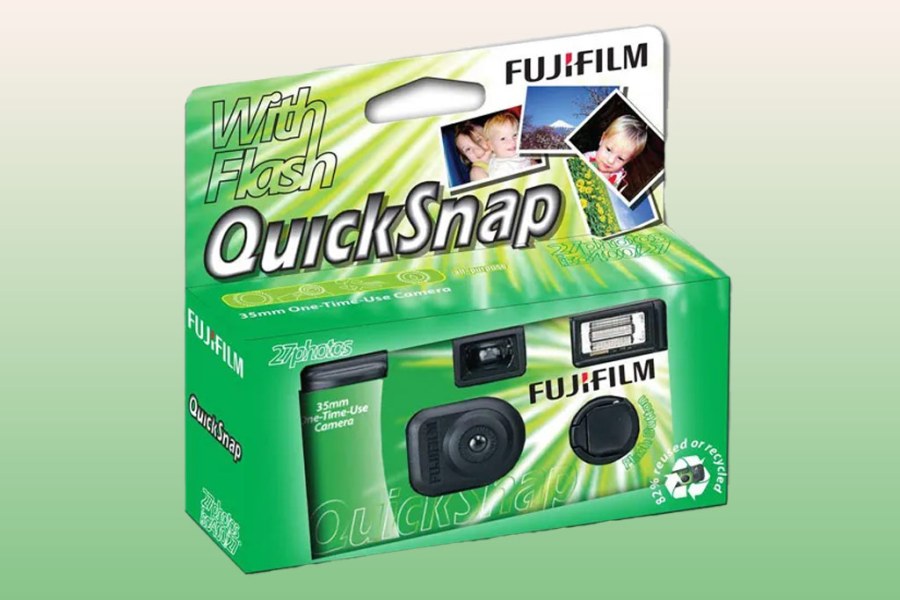
I see Fujifilm’s QuickSnap range everywhere, pre-loaded with 27 exposures from a 35mm roll of ISO400 colour film, in a choice of flash-incorporating or waterproofed plastic bodies. Or there’s the Kodak FunSaver series, offering either 27 or 39 exposures, plus its own built-in flash.
Feeling more experimental? Then check out the Harman 27 exposure camera utilising Ilford XP2 Super ISO400 black and white film. Or, wackier still, Lomography’s Lomochrome Purple or Lomochrome Metropolis single-use snappers. Both feature a swatch of colour gels that can be dropped in front of the flash, to psychedelic effect.
Not for the first time, it’s almost like we’ve turned the clock back on photography.
As a 1990s youth I used to take disposable cameras to my first music festivals, fearful that anything more ‘proper’ might get damaged, nicked or confiscated. But then digital photography and smartphones came along, and I haven’t thought about single-use cameras since.
Now, I appreciate the decade of the Spice Girls, Loaded magazine and Blur vs Oasis is currently being re-evaluated with rose tinted spectacles. But really. What on earth is going on?
Looking to the past to stay present
For starters, just as with digital compacts, it appears that it’s not us oldies buying up disposable snapshots, but today’s teens.
I can see why the almost pocket money price tag is popular. But it can cost the same again to get prints made – dampening my own teen’s initial excitement to receive a single-use camera when that penny dropped.
Still, as with low resolution digicams, I believe the slightly blurry, noisy or imperfect results hold appeal because it feels more authentic. Plus, embracing imperfection in 2026 is almost an act of rebellion, a kick back against the advances made by AI, which my daughter also detests.
Then there’s the fact that, unlike with smartphones, every shot taken with a single use camera must be carefully considered – especially given the creative restriction of 27 to 39 exposures max. We’re all very concerned now about being ‘present’ in our daily lives, particularly when smartphones are a distraction for all generations, and film photography certainly requires that.
There’s also the delayed gratification element, contrasting with the immediate feedback digital photography gives us. And, as with instant print cameras, the potential to be surprised by what we’ve created when there isn’t (always) the usual LCD screen to preview it on.
Waiting hours or days to see how exposures from a disposable camera turn out may seem perverse in our digital age. But youth has typically always wanted to rebel – and do the exact opposite of the generation that came before them. Even if it’s, in this case, the exact same as the generation did prior to that.
The views expressed in this column are not necessarily those of Amateur Photographer magazine or Kelsey Media Limited. If you have an opinion you’d like to share on this topic, or any other photography related subject, email: [email protected]
Related reading:
- New PURE35 film camera will surprise you with how cheap it is to get into film photography
- Here’s what I’ve learned from shooting over 150 rolls of film in the 2020s
- Here’s why I ditched digital for analog film – and I’m not going back
Follow AP on Facebook, Instagram, YouTube and TikTok.