Film photography has become a passion of mine since I first ran a roll in 2019. I’ve shot 35mm rolls in colour and black and white, using a host of different film cameras, from 1970s SLRs to point-and-shoots released last year.
Along the way, I’ve made many discoveries – and more than a few mistakes. Now, mistakes are a big part of the process when it comes to film photography; indeed, some of my favourite shots I’ve ever taken could be described as happy accidents.
But there are also some lessons that I’m very glad to have learned, which I now share with you. If you’re thinking about getting into film photography – maybe you’ve even gone so far as to pick up a camera and a few rolls – then here are a few lessons I’ve learned that will hopefully make the start of your journey a little smoother than mine.
1. You will lose shots. It’s fine.
I was lucky, if you can call it that. The first 35mm film I ever shot, a roll of Ilford XP2 400, didn’t come out, almost certainly because I hadn’t loaded it correctly. While this was heartbreaking at the time, it did the job of inuring me to one of analog photography’s inevitabilities – you will lose shots. It will happen.
Even if you avoid operator error, camera breakage is a common cause of film loss. An old Pentax point-and-shoot I used to love became completely and permanently jammed up just as I was reaching the end of a roll. I couldn’t rewind, nor could I remove the roll from the camera without fatally exposing it to light. Those thirty-something shots on Lomography 400 were simply gone.
And then there was the roll of Kodak Gold 200 (yes I remember the identities of all the rolls I’ve lost, it’s actually very normal and fine) that was in my Canon EOS 500 when it had its fatal encounter with the floor. And generally, the only way you’ll discover a technical fault with one of your cameras, like light leakage, is after it has ruined a roll, not before.
So, be at peace. Losing shots is a rite of passage for film photographers. You may convince yourself that the shot of your life was on that ruined roll – but it probably wasn’t. And even if it was, no-one (including you) will ever know, so it doesn’t matter.
2. Ration your Instagram use (it can cook your brain).
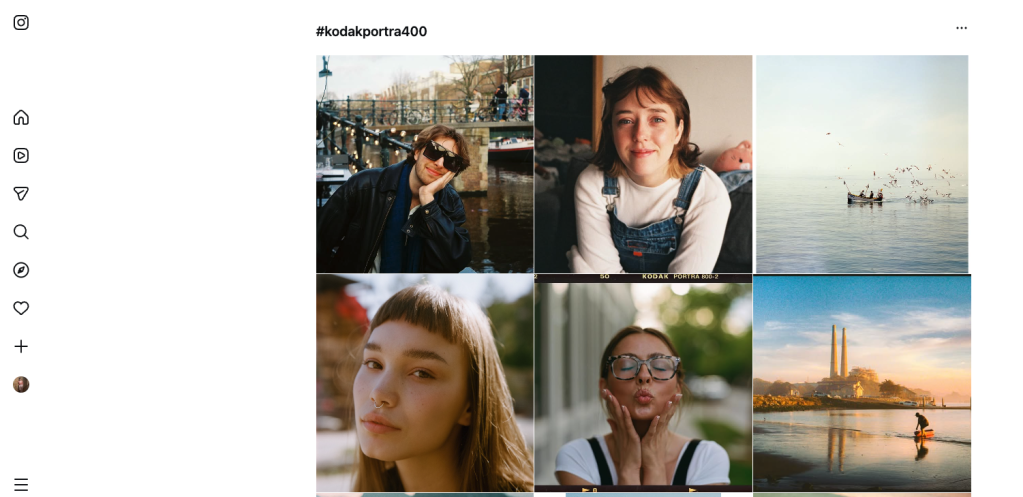
Film photography Instagram is great fun. I’ve got to know some amazing people and fantastic photographers through it, and I love seeing how their work has developed over the years.
But it’s easy to overdo it. There are certain types of shots that do very well on Instagram, and if you over-browse, you can easily convince yourself that these are the only types of shots worth taking. I over-indulged in Instagram when I first started shooting film, and before long I was only ever shooting in golden-hour light, and only shooting Kodak Portra because I was obsessed with getting those smooth pastel tones (free financial advice: don’t do this).
I followed too many Americans – an easy mistake to make on any social platform – and absorbed too many of their predilections, which caused me to become convinced that I desperately needed to photograph basketball hoops. I didn’t. Nobody does.
I still like Instagram. But reducing my usage was a crucial step in finding my own photographic voice, rather than just trying to emulate others.
3. Don’t just go to your nearest lab – shop around!
This goes double if you live in a big city. I live in London, and when I first started to get my film developed, I would toddle along to my nearest lab. I assumed the prices I was paying were just what it costs to develop and scan film, but then I had the sense to check around online – and holy-moly. I was paying comfortably double what it would cost me to post my film off elsewhere.
I don’t mean to put the London lab on blast, which is why I haven’t identified it. London rents are extortionate, and I’m sure their operating costs are daunting. It’s definitely nicer to build up a relationship with a local lab, and I would love to if I were in a financial position to do so. But film is an expensive hobby, and if you’re shooting on a shoestring, it’s definitely worth exploring your development options beyond your immediate neighbourhood.

4. You will probably be okay at the airport.
Travelling with film used to make me very nervous. I’d read horror stories about rolls being permanently ruined by security scanners and the like. However, I have been taking film with me everywhere for years now. I’ve had film X-rayed in airports, train stations, tourist attractions, concert venues and more, and I have never once had a problem.
I still take precautions – I avoid taking high-sensitivity film through the scanners, just in case. I never put any film in checked baggage, as the X-rays are much more powerful. But I’m a lot more relaxed about it than I used to be.
If you are worried, you can ask airport staff to hand-inspect film, and in my experience they will happily agree to do so. Usually you don’t even need to ask – you can just show them the film and they’ll likely know what you want.
5. Be prepared to jump on (or wait for) good deals.
Like many of us, no doubt, I struggle conceptually with large capital expenditures. My stupid brain is a lot more willing to spend £11.99 on one roll of ColorPlus than it is to spend £50 on five rolls, because small number is small and big number big. But if you’re going to shoot a lot of film, over time those savings are really going to start to add up. So sometimes it is worth ponying up now to save money later.
But it’s not all about urgency – there are reasons to wait, too. The development labs I use often run promotions around holidays and special occasions, sometimes offering as much as 20% off development fees. If I have some film shot that isn’t urgent to develop, then I’m more than happy to put it in a drawer and wait until an offer comes along. By bulk developing at a discount, you can make some real savings.
6. If you think you’ve got a great shot, take a few.
I used to be quite puritanical about my 36 (or 24) shots per roll. Given such a limit, it felt wasteful to me to take multiple shots of the same subject. I felt that each frame should be its own separate moment, in order to maximise what I was getting out of the roll.
I’ve relaxed a bit since then. I think it’s come in part from learning to accept that on every roll I shoot, there is going to be a percentage of duds – mis-focuses, mis-timings, mis-exposures, etc. It’s made me keen to ensure that when I’m presented with one of those heart-stopping moments, like perfect light or a stunning view, the resulting shot is not one of the duds.


So, if you think you’ve got something special, open ‘er up. Try a few angles. Play with different focal points. Or – as I like to do – bracket your exposures. One bang-on, one slightly over, one slightly under. It all increases your chances of getting a shot that does your perfect subject justice.
7. It’s hard to go back.
This one caught me by surprise. I originally thought I’d pick up film photography as a fun extra string to my photographic bow. Instead, it has become the form of photography that I am primarily, near-exclusively interested in. And while I’ll retain a digital setup for work purposes, my heart is very firmly analogue and I don’t see that ever changing.
So be warned! Shooting film is a lot of fun, but it might just take over your life.
Related reading
- Film photography and scanning tips
- How to maintain your film camera
- An introduction to medium format film photography
Follow AP on Facebook, Instagram, YouTube and TikTok.