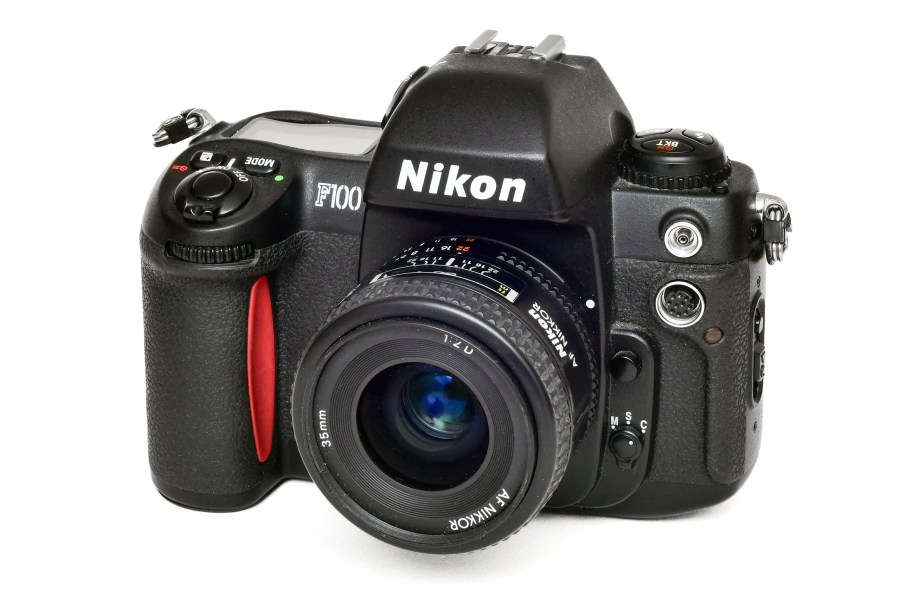
If you became interested in photography at any point in the last twenty years, the chances are that your initial experience was a digital one. The rate of camera development in that period has been truly impressive, and the digital path to imaging is well established as the mainstream technology. Increasingly, however, folk are looking again at analogue techniques – silver-based imaging – as a true alternative to stand alongside digital photography. It’s a route which allows the photographer a lot of individual creativity, as well as being a huge amount of fun, but inevitably you’ll need to buy some additional kit in order to explore it. If you are an existing Nikon DSLR user, there is a very good candidate in the Nikon F100 film SLR, as it can use many of the Nikkor F mount lenses that you already have in your bag.
At a glance:
- $300-400 / £250-350 body-only, used
- High quality 35mm film SLR
- Uses Nikon F mount autofocus lenses
- Similar form factor to Nikon DSLRs
- 3D Matrix metering
- Robust alloy chassis
- Excellent viewfinder
The Nikon F100 SLR is a last-generation film camera. Produced between 1999 and 2006, it shared space in the Nikon range with the decidedly retro styled FM3A film camera (2001-2006) and the very first professional digital models such as the innovative D1 (1999-2001). As a result of its development in this period of crossover for the industry, the F100 benefited from the last refinements of the film era and some of the open thinking which digital developments brought about. This results in a camera whose operation and layout will be immediately familiar to DSLR users.
Layout and handling:
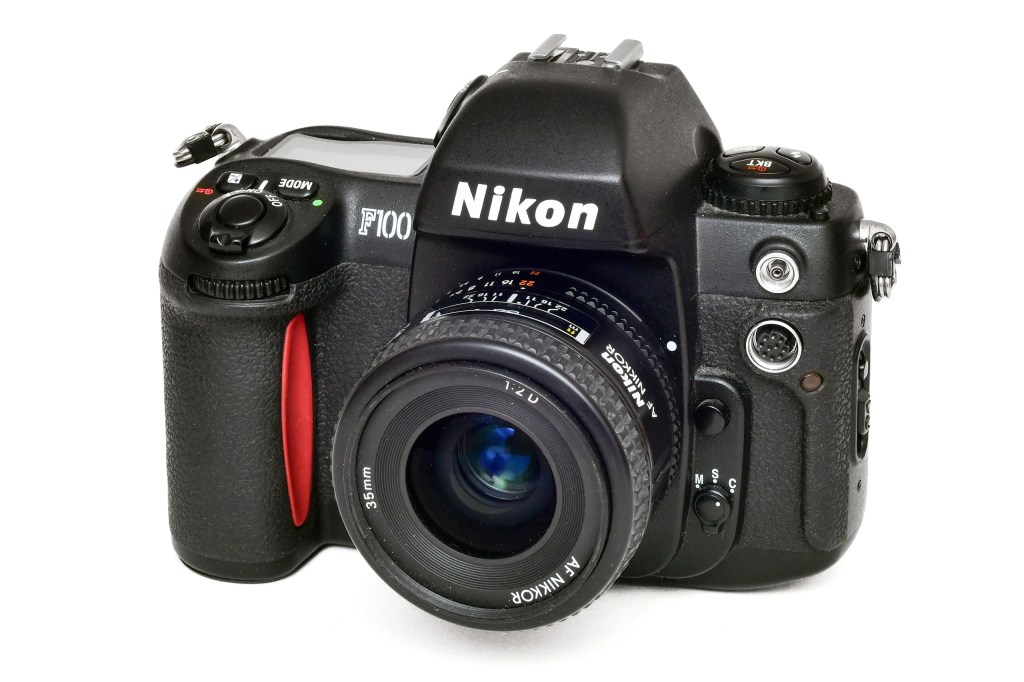
With its modern styling, built-in winder, and top-plate LCD, the F100 looks and feels much like a recent DSLR – and a high-end one at that. The solid alloy chassis emphasises the feeling of quality and gives a reassuring heft to the camera, which weighs in at around 785g without lens, film or batteries. With a 50mm f/1.8D lens, four AA alkaline batteries, and a roll of HP5 Plus, my F100 weighs 1051g.
The four AA batteries are loaded into a holder which slots into the base of the body, secured by a screw. If you’d prefer to use two CR-123A lithium batteries an MS-13 holder is available. The alkaline cells will rattle film through the camera at around 4.5 frames a second – making the F100 no slouch – and a slower, quieter option is available. Rewinding a 36-exposure film takes just under 10 seconds.
Loading the F100 is simple, and almost foolproof. Opening the back involves pressing a button and sliding a catch simultaneously – to prevent errors – and the rear door swings open to the right. Drop the 35mm cassette into the left-hand chamber and draw the film past the shutter until it reaches the marker on the far side. Then click the back shut and the film autoloads rapidly to frame 1. If loading fails, you get a warning message (“ERR”) on the top LCD panel and in the viewfinder. The F100 reads film speed from the DX coding on the cassette, but this can be over-ridden.
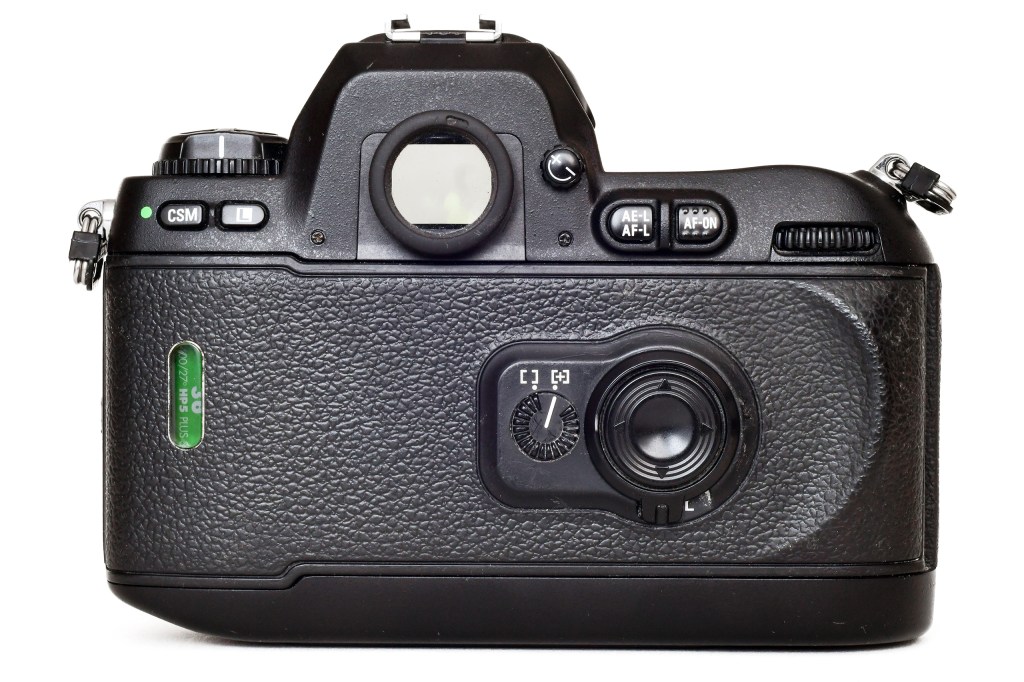
Perhaps surprisingly, the rear door of the camera is plastic rather than metal, which some folk don’t like. One benefit of this, however, is that the moulded back has a labyrinth seal around the edge rather than blackout foam, which tends to age badly. Foam would be better at keeping the dust out though, so it’s a case of swings and roundabouts. The back has the selector for the five focussing areas – yes, only 5 – and can be swapped out for an MF-29 data back which imprints information such as date and time on the film.
The Nikon 10-pin accessory terminal is present on the front of the F100, together with a standard coaxial flash synch socket for use with studio systems. The 10-pin terminal lets you use a variety of remote-control systems, both corded and wireless, which are still available today from a variety of vendors.
The lens mount is a metal, standard issue Nikon F affair which will support Nikkor AF, AF-D and AF-G lenses, as well as older AI and AI-S manual lenses in certain metering modes. It is important to remember, however, that the F100 is a full-frame camera – so you can ONLY use FX format lenses. The DX lenses for the smaller APS format digital SLRs will not provide adequate coverage at the edge of the frame. Otherwise, most lenses that Nikon has produced since AI (aperture indexing) was introduced in 1977 can be used happily. The recent series of electronic diaphragm lenses and a few whiskery old specialist types – such as fisheye lenses which intrude within the camera body and dedicated autofocus lenses designed for the F3 – are understandably not supported. Nikon’s vibration reduction technology won’t operate with the F100, you need an F5 for that, but VR lenses still work fine otherwise.
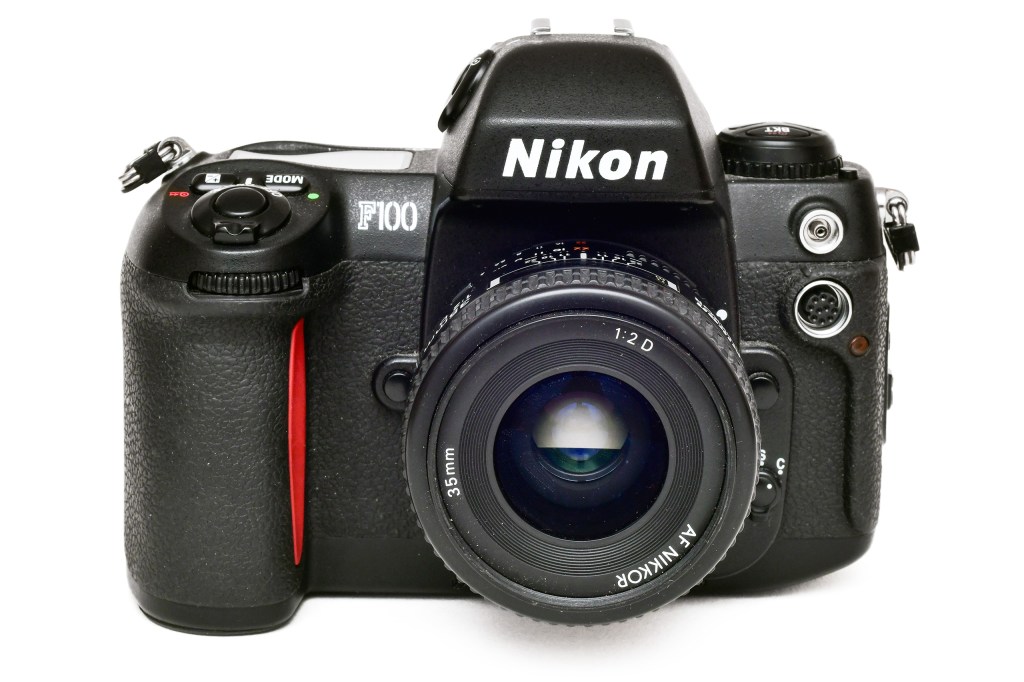
I generally use the Nikkor AF-D series lenses that I have accumulated over the years – which range from 16mm to 600mm. These work very well on my DSLRs, and spectacularly well on film SLRs. As the second-hand prices have fluctuated, I’ve been able to fill in the gaps in what I have available at a cost I can both afford and justify. And, yes, they all get used!
The viewfinder of the F100 is a fixed pentaprism design, which is bright and has a high eyepoint – which is a bonus if you wear glasses. There is also scope to adjust the diopter setting, to allow for long and short-sighted folk. The focusing screen is a B-type BriteView matte screen, which can be swapped out for an E-type grid screen if preferred. This is especially useful in architectural photography and when using a perspective control lens. The viewfinder gives 96% coverage and presents a very accurate rendering of what will be in the frame. All the viewfinder information you would expect is present – including a focus indicator for manual focussing, of the very effective “green blob and two arrows” format.
On the right-hand side of the prism housing is the selection switch for the metering mode. 3D matrix, centre-weighted and spot metering are available, but matrix metering won’t work with AI, AI-S or AI-P lenses. This version of matrix metering uses a 10-segment sensor to help assess correct exposure, and I have found it very reliable across a range of lighting conditions. Unlike some other high-end Nikon SLRs, the viewfinder does not have a built in shutter to keep extraneous light from reaching the meter sensors when using the F100 on a tripod. A simple clip-on eyepiece cover is supplied which does the same job, but with slightly less style.
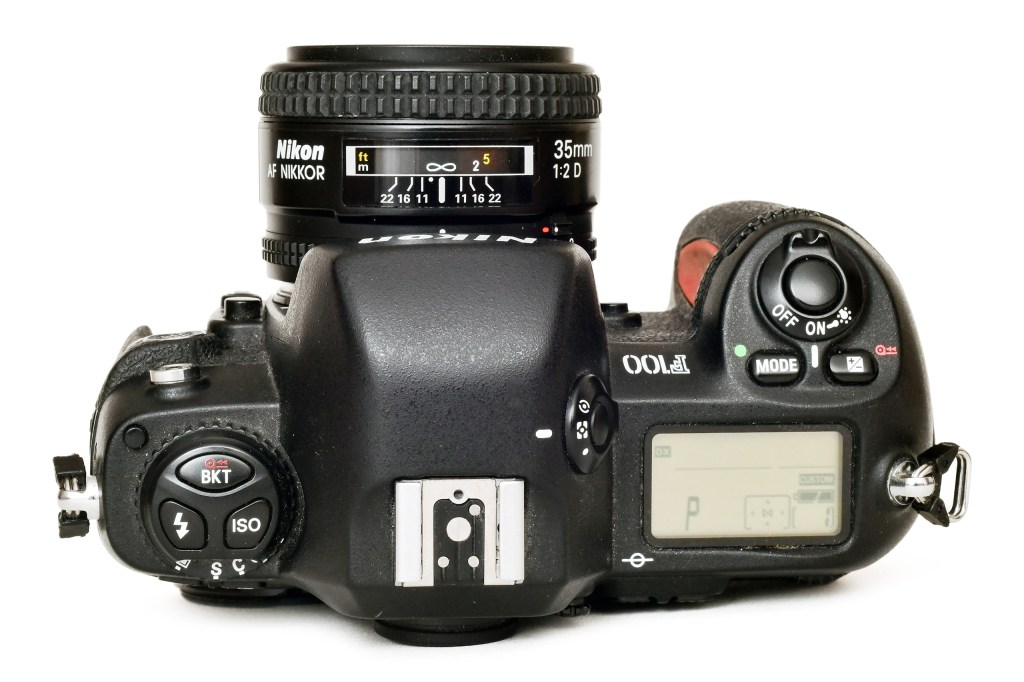
The focal plane shutter is of the vertical run type, giving speeds from 30 seconds to 1/8000th of a second as well as a B (brief time) setting. Flash synchronisation is at up to 1/250th, with exposure being controlled by a 5-segment TTL (through the lens) sensor. Note that this generation of flash control is not compatible with Nikon’s later Creative Lighting System, but a variety of second-hand Nikon Speedlights such as the powerful SB-80DX are available widely and very affordable. The Mode setting gives you the standard offering of Shutter or Aperture priority, Programme or Manual, which all do pretty much what you might expect. If using AI or AI-S lenses you are limited to aperture priority or manual modes only.
In a precursor to today’s complex menu systems, the F100 offers a set of 22 custom settings. These are set using the “CSM” button and the Sub Command Dial to offer settings such as whether to rewind the film automatically at the end of the roll or not, how long the meter should remain switched on for, the delay of the self-timer and other useful tweaks. You’ll need to keep the manual, or a cheat sheet, handy though, as the functions are only identified by number!
In the field
I use the Nikon F100 in two distinct ways. Firstly, as a stand-alone film camera for a particular project, especially when I want a system which is comparatively light and my Nikon F5 would be overkill. And secondly, as an extra body when I’m shooting a project digitally and have the scope to sneak a film body into the bag just in case.
The ability to share lenses and some accessories with the D800 and D850 makes both these use cases very straightforward, and because of the similarities in layout and function, there is a minimum of re-learning to be done when you are swapping between them. In fact, the biggest giveaway is usually when you glance at the back of the F100 after taking an image expecting to see the picture on an LCD that just isn’t there!

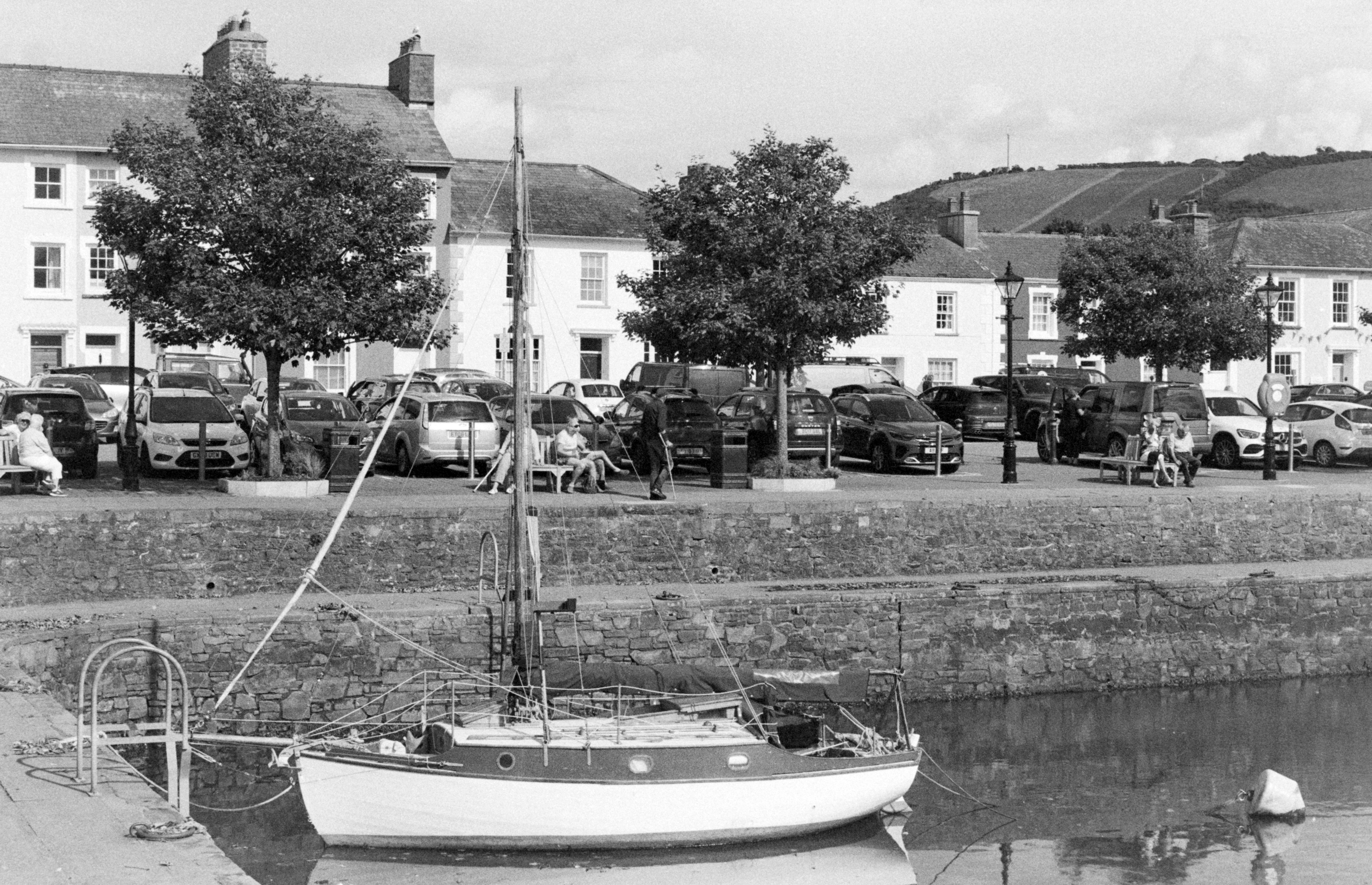
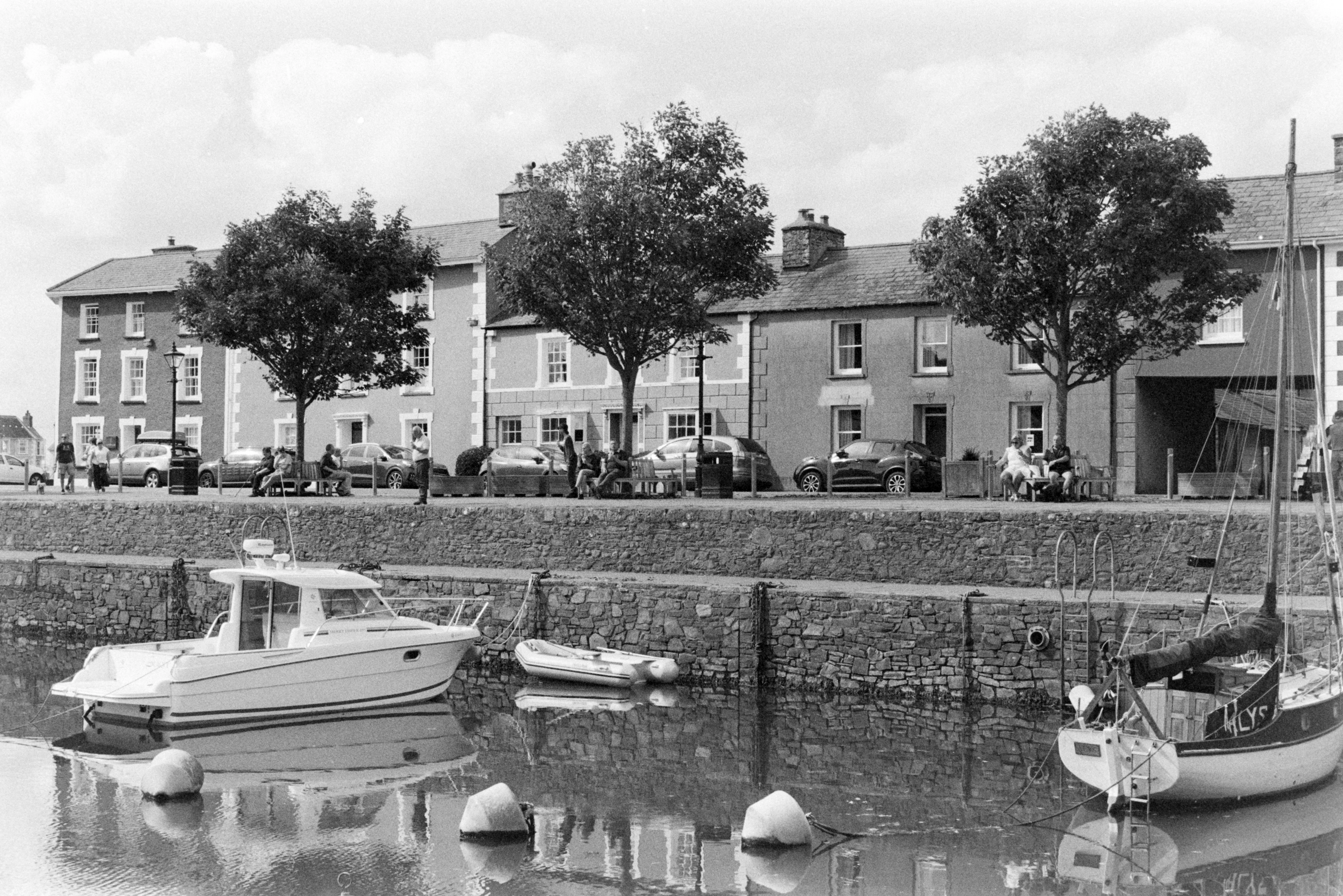
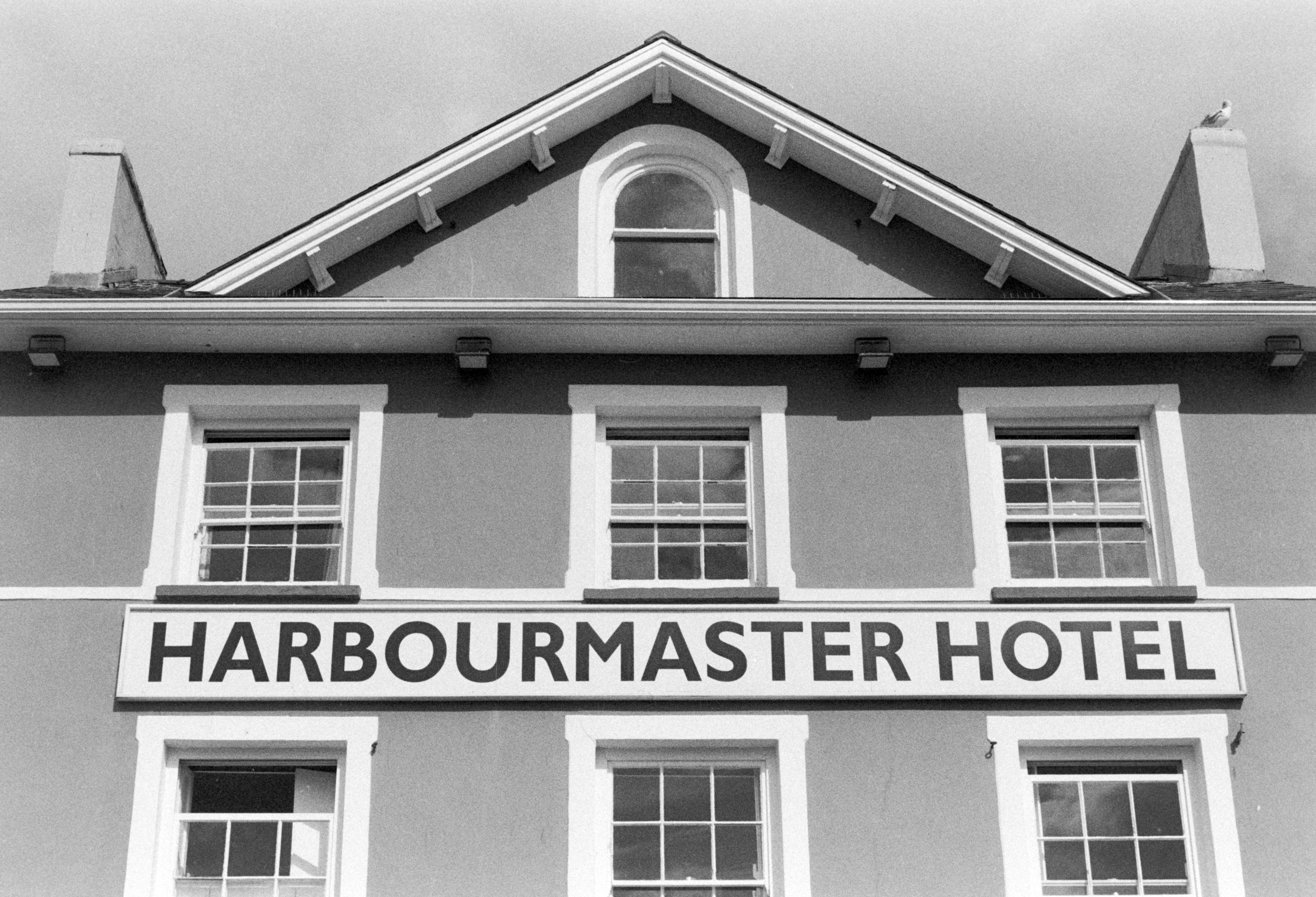
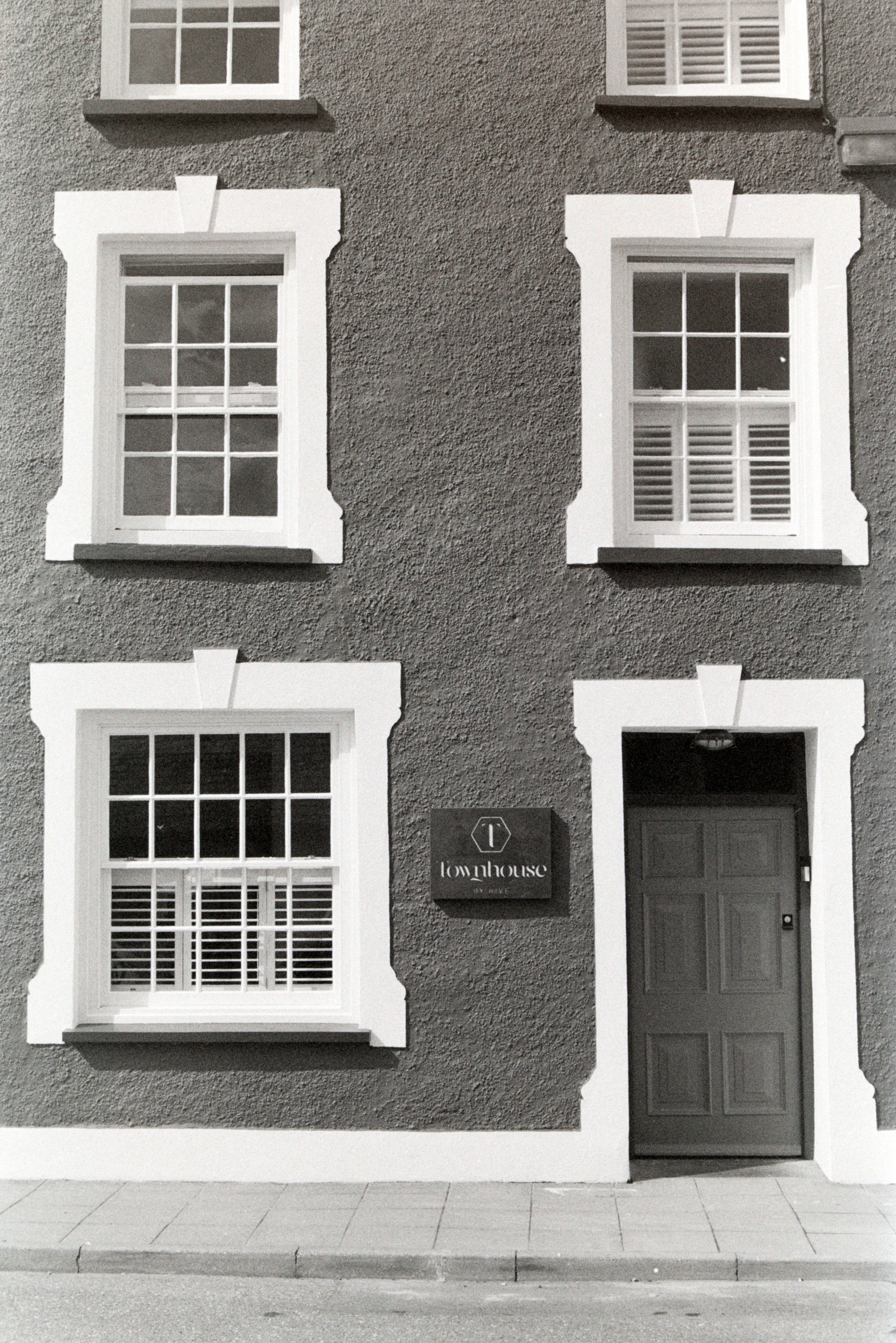
On a spring afternoon, I took my F100 down the coast to have a roam around the Georgian port of Aberaeron and see what I could capture with a single 35mm lens. One of the side effects of being a last generation film SLR is that nobody gives it a second glance, apart from the occasional fellow photographer who might do a quick double take – before engaging you in conversation. It is, in that sense, unremarkable: not flashy or loud, just an effective and reliable tool to do a wide range of jobs.
The obvious film alternative to the F100 is the fully professional F6 – which looks remarkably similar. For most of us, however, the decision between the two is straightforward once you realise that the F6 can sell for four or five times the cost of an F100. The F6, which was the very last Nikon film SLR left in production, always had an air of the exotic about it – which some people thought made it more a status symbol than a professional tool.
Despite being a fully featured autofocus SLR with built in winder, the F100 feels fairly compact when used alongside an equivalent DSLR such as the Nikon D850. In use, it is well balanced, fits well in the hands with a variety of lenses and has enough mass to feel reassuringly sturdy. The low number of focus points by modern standards – five – has made me realise how infrequently I use most of the very much higher population on my DSLRs. I find this slightly more basic specification helps me focus (sorry) on what I’m actually photographing, rather than spending time wrangling with the advanced technology in an attempt to make it do my bidding.
Verdict:
If you are a Nikon DSLR user and want to explore the world of film photography, then the Nikon F100 is a very good route to take. The vast range of Nikkor FX lenses available, some of which you may already have, makes it very easy to put a complete set of kit together at a very reasonable price.
The Nikon F100 manages to combine extremely simple operation with a number of very advanced features – such as fully metered multiple exposures and bracketed flash exposures. While it has a few things missing that I’d have liked to see – viewfinder shutter, matrix metering support for AI lenses, support for vibration reduction – the absence of these is far from being a deal breaker and can all be worked around by using good technique.
The cross compatibility with Nikon DSLRs ensures that you will very quickly feel right at home, and the familiar interface provides an effective and reassuring user environment. Go on, you know you want one. Why not treat yourself…?
John Gilbey is a writer and photographer based in west Wales. Author: John Gilbey – [email protected] – @John_Gilbey
Related reading:
- Ignore the haters, film photography is alive and kicking in 2026 – Analogue in the Age of Digital
- How to get started in film photography – a beginners guide
- Best 35mm film cameras
Follow AP on Facebook, Instagram, YouTube and TikTok.