You may have heard about this exhibition. It’s called Camera Obsolete? and it was the headline installation at this year’s Belfast Photo Festival.
The premise: visitors were invited to pick up a hammer and walk into what the organisers called ‘The Destroy Room,’ where they could smash a camera to pieces. Vintage film cameras, Ricoh rangefinders, ‘wonderfully functioning Zenits,’ nice Pentaxes from around ten years ago… hundreds of them, available for destruction. If you’d rather not wield a hammer, you could dismantle a camera with your hands instead. And if you preferred not to destroy anything at all, you could adopt one for £10 and take it home.
The resulting fragments will be assembled into sculptures, to be displayed permanently in Belfast Botanical Gardens.
I’ve been thinking about this exhibition for weeks. My initial response was actually very visceral, but I realised there’s plenty of the outrage already out there, so I delved a bit deeper into the emotional shock and it actually brought me to a quieter, more unsettled feeling, because the question the exhibition is asking is exactly the right one for this moment in time. Is the camera obsolete? I just think Belfast Photo Festival missed the point of the answer we needed.
The gesture itself says: these cameras are finished. The mechanical era is collapsing. Come and perform your feelings about that with a hammer and shock tactics. It accepts the premise that AI is winning, that the physical is being replaced by the computational and that the nice way to wrap that all up in a bow is to make art from the wreckage.
It encourages you to participate in the surrender without actually questioning or challenging the premise. And my experience of the premise this performative exhibition is built around, is vastly different.
What it doesn’t notice is what I have been watching happen for twelve years, in workshops and darkrooms and at The Photography Show and in the messages that arrive every week from people who have recently picked up a film camera for the first time and cannot quite explain why it’s changed something in them.
Secondhand film camera sales have been rising consistently for years. There’s been huge investment by the film stock manufacturers to ensure they have the right equipment to scale up to supply for the demand. The community that I have seen and been part of building around shooting film and printing by hand has grown continuously for over a decade.
This has happened organically on an international scale, without anyone being invited to smash anything. This is not about nostalgia over a dying medium, it’s because of people discovering a curiosity in the specific experiential practice of loading a camera, committing to a frame and then having to (shock horror!) wait to see what they got, something that no AI prompt and no digital workflow has ever given them.
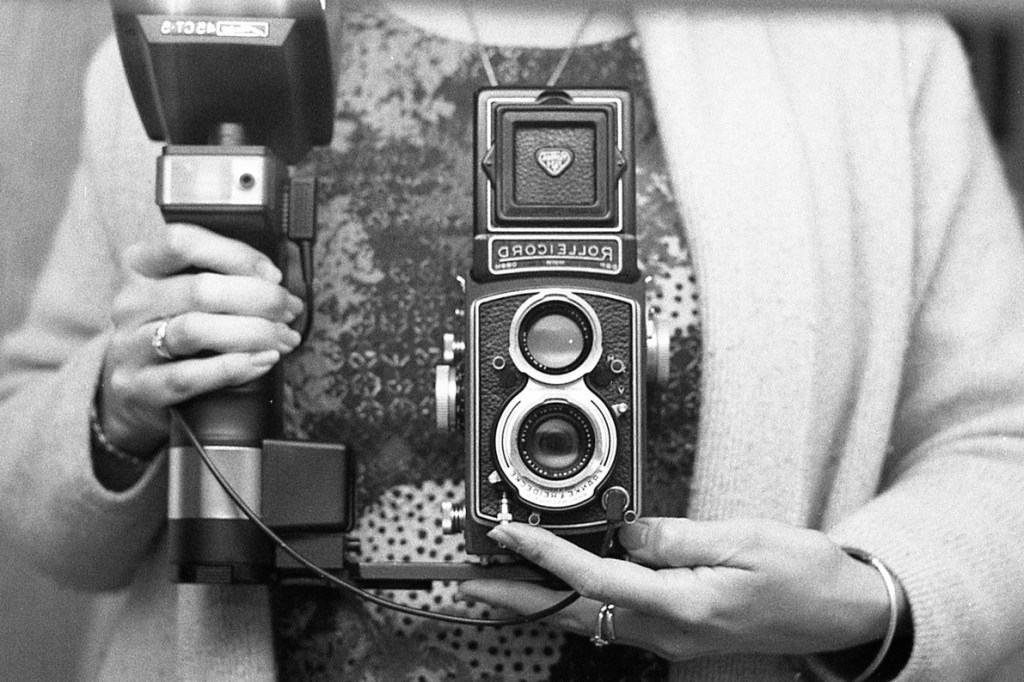
I don’t think of a camera as a passive object waiting to be made obsolete by a better piece of technology. It is a tool that helps you pay attention. Having one, twelve, thirty-six (or even 72! – let’s not forget half-frame) chances to capture the shot does something to your relationship with the world in front of you that an infinite camera roll simply doesn’t. The knowledge that every frame will cost you something – money, thought, effort, time – as well as the physical commitment of pressing a shutter at a precise moment, all make you look longer, harder and more patiently.
It forces you to be there, in the moment, in a way that the ability to check and delete and endlessly re-shoot (or re-prompt) structurally prevents.
The festival’s Director of Development, Toby Smith, has said that ‘Camera Obsolete? is designed to confront audiences with the pleasure, discomfort, and contradiction of destroying physical cameras, a choice many creatives now make silently and privately when choosing to prompt images instead of make them.’
I understand what he’s getting at. The choice to use AI instead of a camera is real, it’s happening, and it is largely silent. I agree that silence is a problem and that this is something we urgently need to talk about a LOT more. The exhibition certainly got air time, shock tactics always make people take notice. My concern is deeper and more long term however… What happens in the space and time after the noise and mess and the viral Instagram shares?
I don’t think the answer to a silent shift toward the computational is necessarily a loud, hammer-wielding performance of its arrival. I think the answer is to put a camera in someone’s hands and let them discover the specific sensory reality of loading film and mixing developer and watching an image appear from nothing in a tray of chemistry. In doing this, it becomes obvious that the mechanical era is not collapsing at all. It is in fact being rediscovered by people from every walk of life you can imagine.
There’s something else that troubles me about Camera Obsolete?, and it’s practical rather than philosophical. Nobody is making spare parts for the film cameras that exist. Every Zenit smashed in a rage room is a camera that will never be repaired, and components that will never be salvaged. For the vast majority of old cameras, parts must be sourced from other cameras, because there is no new supply.
In a world already generating more waste than it can process, celebrating the destruction of functional, repairable tools (whether or not these go on to become a final piece of art) does not actually feel like a radical artistic statement to me. It is simply a spectacle.
I also want to mention something about the specific cameras being destroyed. These are cameras that were, not long ago, someone’s most prized possession. Having grown up on a council estate in the early 80’s I realise my viewpoint on consumerism is biased, but I think my initial visceral reaction to seeing these cameras being smashed to pieces, was probably because it’s so deeply entwined with my personal experience of living on the breadline and seeing the struggle (and the cost) firsthand.
A camera, to me, has always been an aspirational, as well as an inspirational tool. A way to create freedom, a way of sharing real, lived experiences from new perspectives and a way to see a world bigger than just yourself.
Growing up through a recession, I have a deep seated aversion to waste and wanton destruction. I know how much would probably have been sacrificed to own the camera in the first place and how much value it had within the hands of someone who would treasure it. Hundreds of cameras that would have been loaded with film in ordinary kitchens on ordinary mornings, pointed at children who are now adults, used to record moments and create memories that exist now only because someone pressed a shutter and paid attention.
But here’s what I keep coming back to. The exhibition offered a third option alongside destruction and disassembly: you could adopt a camera for £10 and take it home. You could choose, in the festival’s own words, ‘resistance over destruction.’ And for me, every person who did that – who picked up one of those rangefinders, took it home, loaded it with film, and discovered what it feels like to commit to a frame – made a more radical statement than any sculpture assembled from the wreckage.
The camera is not obsolete.
It is, at this particular moment, one of the most necessary objects in the world. Not because it produces better images than a phone or is more convenient (it definitely isn’t, and that’s the point). But because loading a camera and pressing a shutter at a particular moment is an act that requires you to be present and to pay attention. To accept that this fraction of time will cost something, and that the cost is what makes it real.
In a world drowning in fake images and artificially generated realities, perhaps the most radical (and creative) thing you can do is make something real.
The views expressed in this column are not necessarily those of Amateur Photographer magazine or Kelsey Media Limited. If you have an opinion you’d like to share on this topic, or any other photography related subject, email: [email protected]
Related reading:
- This photo festival is inviting people to smash up cameras in the name of art. Have they gone mad?
- Don’t believe the YouTube hype – you will never find a digital camera “shoots like film” and here’s why
- Modern cameras ruined the joy of taking photos
Do you want to win some great prizes for your photography? Enter your photos in our International Amateur Photographer of the Year competition. Free entry for photographers aged 13-21.
Follow AP on Facebook, Instagram, YouTube, TikTok and Irys.