I like to imagine the Fujifilm board sitting around a giant sheet of paper; very 1990s team-building conference. The kind you’d find blu-tacked to the wall of an office, with crudely drawn arrows pointing towards things like ‘more grain control?!’
In the middle is a large bubble labelled ‘cameras’, written in thick marker.
One arrow points towards ‘Medium Format?’. Another reads ‘What if tiny?’ before trailing off into nothingness. In the corner, someone has scribbled ‘What if half?’.
And whilst much of Fujifilm’s recent output can feel slightly nonsensical, I say thank God for that.
Don’t mistake my affection for weirdness as criticism. In fact, it’s quite the opposite.
The colour science. The film simulations. The tactile dials. The strange ability to make a brand-new camera feel like something your dad bought in 1987.
After all, if nostalgia could be loaded onto an SD card, Fujifilm would probably sell it.
Photographers spend a remarkable amount of time asking manufacturers to surprise them, provided the surprise resembles exactly what they’ve already grown comfortable with.
As a result, a company releases a camera nobody expected and the internet erupts.
‘This is stupid.’
‘4.9MP?! What a joke.’
Another company releases what’s essentially last year’s camera with a new processor and 3MP more resolution.
‘Is that it?’
‘Still not as good as my Canon EOS 5D Mark II.’
Photography forums have become the modern equivalent of standing in front of a fully stocked fridge and declaring that there is nothing to eat.
By and large, Fujifilm understands something much of the camera industry appears to have forgotten; innovation is often indistinguishable from nonsense until it works.
Look across its catalogue and coherence evaporates almost immediately. Rangefinder-style cameras sit alongside medium format systems. Fixed-lens compacts coexist with content-creation hybrids.
To an outsider, the strategy can feel less like a roadmap and more like somebody won a game of camera-themed Mad Libs.
Photography has always progressed through ideas that initially sounded ridiculous.
Leica was crazy.
Colour photography. AF. Digital photography.
The death of film? Impossible.
The death of the DSLR? Unimaginable.
History is littered with ideas that sounded absurd right up until the moment they became essential.
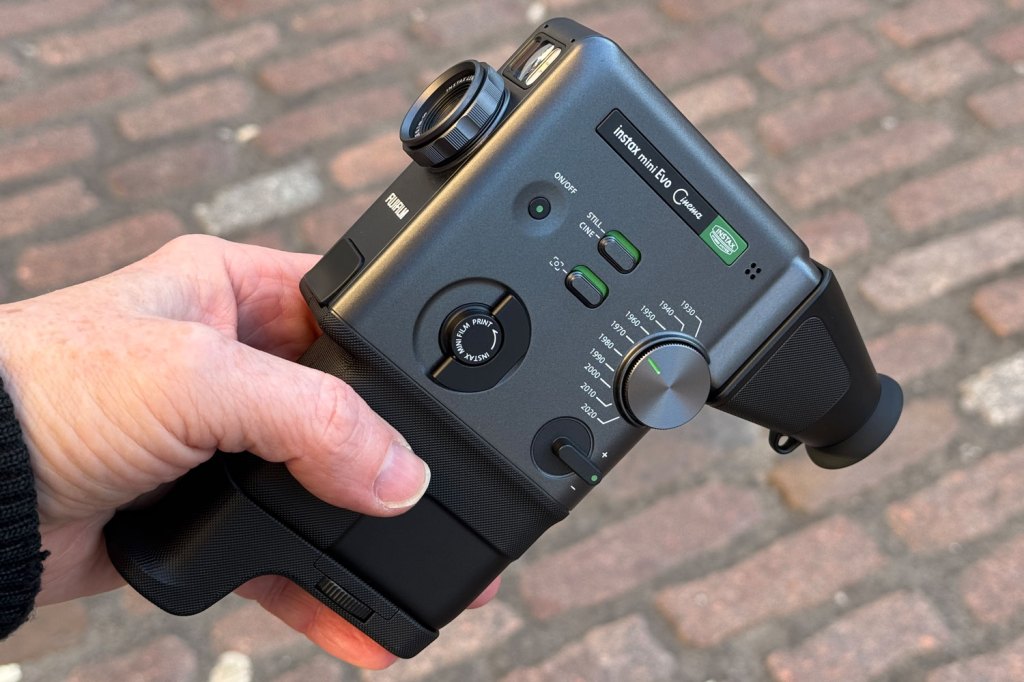
That’s what I admire about Fujifilm. It appears unusually willing to expose the experimentation process in public. And, whilst I will never pay £300+ for a 4.9MP plastic Super 8, Fujifilm feels less like a company chasing certainty and more like one willing to learn.
Much of the industry appears trapped by its own market research. Endless iterations arrive with marginally improved specifications and aggressively diminishing excitement.
Sometimes it feels as though obvious features are deliberately held back, only to be unveiled eighteen months later with dramatic music and a keynote presentation.
The products become safer as the industry becomes less certain.
So yes, Fujifilm can feel contradictory. Its strategy occasionally resembles the contents of a kitchen drawer that somehow contains batteries, a passport, three elastic bands and a £5K watch.
But I’d take that over predictability every day of the week.
The views expressed in this column are not necessarily those of Amateur Photographer magazine or Kelsey Media Limited. If you have an opinion you’d like to share on this topic, or any other photography related subject, email: [email protected]
Related reading:
- I’m a professional street photographer and I think viewfinders are limiting and overrated
- Disposable cameras are a surprising comeback success story – I think I know why
- Sales of full-frame mirrorless cameras are flatlining, while compact camera sales continue to grow – what’s going on?
Follow AP on Facebook, Instagram, YouTube, TikTok and Irys.