I am following a number of YouTubers, most of them focus on the latest camera gear, editing tricks or alternative techniques, but Steve Mould makes videos about science, and sometimes this means making videos about how photographs are made, down to the atomic level. Despite little me not exactly flying through Physics lessons in high school I find his videos and explanations easy to understand and super rewarding to watch. In his video aptly titled ‘You’ve Never Seen a Real Photo’ he explains why standard colour photography is not quite what it seems.
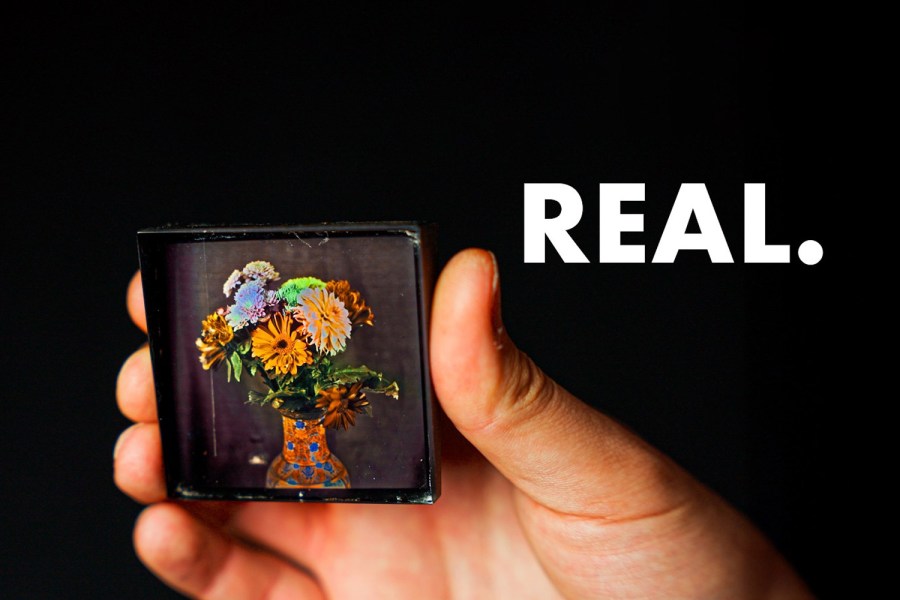
He shows a Lippmann plate, an early colour photography process invented by French scientist Gabriel Lippmann in 1891, and says, “This is arguably the truest colour image you will ever see, and that’s because standard colour photography is a lie”. That is quite a harsh statement, but when you take into consideration that light is made up of a wide spectrum of colours, and standard colour photography relies on RGB (red, green and blue) colour, then you have to admit he’s onto something.
Lippman plate photography
Lippmann, who won a Nobel Prize in Physics in 1908 for “his method of reproducing colours photographically based on the phenomenon of interference” created a photography technique that uses the same chemistry as black and white photography, and yet is able to reproduce the full spectrum of colour from the real world!
A glass sheet is coated in a photographic emulsion, a kind of gelatin containing silver halide crystals. This coated glass sheet is then set in a bath of mercury and finally placed inside a camera and exposed to light. But unlike modern camera sensors, which translate what you see into red, green and blue, this technique is based on light interference and captures the actual colours of the scene.
Without giving you too many spoilers – because I really want you to watch his video, and because he can explain this so much better than I can. You know that light is essentially a wave, and you know that white light is made up of all the other colours, with each colour having a different wavelength. Lippmann’s method is based on constructive interference of light. A daunting word, but fundamentally meaning that when two light waves overlap they produce a brighter light.
So in the case of the Lippmann plate, the incoming light travels through the emulsion all the way to the mercury at the bottom, which reflects the various wavelengths of light (different colours) back. At the points where the incoming and reflected light waves overlap, some silver atoms break away from the solution and solidify, creating metallic silver flakes. As different colours will have shorter or longer wavelengths, the position of these solidified flakes within the plate will also vary. When the image is fixed, the unexposed silver halide is washed away, leaving you with the tiny solidified silver flakes that act like mirrors. After this, when light hits the plate, these flakes will reflect the exact same colours back at you like the ones that originally hit the plate.
With this technique reprints are virtually impossible, and exposure times can go into minutes or even hours, not to mention you can only view the plates from a certain angle as light needs to physically hit the surface to reveal the colour image, yet some – like John Hilty who borrowed his Lippmann plate for this demonstation – are willing to go to all that hassle to reproduce to create a “Real Photo”.
Watch Steve Mould’s full video below to find out what chameleons have to do with this 135 year old process and to see this fascinating phenomenon fully explained.
Related reading:
- YouTuber invented a lens that can do anything
- YouTuber uses full-spectrum camera to capture invisible phenomenon in viral video
- Get great results by converting an older digital camera to infrared
Follow AP on Facebook, Instagram, YouTube and TikTok.