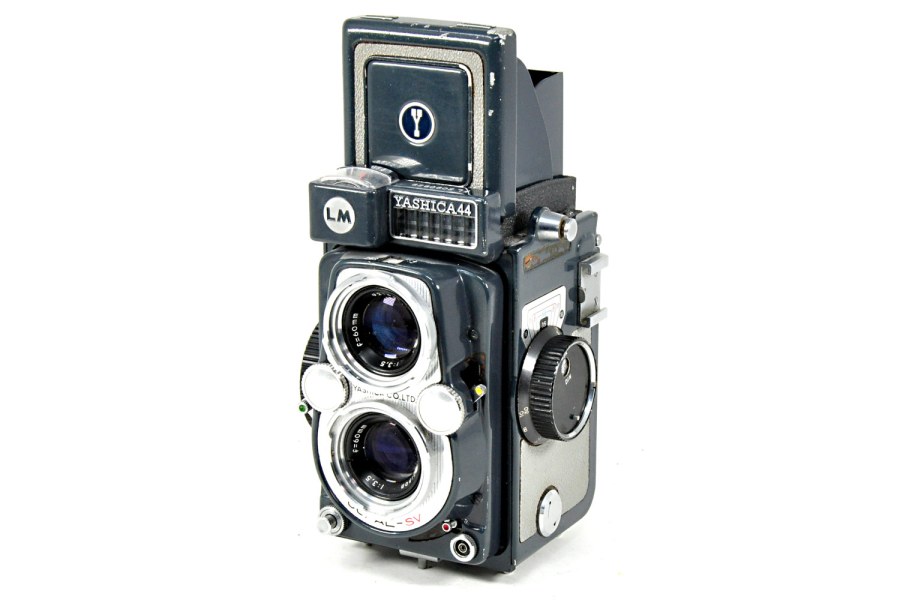
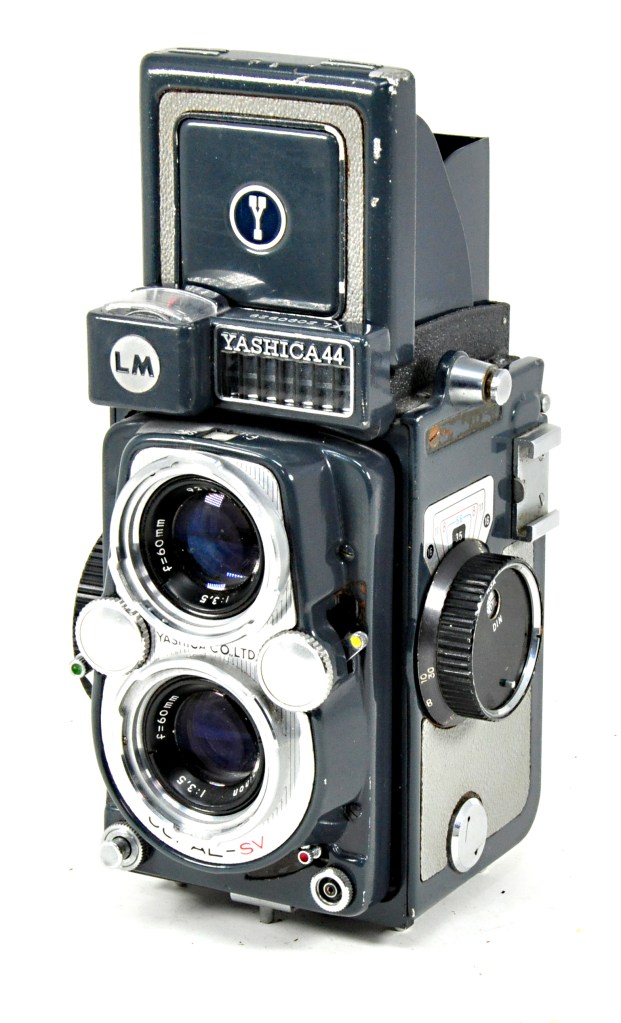
Think of twin lens reflexes (TLRs) and you might recall slightly bulky cameras for 120 roll film. But in 1957, Franke and Heidecke in Germany introduced an upgraded version of its pre-war Baby Rollei, small in size, light in weight and made to shoot 12 4x4cm exposures on 127 film. Almost immediately Japanese manufacturers jumped on the bandwagon. Yashica’s offering began with the Model 44, followed by a slightly stripped down version called the 44A and finally the top-of-the-range 44LM.
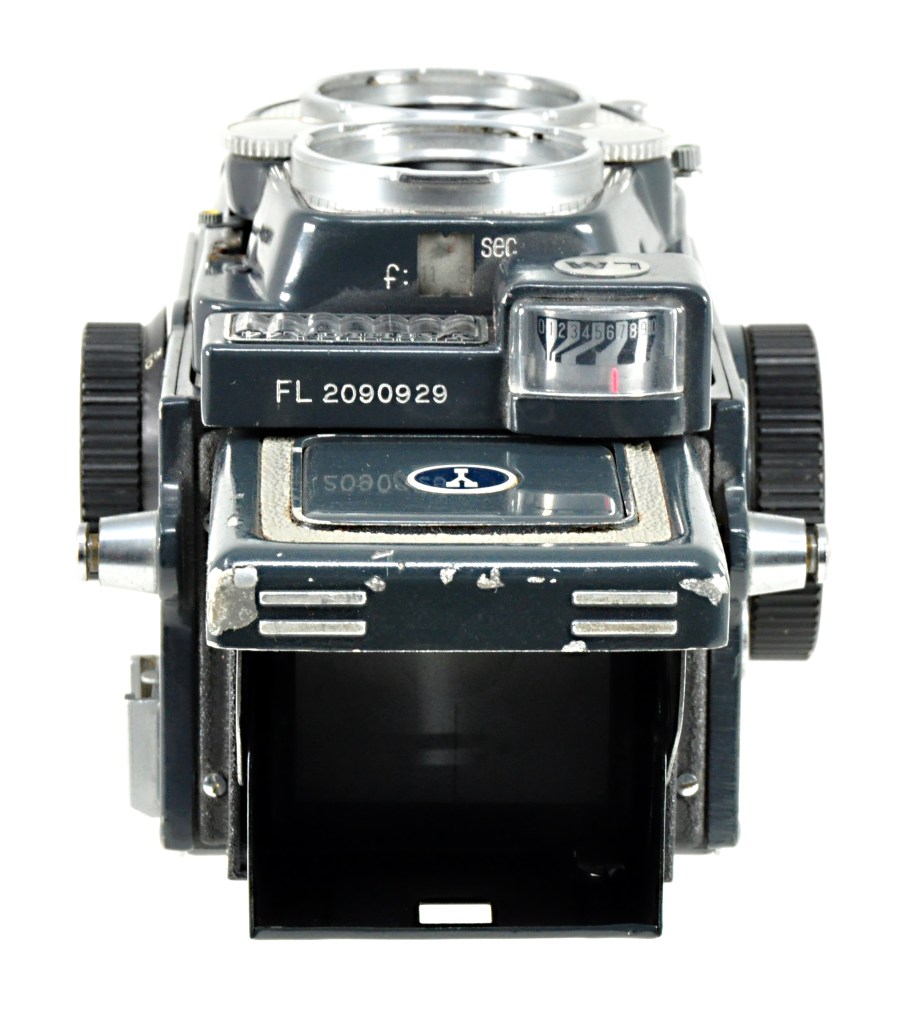
A TLR uses two lenses, traditionally set one above the other. The lower lens shoots the picture, the top one reflects its image up to a focusing screen under a hood on the top of the body. To this basic concept, the Yashica 44LM adds a selenium cell exposure meter.
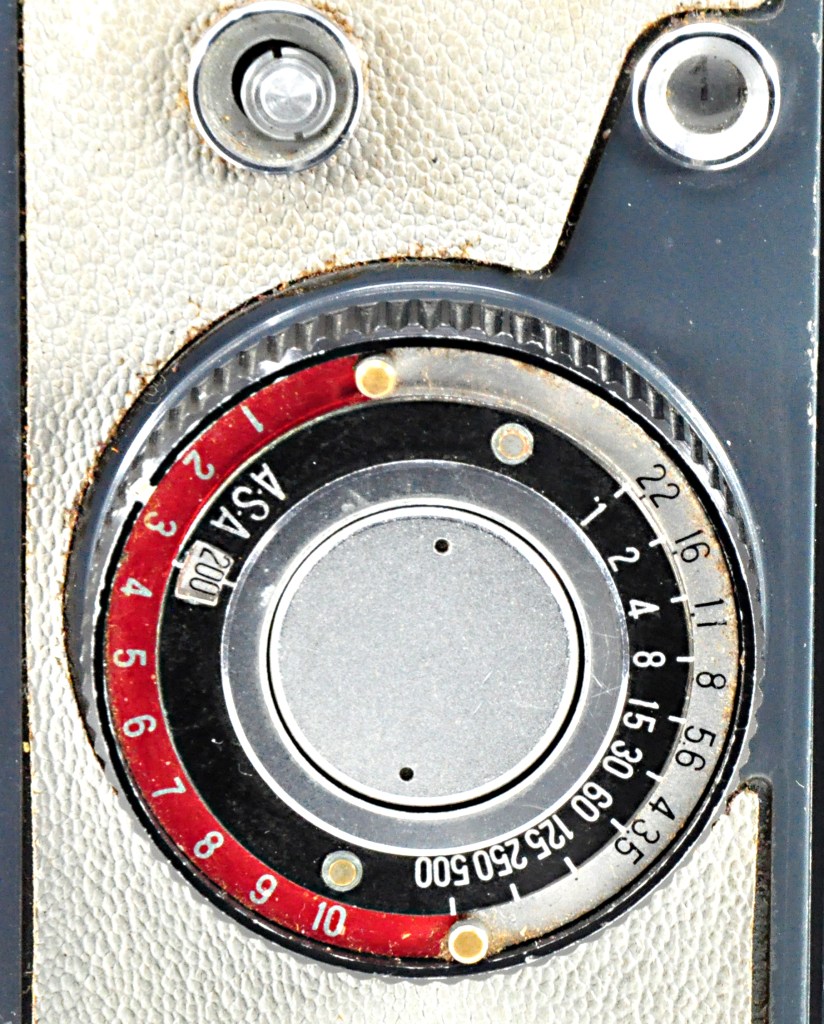
Once the film is loaded and the back is closed, a knob on the right side of the body is wound until ‘1’ appears in a red window on the back. A small button is pressed to set an exposure counter to ‘1’ in a window on the side and, thereafter, simply pressing the centre of the wind knob and turning it until it stops winds the film to the next frame. The meter, mounted above the top lens, activates a needle to indicate a number. Setting that number on a dial embedded into the wind knob reveals a choice of shutter speed and aperture combinations for correct exposure, which are then set manually via knobs between, and either side of, the lenses. A knob on the left of the body racks the lenses and back and forth in tandem for focusing. The shutter is tensioned by a lever to the side of the lower lens and released with a button below.
If you fancy giving one a go, you can still buy mono and colour slide 127 film at Analogue Wonderland (analoguewonderland.co.uk). For processing 127, try Photo Hippo (photohippo.co.uk/127-film-processing)
What’s good
- The 4x4cm images can be viewed using a 35mm slide projector.
What’s bad
- Buying and processing 127 film is expensive.
Related reading
- Best 35mm film cameras
- This forgotten classic is the ONLY analog camera you’ll ever need, and this is why
- Here’s what I’ve learned from shooting over 150 rolls of film in the 2020s
Follow AP on Facebook, Instagram, YouTube and TikTok.