Amateur Photographer verdict
Tamron’s 35-100mm f/2.8 zoom offers an unconventional focal length range that’s well-suited to portraits in particular. It delivers sharp images with attractive bokeh at a very reasonable price.- Unusual range is ideal for portraits
- Very good image quality
- Nicely portable size
- Well priced
- Limited wideangle setting
At first glance, the Tamron 35-100mm F/2.8 Di III VXD seems to employ a rather unusual focal range. There is no other current full-frame lens that offers the same. But ‘current’ is the operative word here, because if you cast your mind back 50 years or so, all zooms started around 35mm, a setting considered wide-angle at the time, and which, technically, still is. Back then 35-105mm zooms weren’t uncommon, albeit with smaller apertures.
Tamron 35-100mm F/2.8 Di III VXD at a glance:
- $929 / £799
- Large-aperture standard zoom for full-frame
- Ideal zoom range for portraits
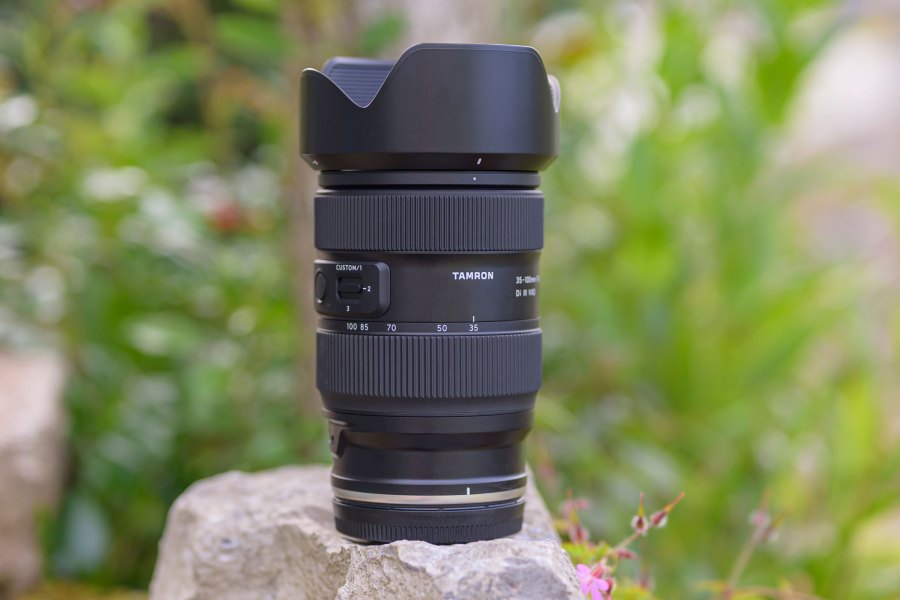
- 121.5mm long, 575g
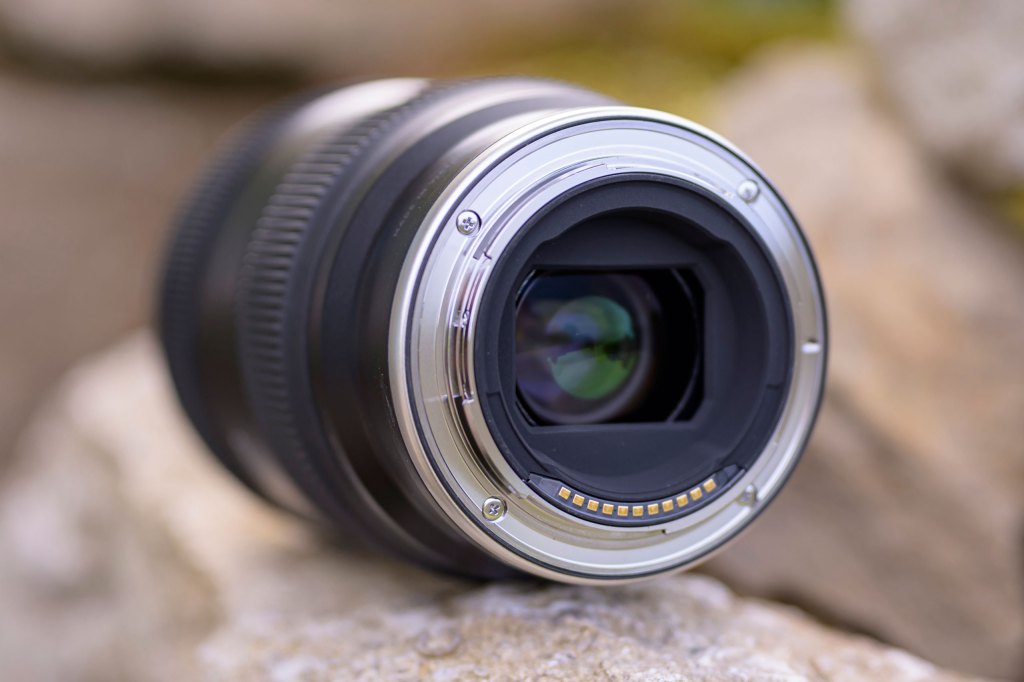
- Sony E and Nikon Z mounts
So why introduce such a lens? And who is it for? In part, there seems to be a desire from manufacturers like Tamron to offer something different. Every big player has a 24-70mm f/2.8, but we are seeing plenty of f/2.8 variations around that, often lenses that cover more ground, like 24-105mm or 28-105mm models, as well as the likes of Nikon and Tamron’s 28-75mm options.
Available for Nikon Z and Sony E mount cameras for $929 / £799, can this 35-100mm f/2.8 prove itself a valuable option within a packed and varied market? I tested a Z-mount version on Nikon Z8 and Nikon Zf bodies to find out.
Features
Starting with the focal length, the 35mm gives a mild wide-angle view of 63º. This is suitable for many situations, though it’s limited in some ways, too, especially if you ‘think’ in 24mm as modern zooms and phone lenses have inclined us to do. 35mm isn’t much good for interiors, night skies, or for the ‘biggest’ of landscapes, but there is a benefit to this being the widest you can go.
Essentially, the wider the angle, the harder it is to fill the frame, and the more distorted the edges can look, so many novice shooters create weak, unnatural looking compositions with ultra-wide lenses. Conversely, 35mm is a much more human view than, say, 24mm, so pictures are generally more accessible and the frame is fuller.
At about 3x, the overall zoom ratio is basically the same as a 24-70mm and covers many classic options, obviously becoming more selective as you go. The options at the long end, like 85mm and 100mm feel genuinely nice to move into compared to stopping at 70mm, especially when working with people or travel subjects. And this is a clue to the lens’s real purpose, the collection of focal lengths making it feel like an all-in-one portrait or documentary lens.
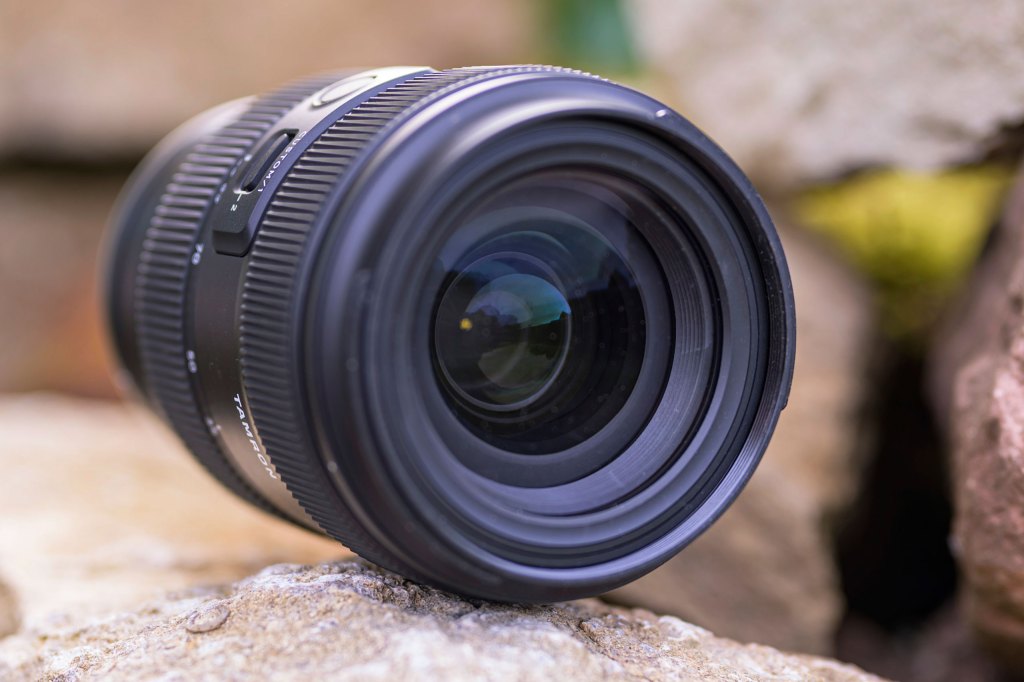
The lens uses a 15-element, 13-group construction, including one eXtra Low Dispersion (XLD), two Low Dispersion (LD), and three Glass Molded Aspherical (GMA) elements, which should provide sharp images free of aberrations, while Tamron’s BBAR-G2 (Broad-Band Anti-Reflection Generation 2) coating is on hand to combat flare.
Along with a fluorine coating on the front element, the lens has a ‘moisture-resistant’ construction, so it should be reasonably well protected from light rain and dust. However, the barrel does extend on zooming, which isn’t ideal when it comes to protection.
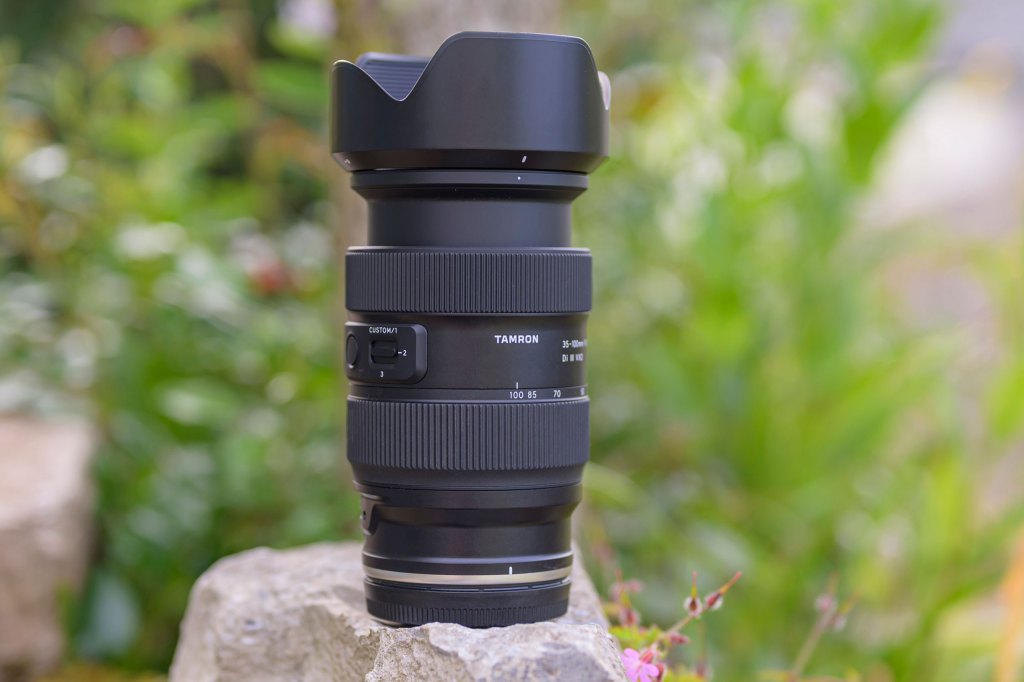
There’s no dedicated aperture or control ring as found on many lenses these days, but there is a lens function button, which works in conjunction with the Custom Switch alongside. This allows three different functions to be assigned to the lens button, depending on the position of the switch. These functions are set via Tamron’s Lens Utility app and include such things as AF/MF switching, and toggling the focus ring to control the aperture instead. There’s also a wide range of more specialist functions.
Autofocus is provided by Tamron’s Voice-coil eXtreme-torque Drive (VXD). Common to many other Tamron lenses, the filter thread is 67mm and a petalled lens hood is included, reversing over the barrel when not required.
Build and Handling
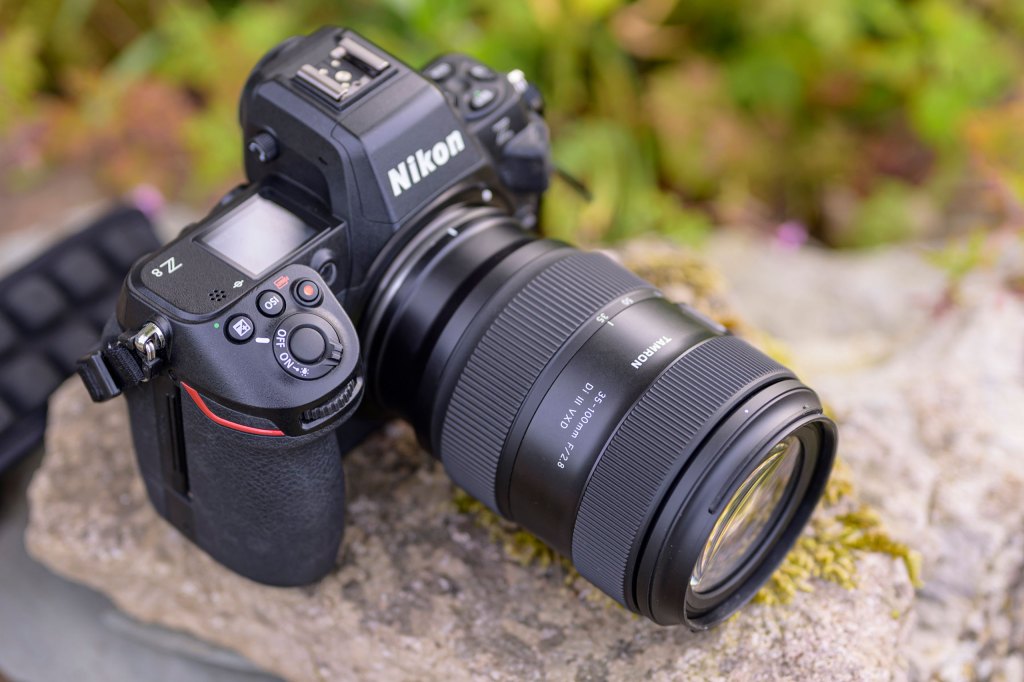
Limiting the wide-angle setting to 35mm also means the lens can be comparatively small and light, and the Tamron 35-100mm F/2.8 Di III VXD certainly feels like a portable lens. At 575g and 120mm long, it balanced nicely on my Nikon Z8 though less well on the Zf, until I fitted a grip. And though the lens extends on zooming, it’s not enough to unbalance hand-holding.
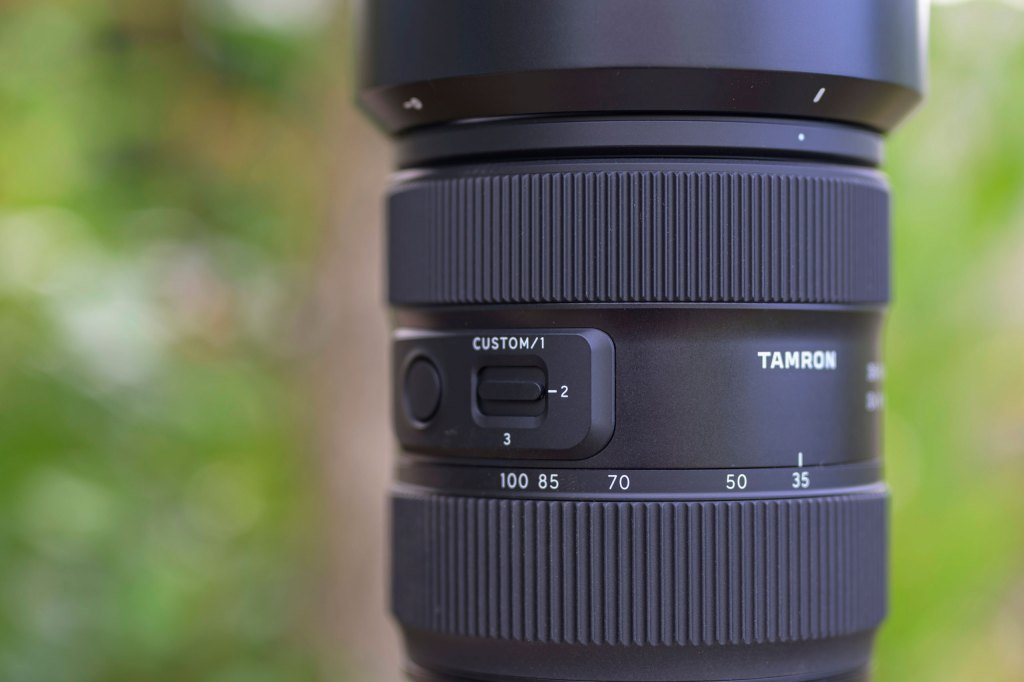
The zoom ring is large and grippy, sitting easily within reach nearer the body, and you can go from near to far in a quarter turn, so changes to framing are quick. The ring turns smoothly to a hard stop, with good resistance and there’s no slip in it.
The focus ring was also easy to find without moving my hand position and its thinner grooves and lighter touch mark it out. The ring is fully electronic, so again its parameters can be set by the user if they want a slower or faster turn.
Focusing
The benefit of the lens’s VXD autofocus motor was immediately obvious. Focusing from near to far was almost instantaneous, and only slowed a little in poor light, or on areas of particularly low contrast. It’s also virtually silent, so a nice partner in situations where you don’t want to disturb the subject.

The performance is also strong when tracking moving subjects. I tried it with walking and running people as well as with dogs and it didn’t struggle with either. In eye-detection modes I couldn’t fault it and as a multipurpose lens, I would be confident using it.
Out of the box, manual focusing is also a breeze. On my model the ring was set to linear, and completed near-to-far focus in 180º. But as mentioned it’s possible to change this via the USB-C port on the barrel.

The close focus at 35mm is 22cm, giving a one-third life-size render. But at 100mm this is 65cm resulting in around half life-size, so it’s quite a handy closeup option, too.
Image quality
Without the benefit of full lab-testing conditions it’s tough to judge sharpness to a minute degree, but on the whole I was very impressed by the Tamron 35-100mm F/2.8 Di III VXD. It can be expected for sharpness to vary throughout a zoom, but it was also quite consistent.

At the short end, centre sharpness seemed excellent right from wide open, improving further at f/4 and only tailing off slightly from f/11 onwards, the edges being pretty well matched throughout.
In the middle of the range at 70mm, it was also excellent in the centre, though seemed slightly less sharp beyond f/5.6. The edges didn’t hold up quite as well here, but were still very good.

At the long end, though still very good, sharpness was slightly less impressive wide open in the centre, but improved to excellent at f/3.5 onwards, only tailing off a little after f/11. Edges held up well from f/2.8 to f/8.
In normal circumstances, I found chromatic aberration to be well controlled at all focal lengths. It was only when, for instance, shooting out-of-focus branches against a bright sky that any fringing could be seen. Thanks to the lens coatings, it was equally tough to introduce flare, so if you want some you’ll need to throw on a cheap filter.

At its modest wide-angle setting, barrel distortion was all but invisible, and I could see no pincushion effects at the long end. There is some vignetting wide open, but nothing alarming.
Finally, though modern ultra-fast lenses can make the bokeh from an f/2.8 lens seem pedestrian, the Tamron 35-100mm F/2.8 Di III VXD produced some very nice, smoothly rendered backgrounds. There was no trace of fussiness in the blur and points of light were pleasingly rounded and flat, only distorting slightly at the frame edges, though this became more pronounced beyond 70mm, I thought. Overall a very impressive performance.
Tamron 35-100mm F/2.8 Di III VXD: Our Verdict
With its 35-100mm f/2.8, Tamron has created a brilliant portrait and documentary tool. The lens covers all the most common portrait focal lengths in a single, fast zoom, and does so very well. Whether it’s people or other subjects you’re working with, this makes for an excellent mix of contextual and selective framing. The f/2.8 maximum means that it’s relatively easy to separate subjects from unsuitable backgrounds, or work in low light, while it definitely feels and handles like a premium lens.

The images it produces are nice and sharp, without distortion, and it’s also no slouch when it comes to focusing. The speed and silence of the AF was very impressive, especially from a third-party lens, but even writing that today feels somewhat out of date, because it’s clear that with lenses like this, manufacturers like Tamron are holding their own against the native lenses of the best camera brands.
At $929 / £800, while not cheap, the lens is well priced, so there’s not much to put off prospective buyers here. If you did need more range at the long end, Tamron’s 35-150mm F/2-2.8 is an obvious place to look, though it’s getting on for twice the price and heft. Overall, I’d be very happy on a portrait or documentary project with this lens alone.


Tamron 35-100mm F/2.8 Di III VXD: Full Specifications
| Specifications | Tamron 35-100mm F/2.8 Di III VXD |
|---|---|
| Price | $929 / £799 |
| Filter Diameter | 67mm |
| Lens Elements | 15 |
| Groups | 13 |
| Diaphragm blades | 9 |
| Aperture | f/2.8-22 |
| Min focus | 0.22m (wide), 0.65m (tele) |
| Length | 121.5mm |
| Diameter | 80.6mm |
| Weight | 565g (Sony E), 575g (Nikon Z) |
| Lens Mount | Sony E, Nikon Z |
| Included accessories | Caps, hood |
Follow AP on Facebook, Instagram, YouTube, TikTok and Irys.
Tamron 35-100mm F/2.8 Di III VXD – Sony E mount
Tamron 35-100mm F/2.8 Di III VXD – Nikon Z mount