We invited three photographers working in wildlife photography to share one image they consider among their best. From split-second decisions to carefully crafted compositions, they reveal the thinking, technique and experience behind the shot, offering insight into not just how the image was made, but why it matters.
Corey Arnold, USA
Corey Arnold is an American photographer known for combining documentary storytelling with stunning wildlife and maritime imagery, much of it shaped by his years working as a commercial fisherman in Alaska. Balancing humour, environmental awareness and an incisive eye for animal behaviour, his work has been published widely in magazines including National Geographic and exhibited internationally. His long-running project Fish-Work offers an insider’s view of life at sea.
Instagram @arni_coraldo
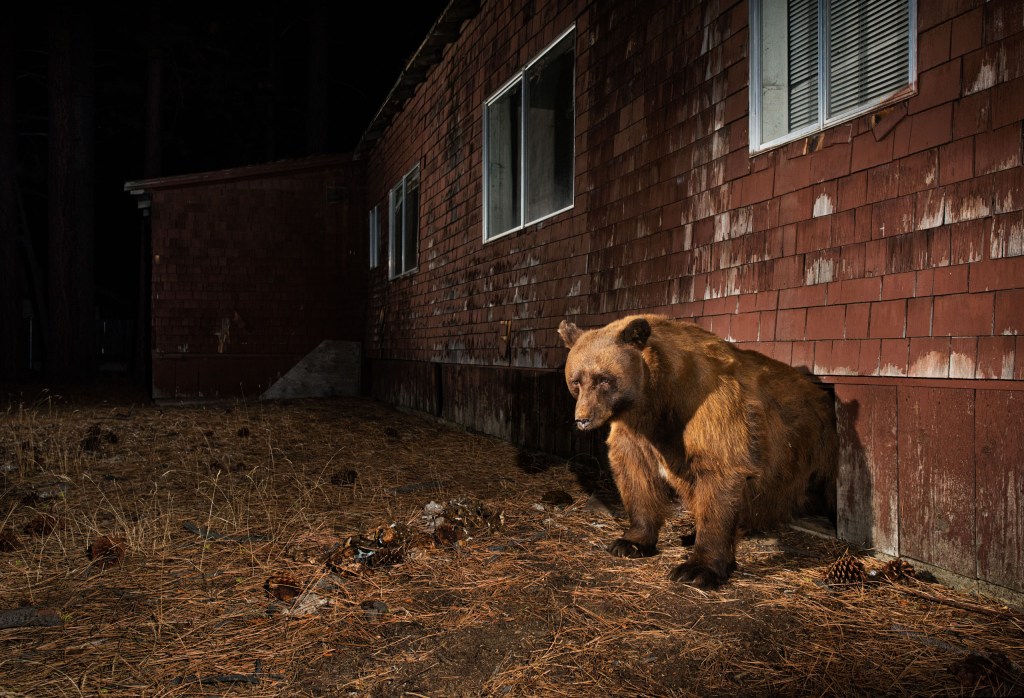
This is a large black bear in South Lake Tahoe that was using an abandoned house as its den. I chose this image because of the shock value of a bear ballooning out of a tiny crawl space in someone’s house. Around Lake Tahoe, bears have learned to survive in a high density close to people due to the abundance of garbage left unattended.
I was on assignment for National Geographic trying to tell the story of urban black bears and we had discovered a bear sleeping under this house. After using a trail camera to surveille the bears’ behaviour we discovered that he left every evening to raid garbage cans in the neighbourhood and returned every morning before daylight. After the shot, the bear bolted away, but also came back and squeezed back in his den, ignoring the flashes.
I wanted the viewer to have a visceral, perhaps a bit scary reaction to a bear emerging from a house in the darkness, the best way to create the drama I hoped for was through how the scene was lit. I wanted the lighting to feel real, coming from a direction that could mimic a street light or security light, but also having a cinematic quality.
I used a camera trap, a Nikon D810 with a prime 28mm lens, f5.6 1/200 ISO 400 and three Nikon speedlights, with camtraptions transmitters and receivers and a camtraptions PIR motion sensor to trigger the camera. I placed two strobes on light stands as high off to the left of the frame, top and side lighting the bear, and one further back to show more of the house. The third sat next to my camera providing a bit of fill.
The first night that I had the camera in place, the bear moved so slowly that it did not trigger the sensor and I ended up only with shots of the bear poking his nose out, then a bear butt running away. The biggest challenge in most camera trapping situations is to get all the elements of a camera trap setup to trigger as planned.
It was lucky that the bear was so massive and took a long time squeezing its huge body out of the hole, but the lighting was all judgement and I’m happy that the lighting shaped the image. Since I usually only have another human test subject, you never know exactly how fur of different shades will look until the final photo is already taken. I was fortunate that he came back several nights in a row so that I could tweak the lighting further to get the look that I wanted.
Tesni Ward, UK
Tesni Ward is a British wildlife photographer recognised for her intimate, atmospheric images of the natural world, particularly the wildlife of the UK. Based in the north, she is known for blending technical precision with a strong emotional connection to her subjects, creating images that highlight both the beauty and fragility of nature.
Instagram @tesniward
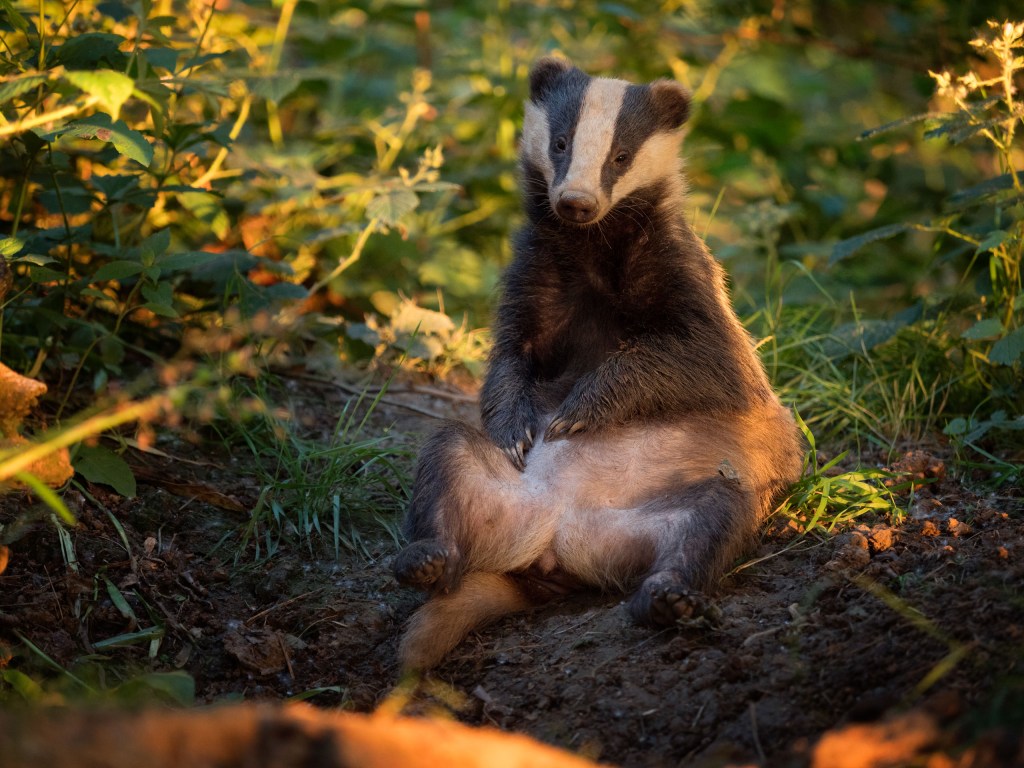
I have to admit, being asked what my favourite image is rates as one of my most ‘feared’ and hated questions. I find it almost impossible to answer as each image has a story behind it, emotions that accompany it and they all mean something different depending on where I was at in my photography journey at the time. It also means I’ll answer different depending on my mood and how you catch me! All this being said, today’s answer is this image of Lyssa, a Badger I had the privilege of watching as she grew from a tiny cub to a fully fledged adult.
Badgers have a special place in my heart and are by far my favourite species worldwide and Lyssa was the first Badger to approach and inspect me after a couple of years working with them. She changed my relationship with this incredible family of Badgers and this was also a common behaviour that I’d failed to capture in an aesthetically pleasing way for years, so the fact that it was her made it all the more special.
The family had been up and about for some time before capturing this, and there’d been ‘too many Badgers’ grouped together which makes it harder to get something. The light was just turning and she plopped herself down and started grooming. For a good chunk of the sequence, a cub was in front of her but he shimmied down the sett eventually and gave me a clear window.
I wanted to capture a ‘clean’ image without other Badgers distracting in the foreground and background, and this was down to luck and and a bit of patience. Beyond that, there wasn’t much additional thought involved beyond ‘get the shot’.
My settings were most definitely not optimal here as I’d been slowing the shutter speed down to drop the ISO. This behaviour can be quite dynamic and in the heat of the moment I didn’t change the settings as I knew the behaviour could stop at any moment. It was fortune that there were brief pauses of activity so the image was sharp. Olympus EM1MK2 40-150mm f/2.8 1/60th at f/2.8, ISO 800.
This is a behaviour Badgers do every night, but so often the light would be too poor, it was be obscured from view or photobombed by other Badgers. To finally get it with a clear view, with the added bonus of being an individual I was very fond of AND with great light was more than I could ask for.
Badgers will always hold a special place in my heart and I was very lucky to get to watch and photograph them for as long as I did. Whilst the images might be the end goal, it’s so important to also be present in the moment. The photography is only part of it, it’s the experience that will truly stay with you for many years to come. Don’t spend the entire time experiencing it down a viewfinder with a narrow field of view, put the camera down and enjoy the moment when the image potential isn’t there.
Both. Luck that the behaviour actually happened and the other Badgers dispersed, judgement in terms of where I sat, what I knew about their behaviour, habits and routines and hundreds of hours spent with them in order to get ‘the shot’.
Kaisa Peltomäki, Finland
Kaisa Peltomäki is a Finnish wildlife photographer renowned for her evocative images of northern landscapes and Arctic wildlife, often captured in the forests and wetlands of Finland. Her work combines patience, atmosphere and a strong sense of place, using soft light and seasonal conditions to create poetic, immersive portraits of the natural world.
Instagram @kaisa_peltomaki
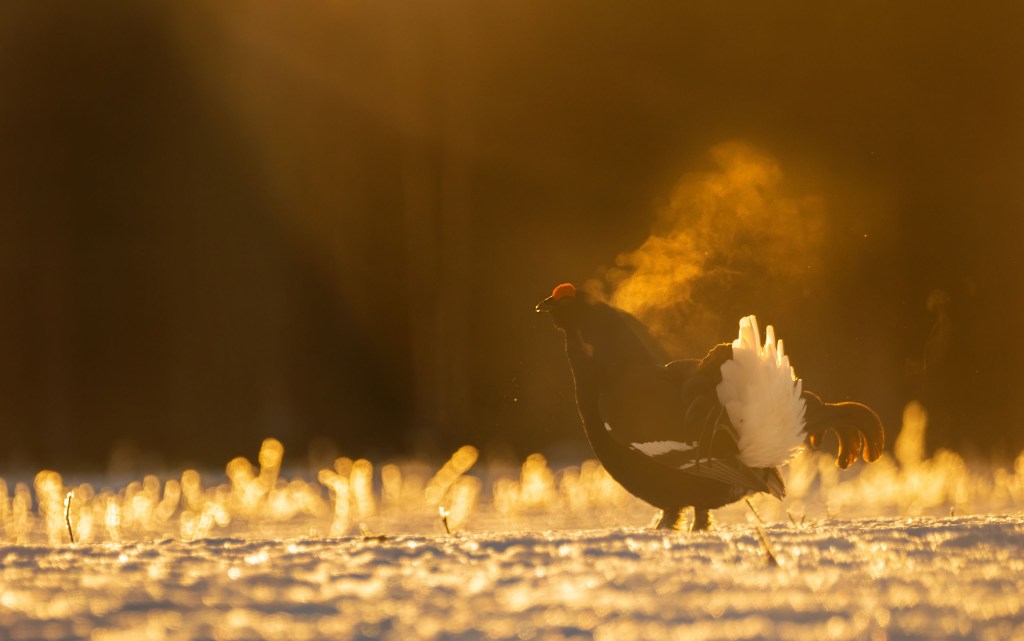
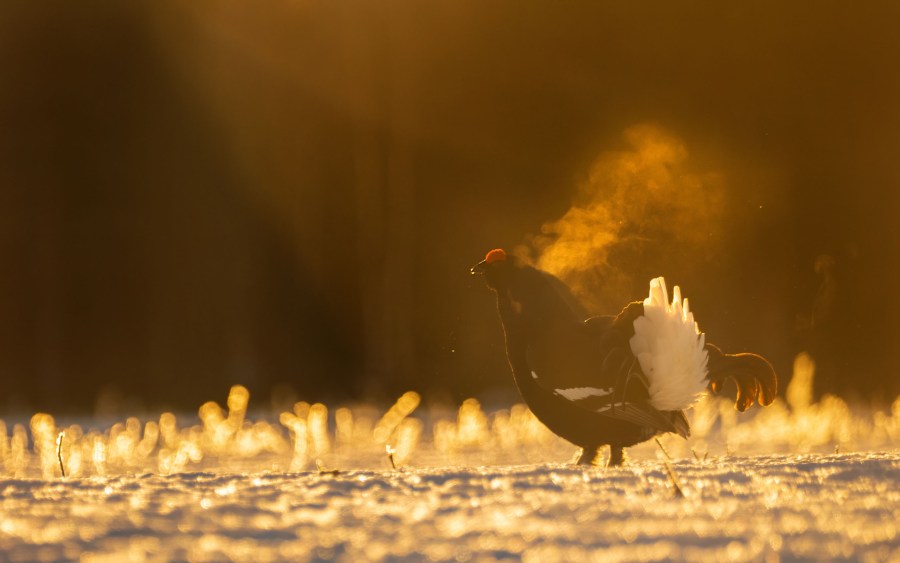
It was so difficult to choose just one photo! After much consideration I chose Black Grouse shot taken in the back light. Black Grouse is one of my favourite species to photograph, it allows for so many different types of images, from traditional action photos to a much more artistic expression. And of course back light is always amazing!
It was a very early morning I had gone to hides well before sunrise and the morning was so cold (-23C), so I wasn’t even sure if the birds would come or not. But they luckily came.
At black grouse leks there are often many birds. Almost all of them had positioned themselves a bit too far to the left. So when the sun started to rise, I decided to focus only on backlight. I waited and watched only the narrow part of the lekking arena where the light was right. Many fights went unphotographed because the birds were in wrong place but my aim was backlit shot. When a bird finally moved into the backlight, I was able to concentrate entirely on that one moment.
It is taken with OM1 + 100-400mm f5.0-6.3, 1/1250, f6,2, ISO 800. Backlit images need very careful exposure. If the exposure is too bright, the atmosphere and light disappear. If it is too dark, the bird becomes only a silhouette without detail. I usually expose for the brightest part of the scene and watch the histogram closely to avoid clipped highlights. When you have all the information in pixels you can do the final tuning in photoshop. In this kind of light, I often underexpose slightly to keep the mood and the warm glow of the rising sun.
One trick is to use also vivid colours in camera settings when shooting so you get better idea of the colours and the shots wont look so flat on screen. I always photograph on RAW so I can adjust the colours on computer. Zoom lenses are especially useful in hide photography. They make composition much easier and give more flexibility when birds move closer or farther away. With a zoom lens, it is possible to react quickly to changing situations without disturbing the scene, and small adjustments in framing can completely change the balance of the image.
I hate early mornings, and for Black Grouse photography you need to be inside the hide well before sunrise. But honestly, this type of image also depends completely on the conditions. You need cold weather, clear skies, and the right light at exactly the right moment – and in the evening you often still don’t know what the morning will bring. Hide photography may look easy from the outside, but in reality everything still needs to come together perfectly.
For me the photo shows the nature we should protect, like most of my photos. Unfortunately Black Grouse is a heavily hunted species in Finland and it is almost disappeared from many of European countries because of the hunting and loss of forests. I hope readers would stop for a moment to think about how we treat our nature and what they can do for nature in their own lives, even if it’s just something small.
I went to the hides and hoped for sunny cold morning to get backlit shots so I knew if everything goes well I might get nice shots. But of course it is a luck that the bird decided to be in the right place in the right time. Sunrise is only a short moment.
Be patient! Even you would go to the good photography site you need luck. Weather might not be sunny, nor cold enough, the birds might decide to stay in a wrong place. So photograph what you can and make most of it – sometimes you get lucky!
Related reading
- Best cameras for wildlife photography in 2026
- These award-winning photos celebrate Scotland’s stunning wildlife and landscape
- These fantastic wildlife photos by this young photographer document life in our fragile ecosystems
Follow AP on Facebook, Instagram, YouTube and TikTok.