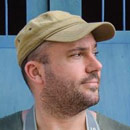
There doesn’t seem an obvious link between four-wheel drive rally cars and puffins. But for Drew Buckley, spending time at frenetic, noisy, muddy races in South Wales as a young man was the perfect training ground for going on to capture the ‘clowns of the sea’. “When I started off photography in my mid-teens and early 20s, I was interested in the Wales Rally GB and other car rallies in the forests,” Buckley says. “That was the main thing I used to photograph as a hobby. It teaches you a lot about shutter speeds, apertures and panning techniques, and you can then put all that knowledge that you’ve taught yourself into birds in flight or anything else. I’ve always been a bit of a speed freak, in terms of trying to capture things that are moving.”
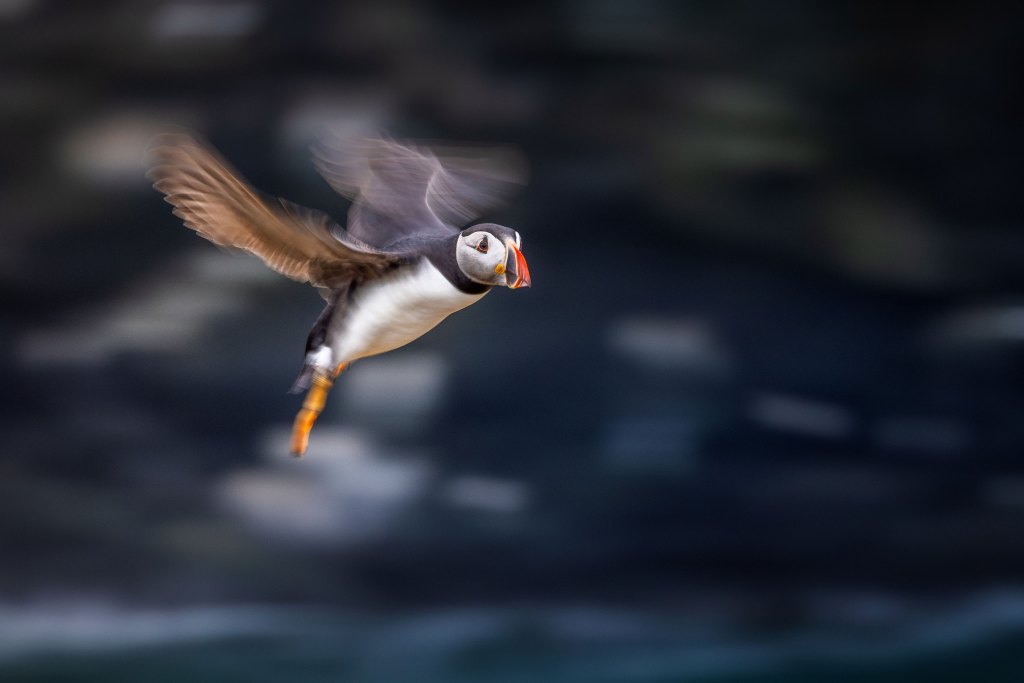
Puffins can definitely shift at serious speeds. They’re known to be able to fly up 55 miles per hour, their wings beating in a blur of rapid movement at around 400 times a minute (6-7 times per second) as they hurtle through the sky like colourful little missiles. “I’ve always loved capturing them in flight because they’re so fast,” Buckley tells me. “Going back to my early days, I was always trying to capture them as they’re flying past. With a tailwind behind them, they’re crazy-fast, and they’re so small in the air as well. If they’re coming at you, they’re just like a circle with two sticks coming out of the side. There’s not much area for the camera to grab.”
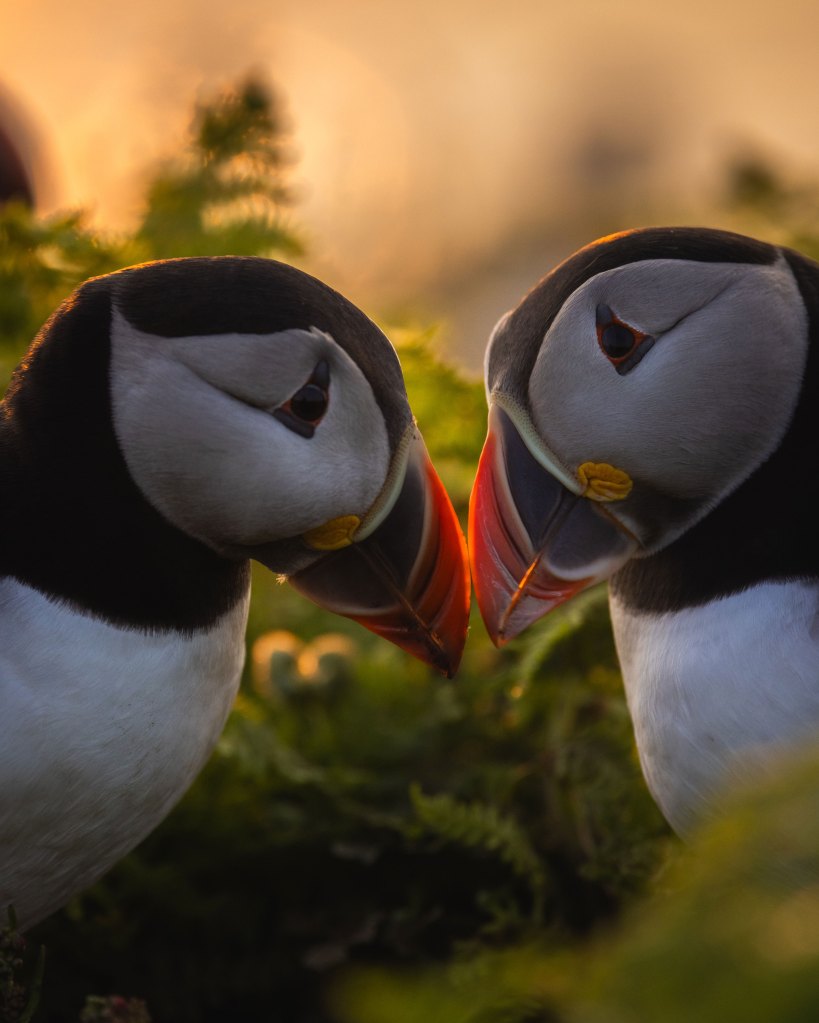
Buckley doesn’t only capture puffins in flight. Over the course of around three decades, he has observed and photographed them feeding, nesting, resting, rearing chicks, socialising, swimming and exploring, operating in all kinds of weather conditions and at different stages across their seasonal visits to Skomer Island, off the south-west coast of Wales. The pictures in his new book Puffins reflect the time he’s invested, from detailed close-up portraits to wide-open habitat scenes to action shots.
Born in 1985 in Middlesex, Buckley moved to Pembroke in Pembrokeshire when he was three, with Skomer, a small puffin-filled island within easy reach. “Being in Pembrokeshire since I was a child, you live and breathe the coastline, the wildlife and the seasons,” he tells me. “Everything around here has a puffin on it in some form of logo or picture. The ‘Pembrokeshire parrot’ is another nickname for them.”
Atlantic puffins are found across the colder, northern climes of the North Atlantic Ocean. They breed on remote islands and rocky coastal cliffs, including locations in Iceland, Norway, the Faroe Islands, Ireland, Canada, Greenland and Russia, especially around the fringes of the Arctic. In the UK, they’re seen around the islands of Fair Isle and Noss (in Shetland), the Isle of May (Firth of Forth) in the far north of Scotland, in parts of western Scotland, and around Anglesey in north-west Wales, particularly near South Stack, with a major population at the Farne Islands off Northumberland. The UK’s largest puffin colony is on remote St Kilda in the Outer Hebrides.
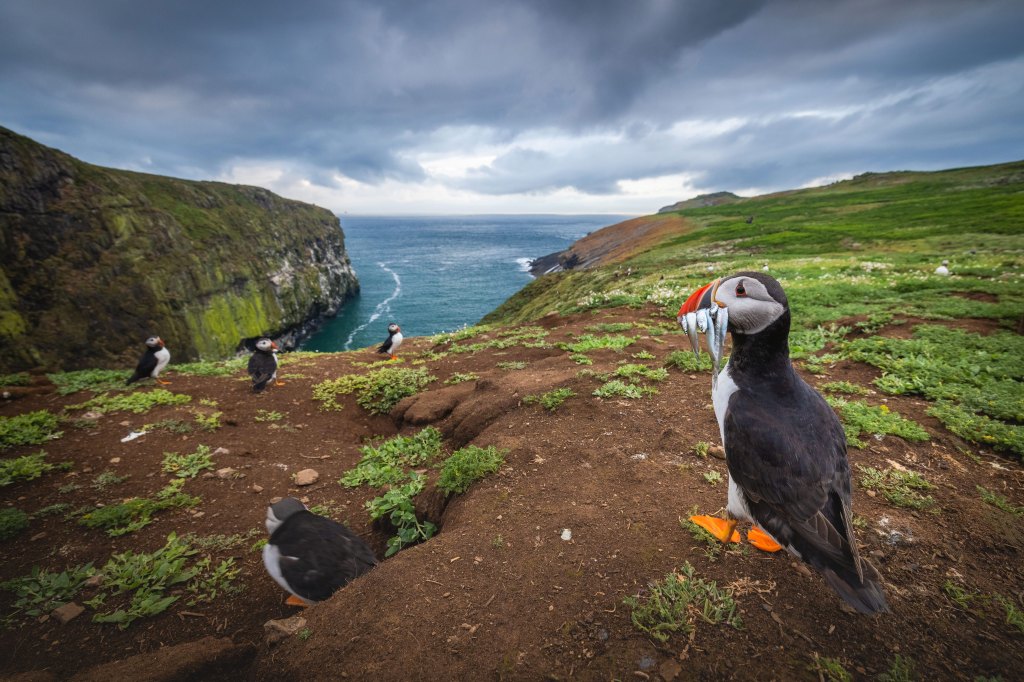
But Skomer, less than a mile off the Welsh coast, is one of the UK’s largest, most popular and accessible hotspots. A record 52,019 puffins were recorded on the island during the spring census this year, breaking last year’s record of 43,626. That means Skomer is bucking the general trend, as Atlantic puffin populations are declining globally and red-listed by the IUCN as Vulnerable. In parts of Iceland, some populations have dropped by as much as 70% over the past 30 years. Norway’s famous Røst colony has declined by more than 80% since the 1970s. UK puffin populations have fallen by 25% since 2000. A shortage of sandeels (a staple food source), due to climate change and historical overfishing, has made it harder for puffins to raise their chicks, with severe storms, pollution, invasive predators on nesting islands, disease outbreaks, and, in some places, continued hunting, also part of the decline.
But Skomer’s numbers have skyrocketed, from around 15,500 puffins in 2005 to the current high. The Wildlife Trust has credited the boom to abundant food in the area and the island’s lack of natural predators. Buckley sees this is a positive example of tourism, including photographic tourism, helping the birds. “Skomer’s a bit of an anomaly,” he says. “It’s a great success story. Due to the food and predation from gulls, they don’t raise as many chicks in other colonies. But around here, sand eels are a mile or less from the island, which means they’re not flying so far, not using so much energy, and they’re gathering lots of food. The coexistence with people really helps. Gulls normally prey on them, but if there are people around, there are less gulls around, which adds to the puffins’ success rate.
Puffins usually arrive on Skomer in March and April, with peak numbers from mid-June to mid-July, when the adults bring fish, usually sand eels, to their chicks in their burrows, before they all fly away usually by the end of July. The island’s also home to 350,000 breeding pairs of Manx shearwaters and thousands of guillemots and razorbills.
Buckley first visited Skomer as a teenager. He estimates he’s since spent around 500 days there, spending 37 days on the island during one season alone. “The beauty of Skomer is that loads of people go there every day, and have done for 20-30 years, so the birds get used to people,” he explains. “You can get close to them or sit and watch them – it’s not always about the camera, but also watching their behaviour. In the satellite sites, they’re a lot more wary of people. You can’t get as close to them as you can here, where they will practically walk past your feet, sit on your camera bag, pull your shoelaces…”
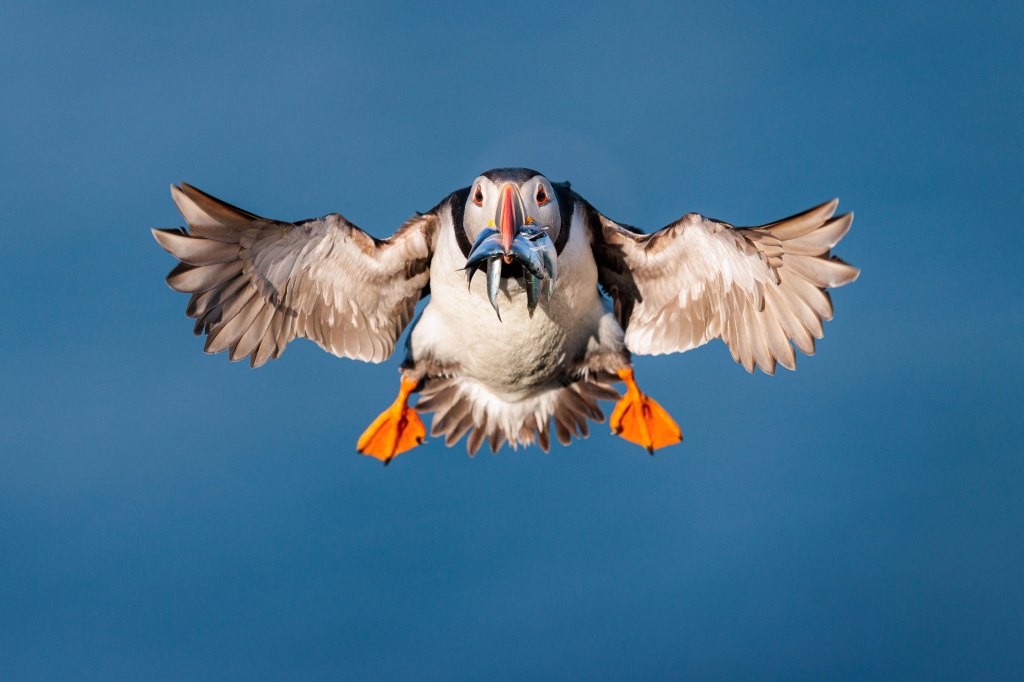
“There was a moment a few years ago, where I had a Selfie with one,” he adds. “The burrows on Skomer are either side of the footpath and the birds walk across the footpaths all day long, every day, especially in the evenings. So once you’re sat there, they’ll happily walk past you. One came along and sat by my side. It pulled my camera bag’s straps, starting tugging that and my shoelaces. They’re so inquisitive. Everything around them, they’ll interact with and play with.”
The birds have an obvious appeal: striking visuals and lots of character. “They’re very comical,” Buckley says. “They crash-land sometimes. They’re always going around checking on each other, peering in to what their neighbours are doing in their burrows. They fall over as well. People are drawn to the colours, the painterly and unreal look to them. They’re quite exotic looking, and very precise in their colouration and markings. That piques your interest. But the more you delve into them and start spending time with them, you get to know the busy little lives that they live. They’re probably characterised in a picture as pretty parrot-type birds. But they’re amazing predators – they dive for food and swim. They catch fish deep under water. Each bird lives for 30 or so years, which is incredible when you think of the crazy weather they live through in the winter time, the storms and big waves.”
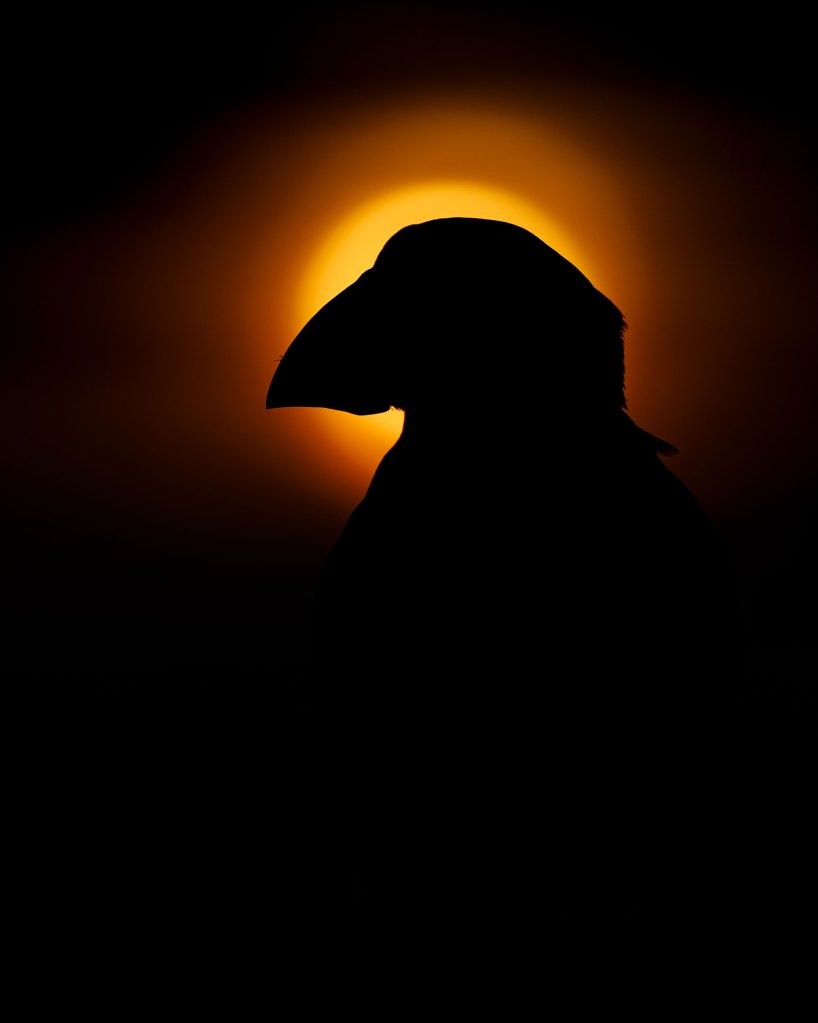
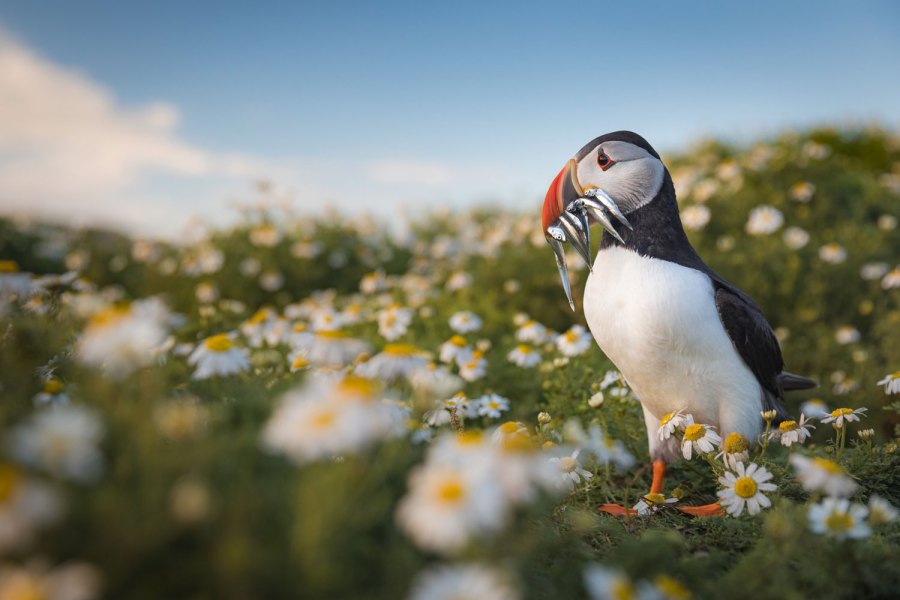
Like many wildlife photographers, Buckley has been obsessed with taking portraits of the birds with a beak-filled with silvery sand eels – the Holy Grail of puffin photography. “That’s what everyone goes for – the classic image,” he nods. “Even then, they’re tricky to do right. It becomes almost as much about the background as it does the subject, making sure the backgrounds are quite clean, using your shooting angle, and looking at different areas behind the birds, the cliffs or the sea, which changes the colour wash that the bird’s set against. Every visit, you think “Can I better the last one?” That’s the aim. Any photographer thinks that.”
Making so many repeat visits, he’s enjoyed working in the “sub-seasons” within the season. “In April, you get nest-building behaviour and the island looks quite wintery still,” he explains. “Then in May you get all the Spring flowers coming out.” As well as focusing in close on the birds, he likes to use wide lenses, making use of the island setting, weather and skies. “I always enjoy habitat shots as it showcases the place more. A lot of people go to a location and just shoot everything at 400mm or 500mm, right on the subject – lovely shots but you don’t really showcase where it lives.”
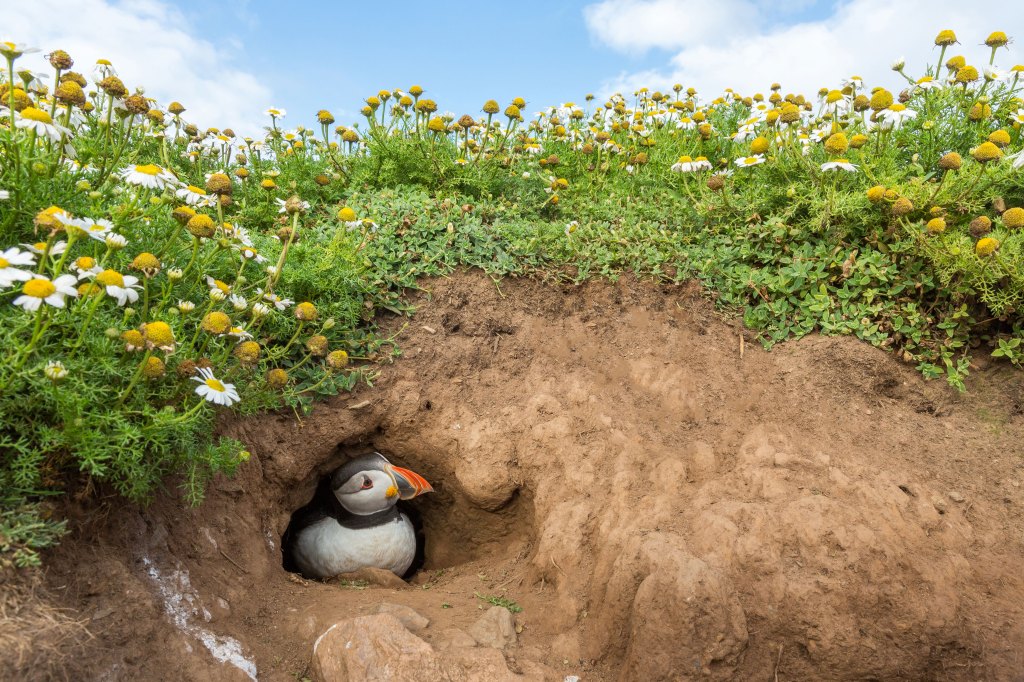
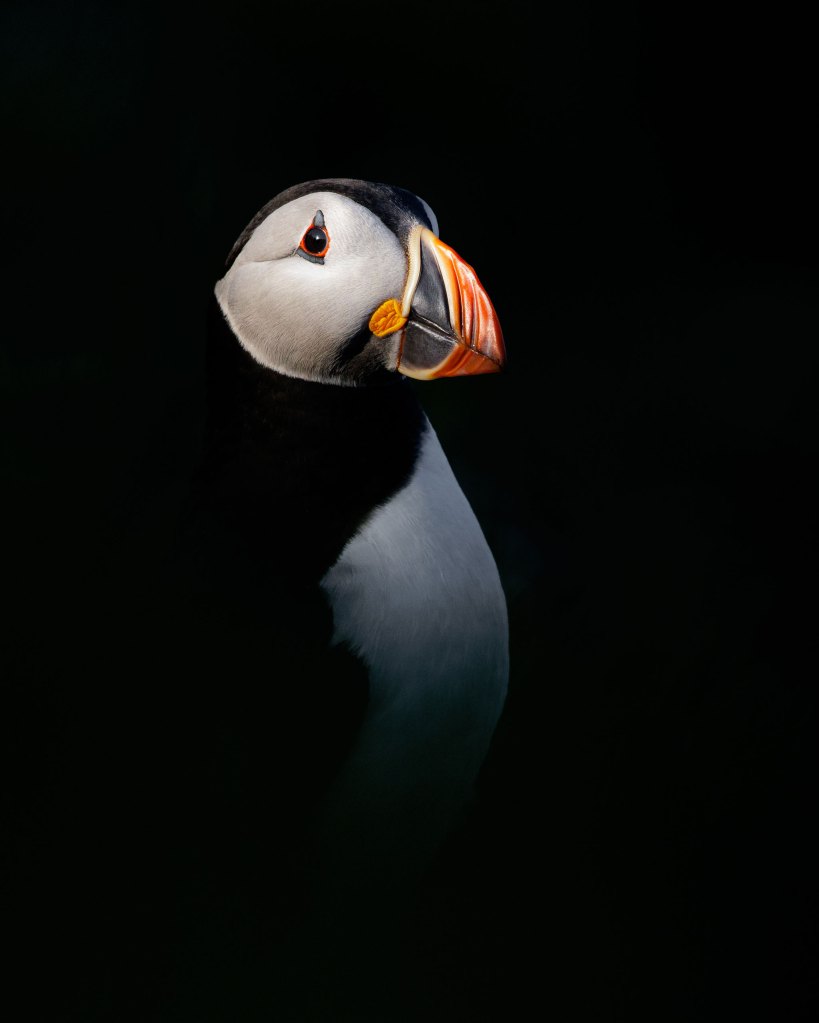
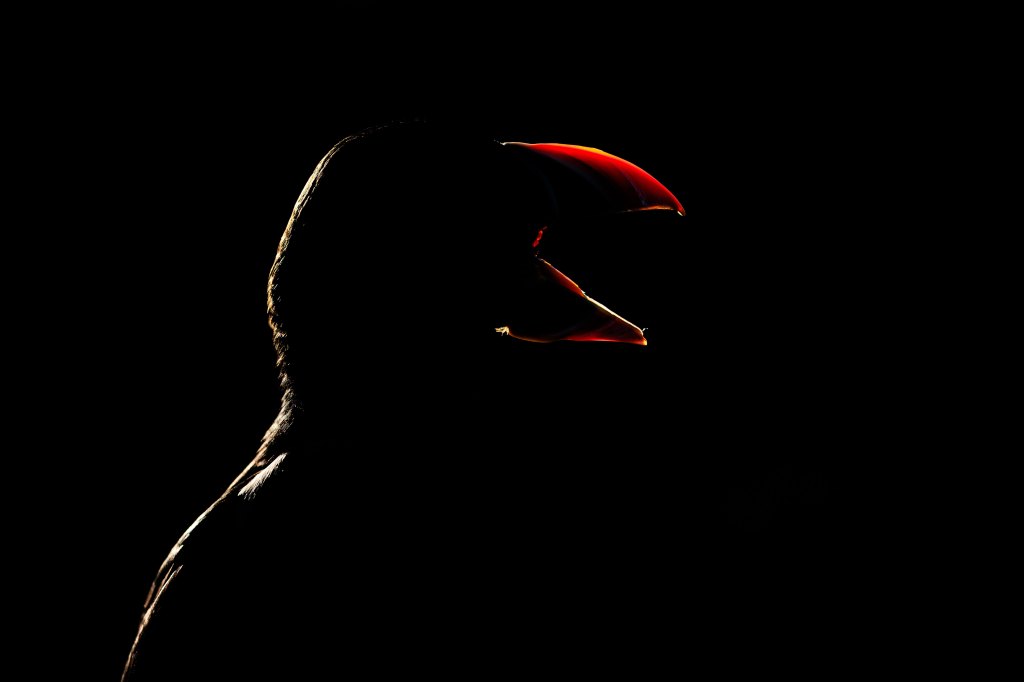
Over “many, many visits”, he’s looked to push his creativity. “Once you get your main portraits and habitat shots, you start looking at other ways you can build on that for a species. You look for gaps in your portfolio. You go down to a smaller level, different kinds of habitat shots through the seasons, with different flora, or sunrises and sunsets… The more you go, the less you shoot. It’s those special shots you’re looking for, when weather conditions come together, or standout moments. In the last few years, I’ve played around with light a bit more, with backlighting, silhouettes, or where there are little pockets of light and shade popping up.”
Playing with interesting light conditions resulted in one of his favourite images, now on the cover of his book. “That was taken looking down a bank, when the light was going down, so the whole bank was in shade,” he says. “When the puffin was walking around, occasionally it’d put its head up just enough that it’s into the sun. So you’re exposing for the white of the face, and by doing that everything else goes into shade and makes everything around it dark. From a first glance, people might think “Is that Photoshop?” but it’s all done in-camera, if you get the right conditions.”
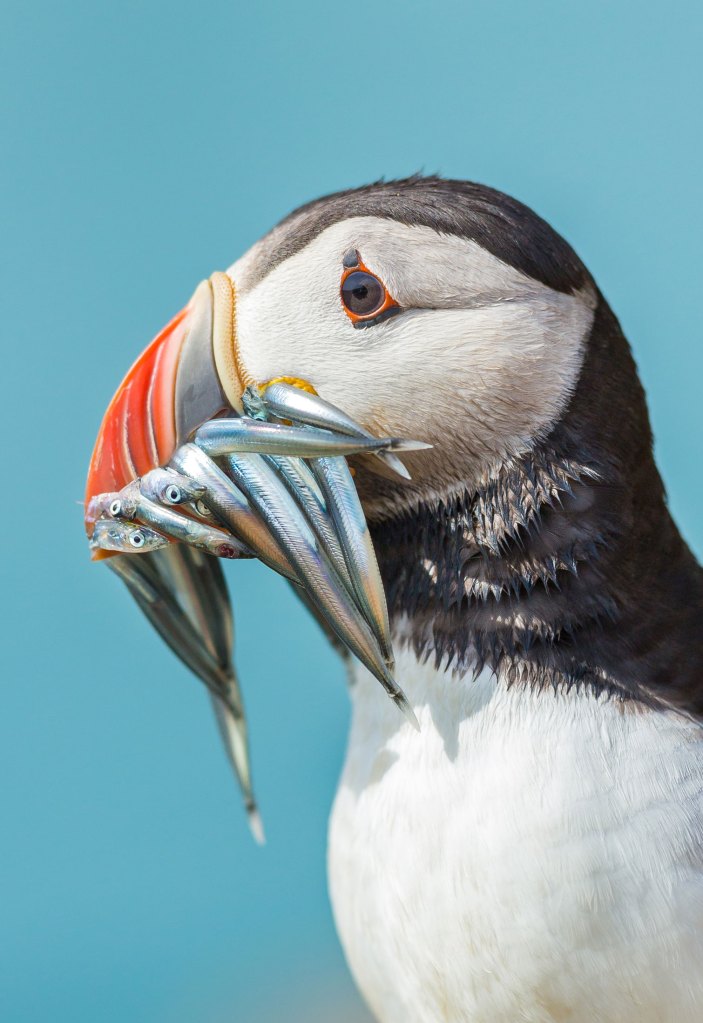
Another favourite image of his is an in-flight capture. “I’ve shot a lot of flight shots, but I’ve always wanted one where the bird is coming in dead straight of the camera, with symmetrical wings,” he says. “That’s easier said than done. This picture was shot in evening light. It’s one out of a sequence of 20 or so frames. There was a point where it was dead straight, almost looking at the camera, and the wings are pretty much, almost, almost symmetrical. I was definitely chuffed with that picture.”
With such tricky, fast-moving subjects, developments in camera technology help. “With mirrorless, it’s definitely become easier, with animal-tracking, eye-tracking, and the snappiness of it all,” he says. “Before that, you learned techniques: watching birds, predicting where they’re going to go, and focusing on an area where they’re coming into, rather than picking anything out of the sky. You really had to cherry pick the ones you’re after. Going back 20 years, it was just old school: pre-focus and wait for it to come through.”
With speeding puffins, he also likes to experiment. “I’ve always loved in-flight images and playing around with shutter speeds,” he says. “Of course, the success rate is quite low, especially if you’re at 1/150, trying to get a blurry puffin panning past you. But they’re way more rewarding than just keeping shooting the same picture at really fast shutter speeds. Once you’ve got your baseline shots, you should push yourself a bit more and try out different things.”
Buckley runs workshops to Skomer and other locations in Pembrokeshire. He’s been self-employed as a photographer since 2010, having previously worked as a 3D artist on computer games. “Redundancy from that job spurred me on to give photography a kick-start,” he explains. “But I’d always been interested in cameras. My brothers had cameras when we were little. I got the bug playing with their film cameras.”
He’s worked in many locations across Wales (Pembrokeshire, Eryri (Snowdonia), Glamorgan, Brecon Beacons, Cardiff…), as well as parts of Scotland and England, including London cityscapes at night, from astrophotography to classic woodland. Like many photographers, he balances up his own interests with commercial work, including collaborations with Canon, Pembrokeshire Coast National Park and the RSPB, and two years working with the BBC Natural History Unit on creative timelapse videos for their 2020 series A Wild Year In Pembrokeshire.
“Since Day One, landscapes and wildlife have been the genres I’ve loved the most. Growing up around here, you have the Gower, Brecon Beacons, Snowdonia… all on the doorstep. It’s what you grow up visiting and holidaying in, and then you start working in those locations. It definitely has a calming effect. Once you’ve been outside, it resets you every day.”
Alongside puffins, he photographs other wildlife, from badgers, deer, otters and dolphins to owls, geese and sanderlings. “I was a bit of a birder growing up,” he tells me. “I was always looking out of the window at the bird feeder and then thinking “What camera can I get, with the biggest Zoom?” With birds, photos with heartbeats definitely capture an audience more than landscapes do, however pretty it is around here.”
Despite putting out a book, Buckley’s far from finished with puffins. “As long as I live here, they’re always going to be an interest,” he says. “It’s the seasonal highlight. You read the paper and hear that the first puffin is back in March, and you think “Great, here we go again…””
See more of Drew’s work and upcoming workshops on drewbuckleyphotography.com
Puffins by Drew Buckley is published by Graffeg and is available to buy now. ISBN: 9781805952190
Related reading:
- How to be an ethical wildlife photographer
- Photographing the birds of Britain
- How to photograph garden birds
- 5 tips on photographing spring birds
Follow AP on Facebook, Instagram, YouTube and TikTok.