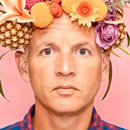
Celebrated street photographer Alan Schaller believes Instagram is no longer serving most stills photographers. So rather than complain, he’s created a new app.
Street shooting guru Alan Schaller has a gruelling schedule; he’s in Tokyo for the launch of three exhibitions of his work, a couple of photo shoots… oh, and he’s just about to launch a new photo app Irys.
Schaller is known and recognised for his striking street photographs, mainly shot in his signature gritty black-and-white style. The work has earned him a massive online audience and a busy exhibition calendar that would be the envy of many a photographer.
Schaller slowly migrated from a hobbyist street shooter to a full-time working pro. His big online audience played an important role in this transition, but he was not a day-one Instagram user.
He joined in 2015 as co-founder of the SPi collective (Street Photography International) with a view to showcasing street photography talent from around the world, and watched tens of thousands of submissions turned SPi into a huge community account on Instagram boasting an impressive 1.7 million followers.
Built by photographers
‘I realised a lot of people do not want to be professional photographers,’ he says. ‘They want to be recognised, to feel seen, to engage.’ But when Instagram pivoted to short-form video, the context for still images changed. ‘If you look at their [Meta] share price, they made the right call,’ he says.
‘But a lot of photographers felt their work had helped build the platform only for the platform to move on.’ Rather than complain, Schaller decided to build his own app.
‘I woke up one day and thought, I am upset with how things are panning out. Why should I expect them to change? They do not owe us anything.’ He continues, ‘I think it is time for a change. Time for something that is built by people from the photography world, for the photography world.’
Video pivot
Schaller’s path into tech began during the pandemic as Instagram’s video push accelerated. He had already proved that curation could open doors when SPi became a destination for street work. He had also seen the status anxiety that numbers can bring.
‘Numbers became a proxy for merit,’ he says. ‘I do not want to be selected because of a following. I want to be selected because the work stands up.’ So we designed Irys to lower that pressure. There are no visible follower totals on profiles. You can see who follows whom, but the tally does not sit above the work like a scoreboard.
‘When you go to a gallery, you do not ask how many people have seen the print today,’ he says with great acuity. ‘You look at the picture.’
He also wants a space where photography means photography. ‘We are building protections against AI content,’ he says. ‘We will not allow generative images. He adds, ‘ We are adding screenshot deterrence and controlled sharing so people can amplify work with permission.’ He is clear that the stance is practical rather than tribal. The aim is to preserve a photo-first culture and to keep photographers’ files and data safe.
Being human
Moderation is tuned for an arts platform. ‘Fine-art nudity is allowed in context,’ he says. ‘Freedom of expression is important, but not when it breaches the terms. We have written policy and enforcement with proper legal advice.’ Then he adds the unromantic truth. ‘It is not like setting up a lemonade stall. You need GDPR compliance, security and real moderation.’
From launch, Irys supports high-resolution stills and preserves image integrity. Free accounts get generous uploads. The paid tier unlocks maximum file sizes, with a cap moving toward 50 MB per image. Curation is human. Editors and invited experts highlight work in themed selections, and users can organise their own pictures into collections.
Group mentality
Groups sit at the heart of the Irys community. ‘I have already started a street photography group,’ Schaller says. ‘We have added announcement boards so you can post, for example, a photowalk plan. Meet here. Bring a 35mm. That kind of thing.’ The point is not only to scroll. It is to meet and make work.
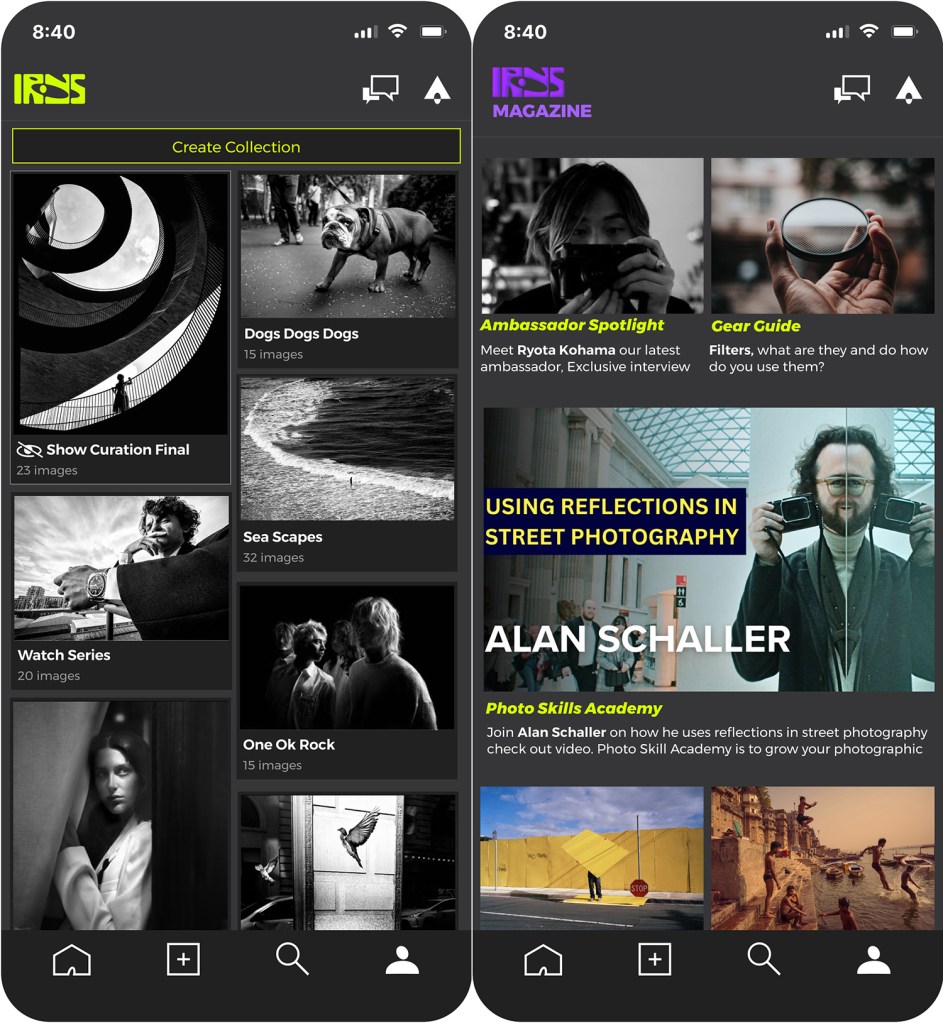
The roadmap is practical. Shared collections so multiple photographers can contribute to one set. Private and password-protected collections for client proofing, with comments and approvals in one place. Private groups for commissions, workshops or brand cohorts. ‘You can set up a workshop group and have people upload their results in high res,’ he says. ‘Leaders like Phil Penman are already doing this.’
Irys is also setting rules around identity. ‘Brands will be verified,’ he says. ‘We will not let people use logos they do not own.’ He is equally frank about data and ads. ‘We are not going to sell data and we are not going to serve third-party adverts,’ he says. ‘People have been through enough of that.’
Size matters
Funding matters. ‘You cannot attract partners or protect users without doing this properly,’ he says. ‘Hosting large files is far cheaper than a decade ago, but it still costs money. So does moderation, accessibility, privacy and legal. We have invested in that from day one.’
The first working build went to a waitlist of roughly 20,000 people, with several thousand early users testing ahead of launch. ‘We wanted to stabilise for hundreds of thousands of users before opening the doors,’ he says.
The choice to support big files is not just a matter of being purist – it sets up plans around print fulfilment and publishing. ‘We plan one-button print ordering through approved partners,’ he says. ‘You will tag images as for sale, set sizes and prices, and the system will handle fulfilment.’

Schaller keeps returning to the same idea. ‘You do the photography,’ he says. ‘We will do the rest.’ If you want a feed that respects still images, you will find one here. ‘A free account gets a lot,’ Schaller says. ‘High-quality uploads, collections, groups and unlimited viewing.’ The paid tier, about five pounds a month with an annual discount, unlocks maximum file sizes and pro-leaning tools. ‘We need a percentage of users to subscribe so we can pay for servers, support, moderation and the team,’ he says. ‘In return, you get no ads and no data sales.’
Collectives
The practical gains are obvious. A photo editor can browse curated work and targeted groups rather than trawling a generalist feed. A workshop leader can create a private group, share briefs and gather results in one place. A commercial client can approve a protected collection instead of juggling file-transfer links that expire. ‘We are building targeted features because we are not trying to serve everyone,’ Schaller says. ‘We are building for people who love photography.’
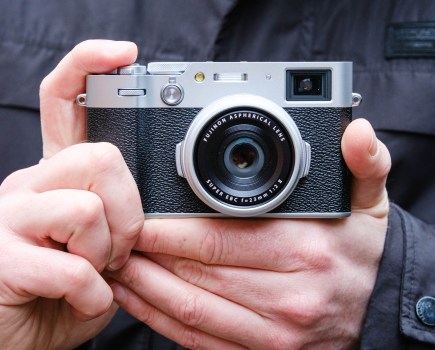
Discovery is designed to favour quality. ‘We are prioritising talent over numbers,’ he says. ‘Editors and brand partners tell us they want a more precise way to find photographers. We can give them that.’ The company is already lining up partnerships with camera makers, cultural institutions, publishers and galleries to introduce the app to their audiences. ‘We will announce the first wave after launch,’ he says.
Growth will come through partnerships and culture rather than pure performance spend. ‘We are bringing the community we already have, but we are also working with brands and institutions who want to support photography in a more focused way,’ he says.
He is also building an ecosystem around the app: a print magazine, a publishing arm, an agency that centres the work rather than the social reach, real-world exhibitions and events, and a foundation to fund deserving projects. ‘The industry does not need fixing,’ he says. ‘It needs support, and a place where it can thrive without the pressure of unrelated trends.’
Irys v Meta
All worthy goals, but can Irys really compete with Instagram/Meta? Schaller doesn’t hesitate. ‘I do not see us taking on Meta,’ he says. ‘We are complementary.’ The analogy is simple. Independent coffee does not need to be Starbucks to be successful. It needs to be good and to serve the people who want it. ‘Meta builds for everyone,’ he says. ‘We are building for a specific culture. That means we can ignore trends that do not serve still photography and adopt features that do.’
The photo world has been squeezed by contracting publishers and closed galleries, even as more people take pictures than ever. Film is back. Photobooks still matter. Brands of every kind rely on photography.
The gap is a digital home that treats pictures as pictures, not as bait for a video feed. Irys is not alone in trying to close that gap, but the combination of a photography-first spec, funded engineering, clear governance and a founder with global reach is unusual. Schaller does not claim to have reinvented the wheel. ‘A social platform that shares photographs is not new,’ he says.
‘What is new is the intent and the focus. We are committed to photographers. We are not going to pivot away from them.’ If he delivers on that simple promise, a lot of photographers will breathe a little easier every time they open the app.
Irys launched recently (Oct 2025) on the App Store and Google Play. Early access is now opening to all. Free membership is available, with a subscription for additional benefits. ‘The world has changed,’ Schaller says. ‘Photography has changed. It deserves a home that is built for it.’