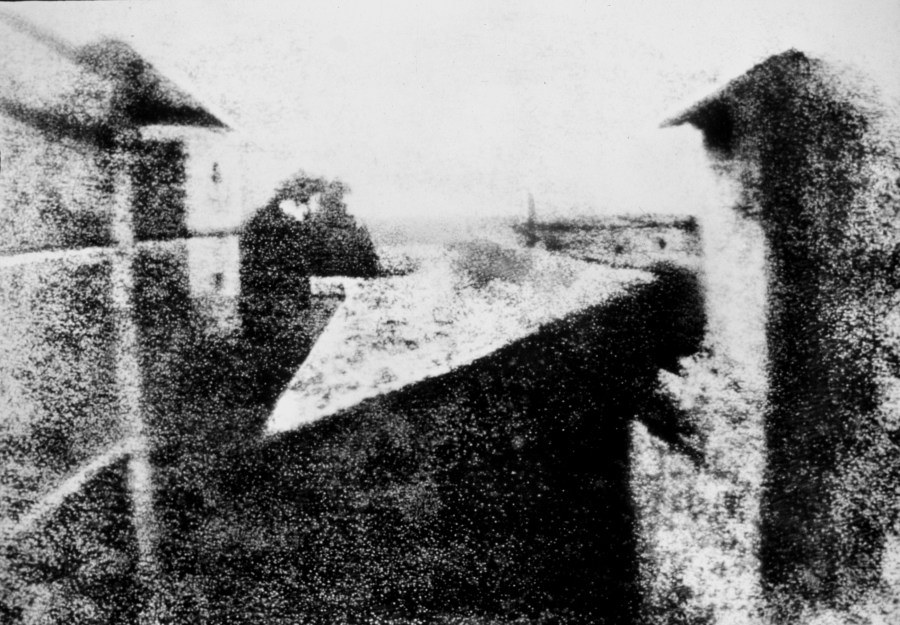
The exposure of Nicéphore Niépce’s first photograph, in the sense that would have been understood for the first 60 years of photography, was several days. I will trace the subsequent evolution of its meaning using two openly accessible sources.
The first is the Journal of the Photographic Society, for which the archive is available at https://archive.rps.org/archive. Citations from this source are identified as “JPS v-s”, where ‘v’ is the online archive volume and ‘s’ is the archive sheet number.
In the early years today’s basic concepts were not fully understood, and emulsion speed (now called ‘ISO’) had not been formalised. There was an appreciation that the required exposure would change with both the aperture and focal length. As Sir W.J.Newton wrote in 1853:
The lens I generally make use of is 13-inch focus, and the diaphragm half-an-inch …a lens of 16-inch focus would require a larger diaphragm in proportion to the length of focus, because the longer the focus, the more time is required for exposure in the camera, and therefore a larger aperture would be necessary in order to make it work in the same time. (JPS 1-78)
In the same year P LeNeve Foster notes:
We hear and read daily of this or that process being quick or slow, but even when the time actually occupied is given, unless, at the same time, we know the focal length and aperture of the lens, no certain conclusion can be arrived at. (JPS 1-65)
In 1855 Thomas Sutton suggested improving on the use of aperture diameter.
It would be a good plan to represent the comparative intensities of different portrait lenses by numbers obtained by exact calculation. (JPS 2-157)
In 1857 the lens designer Thomas Grubb explains expression of the aperture of a lens in relation to the focal length:
While “aperture” (of a lens) means simply its effective or exposed diameter – “angular aperture” is the diameter, taken in connexion with its focal length. (JPS 4-111)
What we would today call f/2 would be 28° for instance. Other lens makers preferred to express aperture as a fraction of focal length. The famous lens maker J.H.Dallmeyer, describing a new design, wrote in 1863:
the largest aperture not to exceed 1/10 or 1/12 of the compound focal length (JPS 8-374)
In 1866 Dallmeyer discusses a lens “with the full aperture f/7”, using the notation used to this day (JPS 11-163). He also talks about another lens “the ratio of effective aperture to focal length of which is as 1:3”, using the notation which we still see written on the front of lenses.
As of 1866 the effect of aperture on exposure was understood and the current notations were in place. There remains the formal definition of exposure itself, for which we need to use the second source, the Hurter and Driffield Memorial Volume (HDMV, available at https://archive.org/details/memorialvolumeco00hurtiala/). Frederic Hurter and Vero Driffield were amateur photographers who spent years developing a scientific approach to photography, along the way defining not only exposure, but also emulsion speed and the concept of ‘correct’ exposure. In May 1890 they wrote:
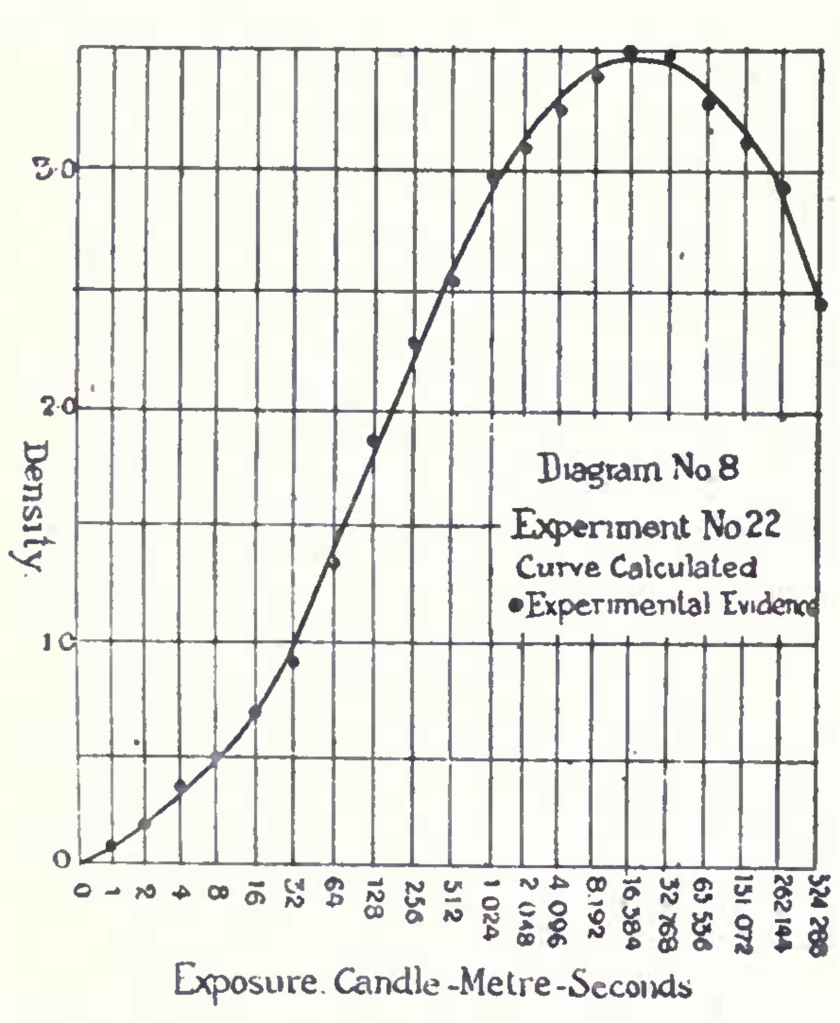
For these investigations it was necessary to adopt a standard unit of exposure. As unit of light we have chosen the intensity of a standard candle at one metre distance, and as unit of time the second, so that our unit of exposure is the product of the intensity of the standard candle at one metre distance and the second, and we call this unit of exposure one “candlemetre-second”. (HDMV 101).
This definition stands today, although ‘intensity’ now uses the SI unit lux, providing a unit of exposure as the lux-second.
Related reading:
- The big Exposure Triangle mix-up and why it’s wrong
- Testing Lenses and Cameras – Why Metrics Don’t Matter
- In praise of Bryce Bayer and the supreme Bayer Sensor
Follow AP on Facebook, Instagram, YouTube, TikTok and Irys.