Names like Helmut Newton, Richard Avedon and Irving Penn tend to trip easily off the tongue when people are asked about the world’s most famous fashion photographers… but there are some fashion photographers who have produced stunningly creative work, yet you may not know their names. The late British photographer Neil Kirk, who died in 2022, falls into the latter category, but a new book that showcases dozens of his iconic fashion images is shining a fresh light on his life and work.

Neil Kirk in Vogue: The Supermodel Years was made possible by the magazine publisher Condé Nast opening the vaults of its Vogue photo archives and by the efforts of Kirk’s wife Vivienne (well known for her work as a fashion and advertising stylist) and the fashion editor, curator and educator Iain R. Webb. The duo spent years diligently trawling through Neil Kirk’s photographic archives to find hidden gems. The vibrant images in the book are regularly interspersed by the recollections of knowing and working with Kirk penned by supermodels, art directors, fashion editors, stylists, photographers and fashion designers.
Within the tributes and anecdotes, the former fashion editor of British Vogue, Harriett Jagger notably writes, ‘You could immediately tell a Neil Kirk picture; almost always on location; he was the king of the location shoot, beautiful light and almost always moving or bringing some form of energy to the picture.’

Roxy Music and fashion
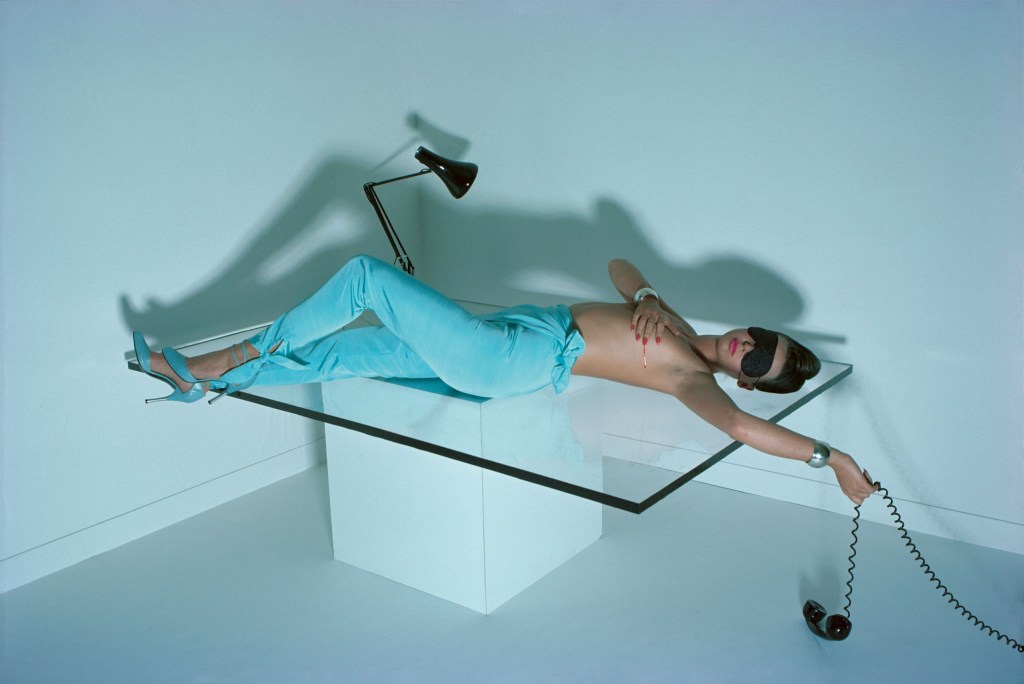
If you’re unaware of Neil Kirk’s fashion photography you might be more familiar with his effortlessly cool photography that adorns the covers of three Roxy Music albums – Manifesto (1979), Flesh + Blood (1980) and Avalon (1982). Indeed, in the book’s foreword Roxy Music lead singer Bryan Ferry writes, ‘Neil was cool with a good sense of humour and we got on well. It’s lovely to work with someone you know, like and trust’. Kirk also worked for Ritz, 19, Honey, The Sunday Times and, in step with the supermodel era, for many of the international editions of fashion bible Vogue. To find out more we spoke to the two key driving forces behind the new book – Neil’s wife Vivienne Kirk and Iain R. Webb…
Neil Kirk initially studied medicine, as Vivienne Kirk recalls, ‘He was going into the psychiatric side of medicine, but decided he didn’t want to spend the rest of his life with that kind of sadness. He was clearly very visual and then he switched to studying the history of film, because that was something he was interested in. He’d always had cameras since he was a child. He was self-taught.’
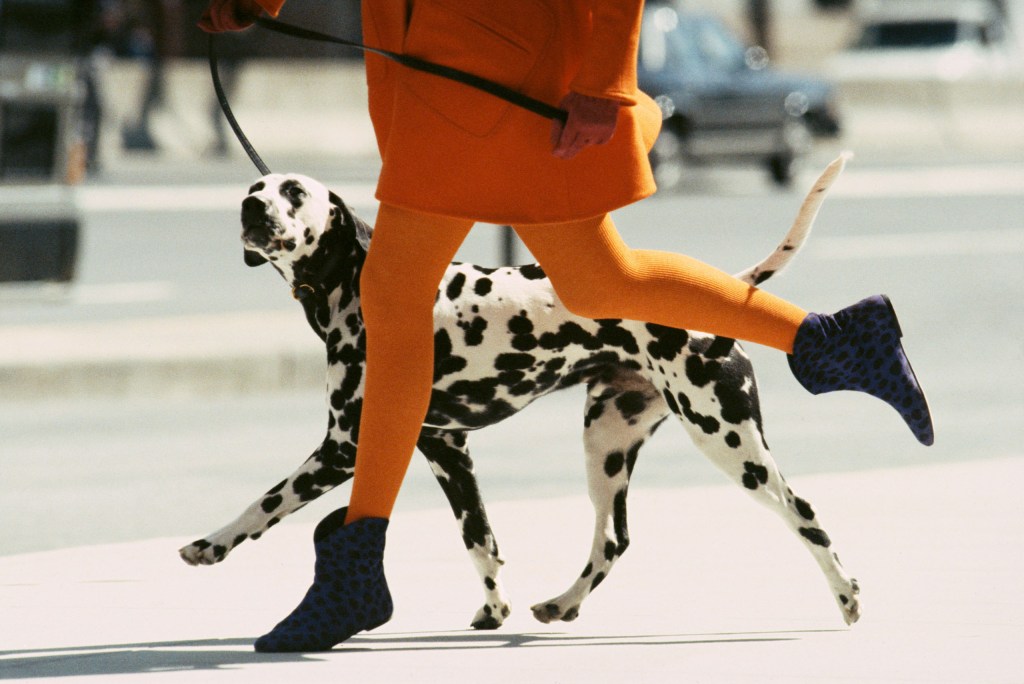
Vivienne Kirk believes Neil Kirk was ‘inspired by classic photographers like Irving Penn’ and the movement in the ‘jumping’ photographs of Philippe Halsman. She notes, ‘once Neil was in the swing of his photography career he loved motion and movement’. That movement in images is predominant in Kirk’s work – supermodels running across streets or hanging onto the back of a scooter in Rome, whilst wearing a £2,000 Versace jacket. Kirk’s studio was the outdoors, where he could play with light and give models the freedom to express themselves.

Getting into Vogue
Neil Kirk’s career progressed through the connections he made in the fashion industry. Iain R. Webb explains, ‘He did three of the Roxy Music album covers with Bryan Ferry and there were a lot of people in that circle. There was Antony Price, a fashion designer who used to dress Roxy Music, and Neil did a lot of the advertising imagery for Antony Price. The store that Antony had in the King’s Road, Plaza, had a screen in the window, which was kind of ahead of its time, and Neil produced a lot of the pictures shown on that screen. The work wasn’t just in magazines – it was a wider audience that saw his work quite early on.’

Webb adds, ‘Michael Roberts was also then fashion director of the Sunday Times and at Ritz newspaper, which was really important in the fashion world. They collaborated a lot in the very beginning. That gave Neil that entrée into the world of fashion magazines. Quite early on in his career that he was doing things with Italian Vogue.’
Throughout his career Kirk worked with Hasselblad cameras, often shooting with long lenses, to capture models in real life situations on the streets of Paris, Rome and other major cities. Vivienne Kirk recalls, ‘He worked extensively with a Hasselblad. It was his go-to camera, especially in the street with a long lens blown out. He went digital in about 1999. He still used Hasselblads and he would also use Canon EOS… I’ve still got all the cameras.’

Photographic style
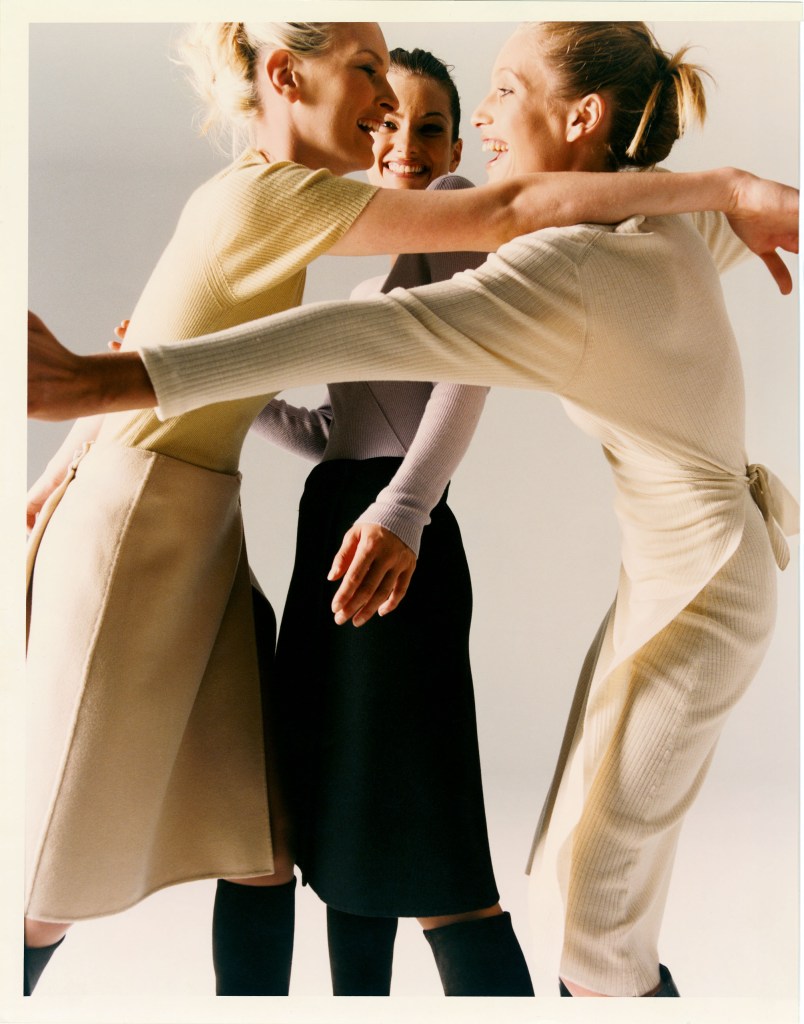
Even early on in his fashion photography career Kirk had a defined and exciting style, producing images packed with movement and humour. Iain R. Webb explains, ‘From the beginning it was very much a look that wasn’t static photography. One of the things that he always said was that it wasn’t about a perfect moment – it was about the things that were a little bit undone. There are pictures where models are always running about and the clothes are a little bit dishevelled. That seems to have been his style from the beginning.’

Webb continues, ‘The very early stuff may have been slightly more stylised. He’s been quoted saying that if you didn’t enjoy yourself, there was something wrong and you should get out of the profession. He enjoyed taking pictures and that was something that then emanates throughout a team.’
Notably, Vivienne Kirk describes Neil Kirk as ‘definitely a people person. He loved talking and he was a character for sure. He was a big storyteller, both in his work and in his personal life.’ This storytelling seeped into Kirk’s work and creative process.

Vivienne Kirk reveals, ‘As far as magazines and advertising are concerned either the editor or the client would propose a vision of how they saw something visually. Neil would often do these little drawings, because he went into the advertising industry prior to taking photographs, so he had that way of knowing what he was trying to aim at. It was rather like a storyboard. For the first 10 or 15 years of his career Polaroids were part of that process. He would run round Rome taking pictures of different corners and then say, “right, we can shoot here”… that kind of thing. With film, he would keep an eye on the developing side of it – test prints and all of that.’

The book project
The book Neil Kirk in Vogue: The Supermodel Years has its roots before Kirk passed away. Vivienne Kirk recalls, ‘I started working on Neil’s archives with him around 2018. We had to just sit at the computer for days on end, looking at all of the images we had that were mainly digital or had been scanned by a laboratory. When Neil was doing it with me it wasn’t as edited as the book that we’ve ended up with. We decided in order to condense what we were working with we’d work with Condé Nast, because [editing] 30 to 40 years of so many images was quite hard to get your head around.’
Thankfully Vogue and its publisher, Condé Nast, were keen to help with the book project and were more than willing to throw open their archives, which contained much of Neil Kirk’s films and work from over the decades. Iain R. Webb then introduced Vivienne Kirk to a publisher he’d worked with previously – ACC Art Books – who loved the idea of the proposed book.
So, from 2023, the proiect was in full swing. Iain R. Webb, recalls, ‘We just jumped in. We’d be opening boxes in the garage and going through brown envelopes with negatives and slides. We’d be working with all sorts of things, like tear-sheets from magazines. In the very beginning we spent a few weeks literally editing through and then we ended up with a layout that we kind of liked the idea of, which we laid out on Vivienne’s bedroom floor. It went from there.’

Webb explains, ‘Early on, we decided we wanted to have comments from people that had collaborated with Neil. That’s a bit more of a long-winded process because it’s just getting hold of people, but everybody was very cool with coming forth. It’s been a very enjoyable process.’
Vivienne Kirk adds, ‘Some of the images, for one reason or another, couldn’t be blown up because of the quality; because they were too old. Neil did a lot of grainy images anyway, but they’d been sitting in a filing cabinet somewhere for about 30 years and it was just impossible to use them, even if we really wanted them in the book.’

There were also some previously undiscovered gems. Iain R. Webb notes, ‘The great thing was we also found things which we didn’t really know about, like the portraits he did for Italian Vogue, which were black and white negatives. We used one of those apps on the phone where you hold it over [the neg] and the pictures come up. Suddenly you saw all these images he’d done that neither of us really knew about.’
Speed and legacy
One thing that comes across clearly is that Neil Kirk wasn’t a photographer to dwell on getting things right – he was happy to have imperfections in his work. This is backed up by the fact that he worked speedily. Vivienne Kirk explains, ‘Did he really ever over-think it? I don’t think he ever really did. It had to be stylish. He was quick and I think that comes across in the movement in the pictures. He didn’t hang around in any shape or form.’
Iain R. Webb chimes in, ‘Models responded to that because I think there’s nothing worse for a model than a photographer who does roll after roll of film – it can become laboured and tortured. The models responded to Neil because they could just be themselves a lot of the time. I think he wanted that kind of character within pictures – it wasn’t something that was overly studied or overly stylised.’

Webb adds, ‘I think it’s really interesting that people are looking back at that period and are reassessing photographers like Neil and Pamela Hanson, who were around at that time in that kind of “lifestyle” work that isn’t these very studied, archaic ideas of a fashion image. They are much more vibrant and dynamic and I think that brought a whole, new thing. Neil kind of tied in around the same time that Anna Wintour came to British Vogue, threw everything up in the air and changed the whole dynamic of what fashion could be.’
As the interview winds towards a natural end I ask Vivienne Kirk and Iain R. Webb what people should expect to see in the new Neil Kirk book? Vivienne Kirk replies, ‘I think it captures that time in magazines when the audience waited in anticipation about magazines being produced, because there wasn’t any other way of knowing what was fashionable or what you could buy. I think it’s very of that era.’
Iain R. Webb adds, ‘It’s a great anthology of his work, but it also captures that period because of all the commentary from the people who collaborated with him. The book tells not just Neil’s visual story, but also a story of that time, which is why we gave it that subtitle The Supermodel Years. It’s about that period and the all those people’s takes on it and experiences of it.’
Neil Kirk

Neil Kirk (1946-2022) was a self-taught British photographer who came to the public consciousness as the man behind Roxy Music’s album covers Manifesto, Flesh + Blood and Avalon, on which he worked with the legendary art director Peter Saville. He worked on campaigns for Antony Price’s Plaza fashion shop and label and shot for style bible Ritz. He shot for publications such as 19 and Honey and then worked extensively with The Sunday Times and the various international editions of Vogue. He moved to Los Angeles and became famous for his celebrity portraits, thus proving himself a master of both fashion and portraiture.

The book Neil Kirk in Vogue: The Supermodel Years by Vivienne Kirk and Iain R. Webb (ISBN: 9781788843485) is published by ACC Art Books and has an RRP of £45. www.accartbooks.com
Related reading
Follow AP on Facebook, Instagram, YouTube and TikTok.