We’ve invited three photographers working in the landscape genre of photography to share one image they consider a ‘hidden gem’ of a location in the UK. From split-second decisions to carefully crafted compositions, they reveal the thinking, technique and experience behind the shot, offering insight into not just how the image was made, but why it matters.
Neil Burnell
Neil Burnell is a multi-award-winning fine art landscape photographer based in Devon, South West England. With a background in graphic design and early training in art and photography from college in the 1990s. Neil has developed a distinctive style that captures the evocative, atmospheric essence of the natural world.
Instagram @neiljburnell
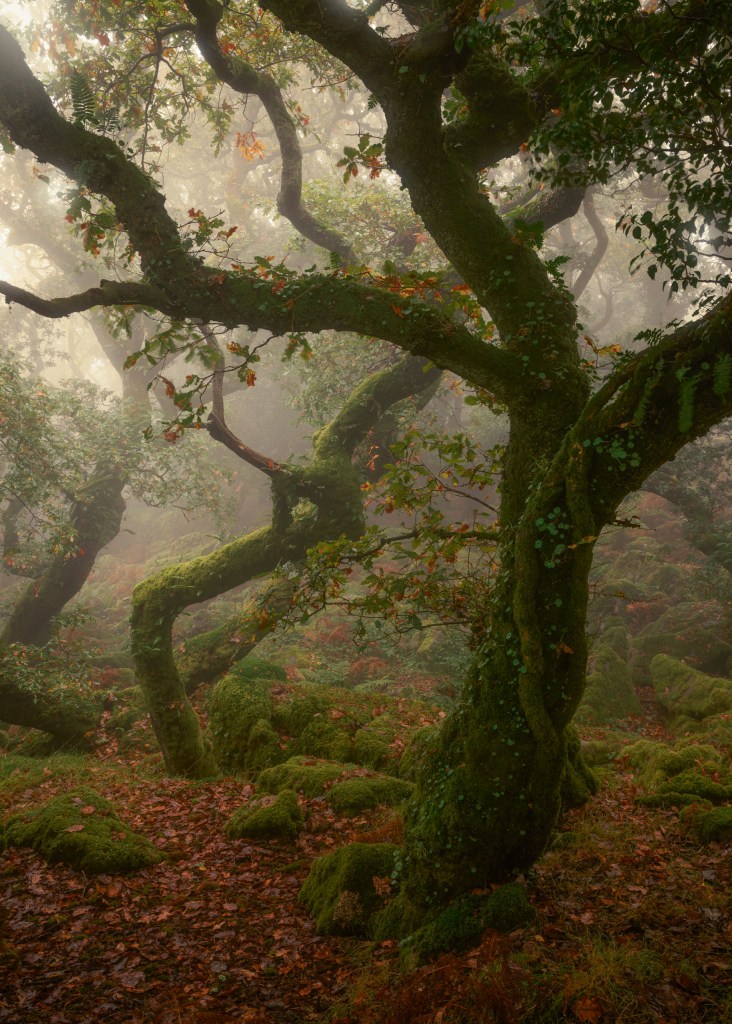
This atmospheric woodland is one of my favourite hidden spots on Dartmoor. While it shares the same ancient, moss-covered, gnarled character as the famous Wistman’s Wood, it is not part of Dartmoor’s official ancient woodlands. I visit many locations across the moor, but this little wood remains a personal favourite. Because so few people know about it, I’ve chosen to keep its exact location secret.
This was one of the first frames I captured that day. Before the shot, I had driven to the moor and then walked into the woodland with this specific composition already in mind. I had scouted the location on a previous visit and had been patiently waiting for the right weather conditions to return.
For me, balance is crucial in woodland photography. Often, it’s more about what you choose to leave out of the frame than what you include. My key decision here was to tightly compose the image to exclude the sky and any distracting elements, creating a more immersive and intimate feel.
The image was shot at f/11, ISO 100, and a shutter speed of around 2 seconds. Fortunately, it was a completely still morning with no wind, which allowed me to use base ISO and achieve maximum sharpness and image quality without needing to raise the ISO or introduce noise.
Framing scenes like this is always the biggest challenge. There’s a constant temptation to include more of the beautiful surroundings, but restraint is essential. The difficulty lies in knowing when to stop and resist over-complicating the composition.
I prefer not to over-explain my images. They mean more to me when viewers bring their own feelings and stories to them. I’d love people to spend time with the photograph and let it create its own narrative in their imagination.
I don’t really believe in luck when it comes to photography. Consistent good results come from time, preparation, and effort — repeatedly returning to a location and knowing your craft.
Be patient, take the time to really learn your craft, and focus on developing your own distinctive style. The best woodland images rarely happen on the first attempt.
Quintin Lake
Quintin Lake is a Cheltenham-based British photographer and former architect specialising in landscape and architectural photography. His work focuses on themes of beauty, geology, and serenity in both commercial and fine art projects. He is arguably best known for, The Perimeter, a five-year, 11,000KM walk around the coast of Britain, documenting his journey through 170,000+ photos. The Perimeter book is published by Hutchinson Heinemann in hardback and eBook, with more of his photos of the British coast on his blog at theperimeter.uk.
Instagram @quintinlake
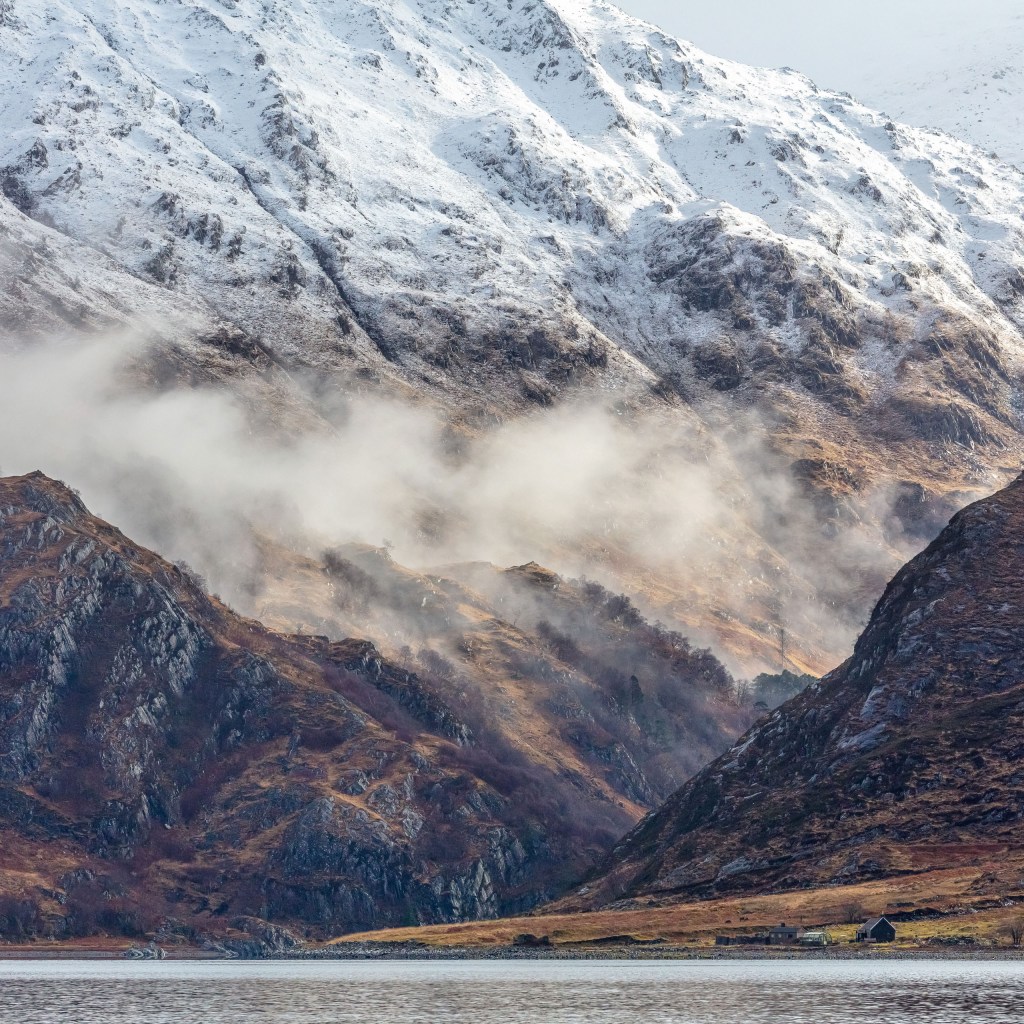
Skiary, Loch Hourn from Knoydart, 2019: On a winter’s day in the north of Knoydart, I wake to alternating rain and snow flurries by Loch Hourn. It’s so cold that I walk quickly not only to cover miles, but simply to stay warm. As I round one headland, a magnificent sight emerges: a tiny, solitary, resilient cottage by the loch shore, above which rises a mountain like a never-ending wall of rock. Its upper half is snow-covered, with the transition at the snow line accentuated by a swirling sheet of mist.
Looking through the viewfinder, a tingle runs up my spine as I capture what I know will be a special photograph. I chose this as my hidden gem because it represents the kind of epic landscape I had no idea existed in the UK when I first set out from London, four years before this moment, on my 11,000km coastal circumnavigation, later documented in my book The Perimeter.
Prior to this moment, I’d been camping for several days in wet and bitterly cold conditions. Knoydart is a true wilderness peninsula in northwest Scotland. The only dwellings are the village of Inverie and the surrounding farms, both accessible only by boat. The route I took on foot involved three days of walking through the aptly named Rough Bounds: a mountainous region of peat bog, cliffs, and remote terrain.
On this particular morning, wind-driven sleet made progress especially difficult, while mist continuously obscured and revealed the view ahead. I was thinking more about getting warm than about photography.
Afterwards, although I was thrilled with the image I had captured, the few minutes I’d spent standing still photographing had left me even colder, so I quickened my pace to Barrisdale bothy, a few miles away, where I knew I could escape the wind and make a brew to warm up.
Framing was the key decision: deciding what to leave out to make the image stronger. I wanted to show a potent fragment of the scene rather than the whole landscape to emphasise texture and scale. If I had zoomed out to include the mountain tops, the image would have appeared more pictorial and less awe-inspiring because the imagination fills in what is cut off, and the contrast of the cottage and the mountain would be less apparent. I spent considerable time manoeuvring from side to side and adjusting focal length to compose the line of mist and ridges so they created an intelligible image. Too much mist and the white would blend into the snow; too little and the sense of place and season would be diminished.
A telephoto focal length of 200mm compressed the perspective, emphasising the relative scale of the mountains behind the cottage. An aperture of f13 ensured optimal sharpness for the deep depth of field I desired, essential for rendering the intricate textures that draw the eye through the image, especially when printed large, my end goal. Because conditions were so windy and light levels were relatively low, I needed a high shutter speed of 1/1000 second and an ISO of 800 to freeze the frame.
The weather was awful—sleet and gale-force winds. I had to remove the camera from my backpack during brief lulls in the weather, work quickly, and use nearby rocks for what little shelter they could provide. Reaching this location had already required three days of self-sufficient backpacking, so the challenge was as much about long-term mental endurance as it was about photography.
For me, the image is about the resilience of humanity against the elemental forces of geological deep time and the natural processes that shape our world. It’s also a celebration of the beauty of Scotland: of how rain and mist are just as integral to the landscape as granite and heather. In this photograph, deep time and transient weather blend, and in that union, landscapes can truly touch the soul – or at least they do for me!
I hope that people will feel that sense of awe and be inspired to make their own journeys of discovery in our wild places.
I believe photographers make their own luck by consistently putting themselves out there, whatever genre they pursue. For me, long-distance walking maximises the time I’m ‘out there’, connected to the landscape, which in turn increases the likelihood of witnessing sublime, fleeting moments when land and weather collide in thrilling ways. Judgement also plays a part, as you need to have committed years to visual study to know when what you are seeing is truly special, and, once recognised, have the technical ability to capture it effectively.
That even after hundreds of days exploring the same subject, in my case, the British coast, there are always rewards waiting if you persevere and keep an open mind. The importance of maintaining the innocence that you haven’t seen it all, and keeping at bay the cynicism that it’s all been done before.
Undertake a multi-day walk somewhere that genuinely interests you, even if you don’t know why yet. Understand that weather shapes the landscape’s mood; while we cannot control it, we can be prepared for the fleeting moments of flux that often create the most powerful images.
Rachael Talibart
Rachael Talibart is an award-winning fine art landscape photographer famous for her dramatic photographs of Britain’s coast. She grew up on the south coast of England in a yachting family and this close connection with the sea informs her work.
Instagram @rachaeltalibart
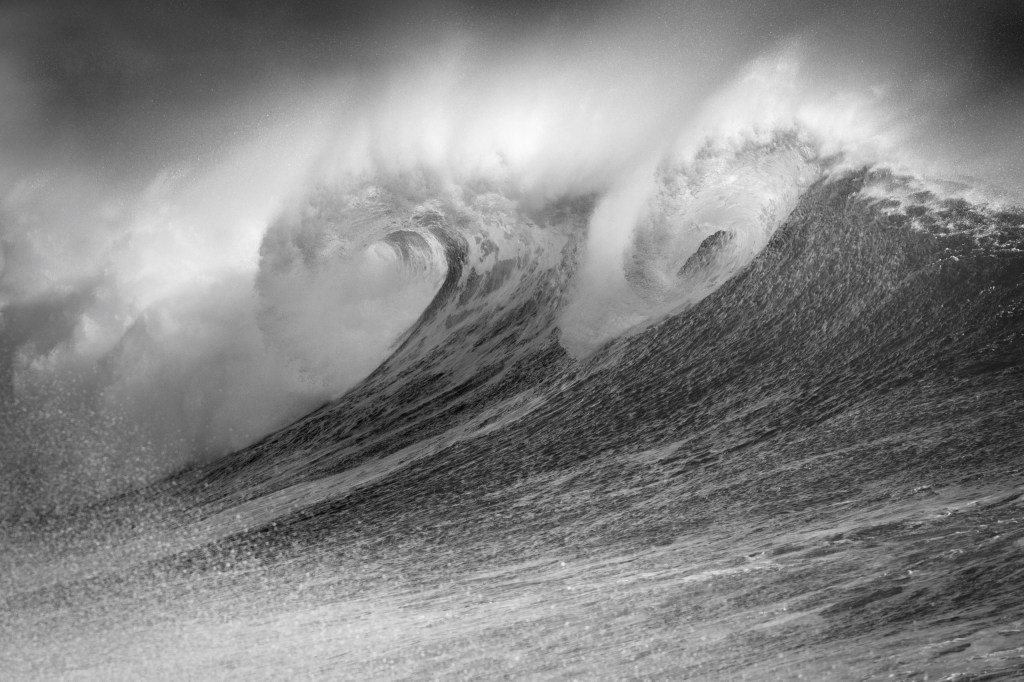
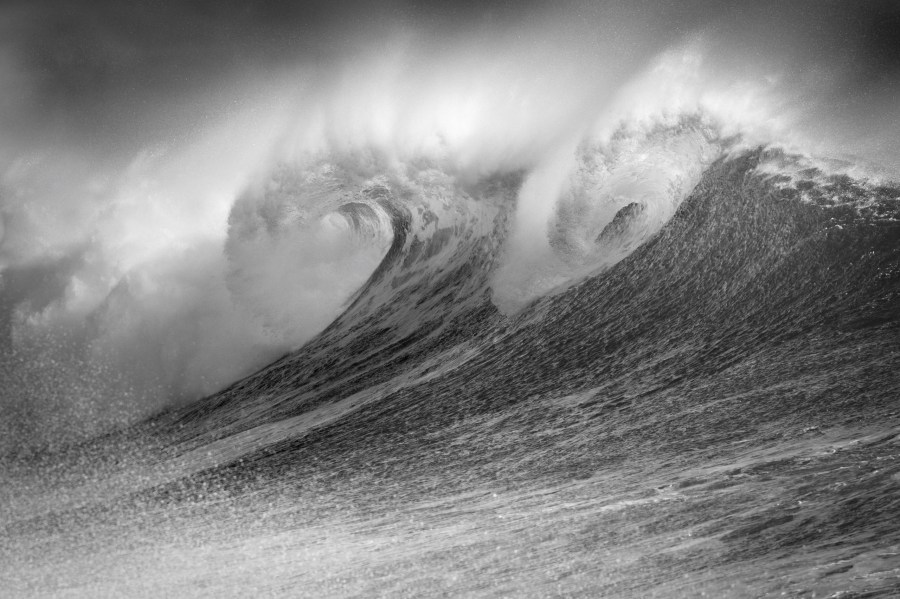
My photograph, ‘Twins’, is a mighty breaking wave from the Cornish coast captured during Storm Eunice in February 2022. I chose it because it was such an amazing moment for me, these two wonderful curls and a beam of light breaking through the clouds just at the right moment. I have built a career on photographing rough seas, chaotic moments when waves intersect. I have tended to overlook classic rolling surf as too obvious, perhaps even too easy, but on this day, I am very glad I changed my outlook.
With fast-shutter wave photography, you have to be willing to press the shutter a lot. So, just before and after this frame, I was photographing more waves. I made about 2000 exposures that day. This sort of photography is more like sports photography – fast reactions are key. Don’t waste time reviewing the photos on the back of the camera, just dig in and get busy!
I suppose the obvious one is making it black and white. I love the elemental timelessness of black and white, and it seemed very right for this photograph. The colour version is too pretty for the mood I was trying to evoke. Another big decision, which is quite typical for me, is to exclude landmarks. I was not trying to document how a particular place looked – it’s all about the sea. Finally, I try not to be too fussy about perfection in wave photography. An element of rawness suits the subject, and I really like the out of focus spray detail in the foreground of ‘Twins’.
360mm (full frame), 1/1250, f/8, ISO 400. With ocean photography, shutter speed is the key choice. I usually try to achieve a shutter speed of at least 1/1000 when taking fast-shutter photographs of the sea. Anything less risks blurring some of the wave and that can look jagged and ugly. f/8 and ISO 400 were the compromise needed to get me the fast shutter speed.
Being somewhere new. I made my career photographing storm waves at Newhaven in East Sussex. I know that beach incredibly well and have an established style that suits it. I know exactly which weather conditions will be right for it, and I know what I want to achieve when I’m there. When the forecast for Storm Eunice came out, the UK’s first red weather warning, I was far away from Newhaven, on holiday with my husband in Cornwall!
I could tell from the forecast that the waves were going to be absolutely amazing at Newhaven. I had to decide whether to cut short our holiday or try to do something where we were. The FOMO was intense! After much agonising, I decided to stay in Cornwall and went instead to Porth Curno beach with my friend, Cornish photographer, Lucie Averill. The waves were indeed completely epic at Newhaven and I missed that, but I am glad I did. The surf and the light were different in Cornwall, I really enjoyed the challenge of adapting to somewhere new, and I captured five portfolio pictures that were very different from my normal storm work. ‘Twins’ is my favourite.
For me, this photograph is an attempt to express the power and the beauty of the ocean. It never ceases to amaze me that our planet is seven tenths ocean, yet we, the dominant species on this planet, are land-dwellers. The ocean is the great unknown – majestic, terrifying, and utterly fascinating. It overwhelms me and fills me with awe, and I hope I have shared something of that feeling in my photograph.
This photograph was a little of both luck and judgement and a lot of very hard work, kneeling or lying on a beach for four hours without a break, holding a heavy DSLR and 100-400mm lens, in a force 10 storm.
I know it’s not exciting advice but be careful! Working in strong storms can be dangerous. Trust your instincts – if you feel unsafe, you probably are. Move back, use a longer focal length, rather than putting yourself at risk. Know the tides, observe the surf before you start working and always be wary of the rogue wave that will be stronger and behave differently from all the others.
Related reading:
- These painterly landscapes will give you some much needed photo inspiration this Spring
- Best smartphones for landscape photography: these are the phones I’d take to stunning locations
- This is the best time of day to photograph landscapes – these magical pictures prove it – Not Quite Light
Follow AP on Facebook, Instagram, YouTube, TikTok, and IRYS.