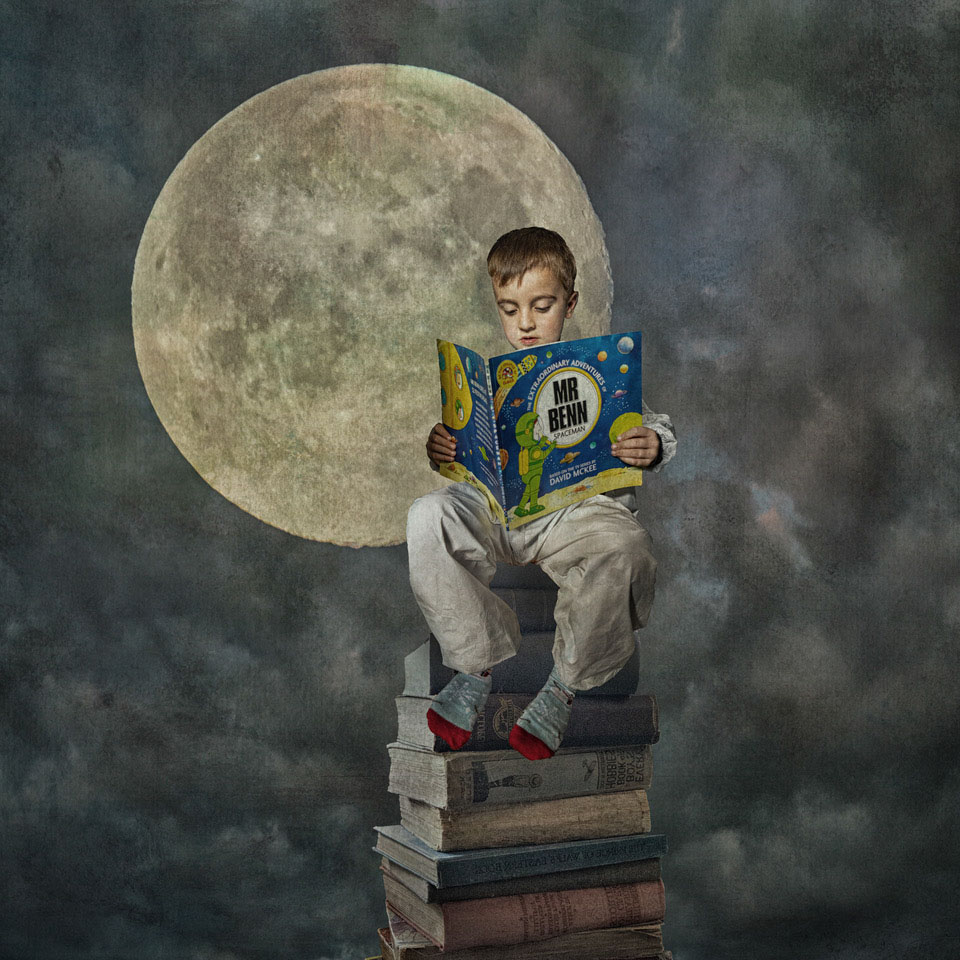
Wendy Irwin has been taking pictures since she was a child when her uncle bought her a Kodak Instamatic. When she retired from her career teaching art and design, she joined a camera club where she learned Photoshop skills and became interested in making composites. Many of her composites feature her grandson, Humphrey, who loves dressing up and going on adventures.
If you were a child in the 1970s in the UK, you will no doubt remember the cartoon series Mr Benn. The concept was pretty straightforward: a man in a bowler hat would enter a costume shop and be greeted ‘as if by magic’ by a shopkeeper. Having selected a costume, he would disappear into the fitting room, put on the clothes and walk through a door that ‘led to adventure’.
Mr Benn was wonderful. It offered excitement, escapism and comfort. One day this businessman was a knight clearing the name of a misunderstood dragon, the next he was a balloonist abandoning a race to assist a fellow contestant. It was Thursday afternoon chicken soup magic.
An idea is born
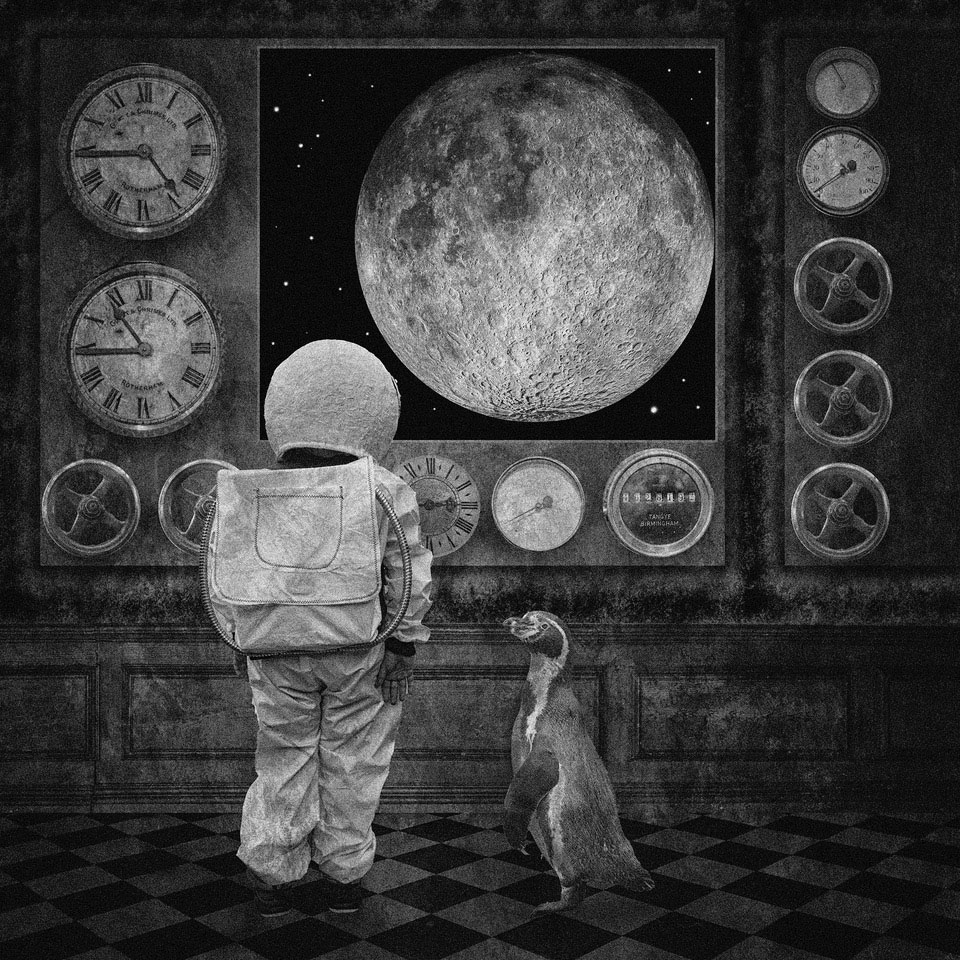
Photographer Wendy Irwin is both a fan of Mr Benn and a fan of adventure. In 2024, she took her grandson, Humphrey, to see Cheadle Moon, a celebration of the life and achievements of astronomer and selenographer Mary Adela Blagg at St Giles the Abbot church in Cheadle. To keep children amused, the organisers had laid out some fancy-dress. ‘Humphrey got dressed up in a spaceman suit,’ recalls Wendy. ‘He loved it so much he wore it around the church posing in front of the moon [an art installation by Luke Jerram] and doing all sorts of movements.’
The first cut
When Wendy got home, she asked her husband if he had any work overalls that she could cut up to make Humphrey a spacesuit of his own. ‘I used to be a textiles teacher,’ she explains, ‘but later on I taught all sorts of things: resistant materials, graphic design etc.’ Having fashioned him a spacesuit, Wendy made Humphrey a helmet out of papier-mâché and a fake cooling system out of old shower tubing. The project soon became a family affair. ‘My daughter designed some badges which I had printed on to fabric and sewed on,’ she reveals.
Get it down
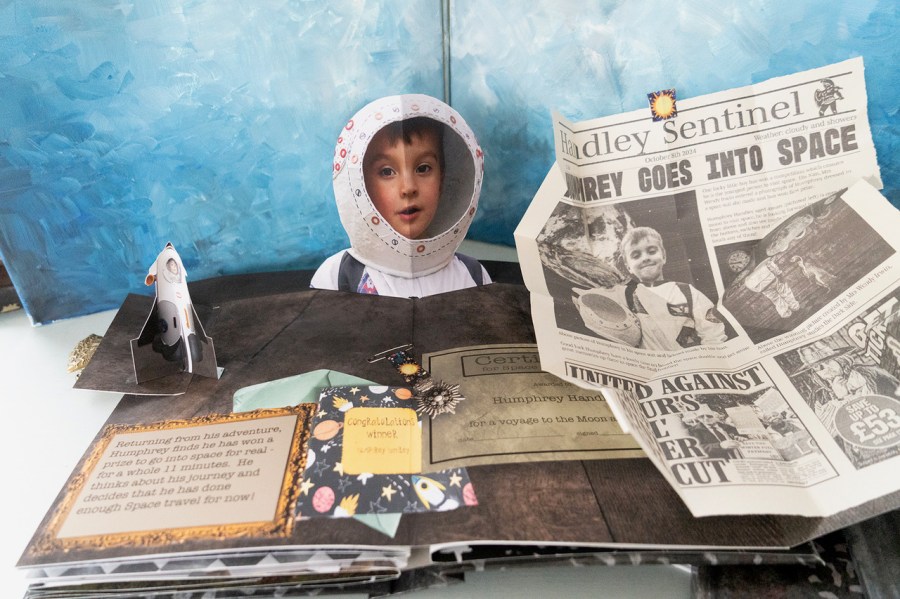
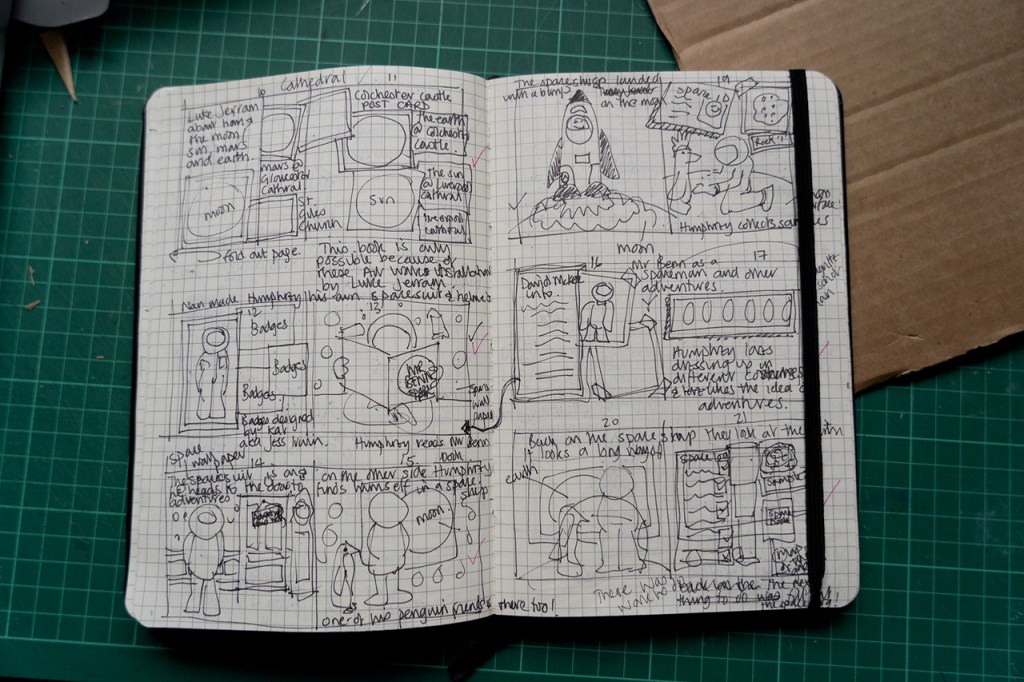
Much to Wendy’s delight, Humphrey adored his new spacesuit. Seeing him all dressed up, she decided it would be fun to make a pop-up book featuring composite images of Humphrey and his adventures as a space explorer. Having taught basic paper engineering at school, she knew it wasn’t going to be easy. ‘I sensed it was going to be a massive project, so I kept putting it off,’ she laughs. To try and anticipate some of the problems, she sketched ideas in a notebook and decided to make a two-dimensional version first. ‘If I get an idea in my head I just try and get it down on paper,’ she says, holding up a journal full of storyboards and crossings out.
Condensing the story
Most pop-up books comprise five or six spreads, so the first challenge for Wendy was dealing with limited space. ‘I had to condense the story so it could be told across just five spreads,’ she recalls. To make the most of each page, she carefully mapped out pop-up elements, fold-out sections and even doors and windows leading to other parts of the book. Using this method, it wasn’t long before key components were settled on. After that, Wendy set about gathering all the elements she needed to tell her story.
Posing and persuasion
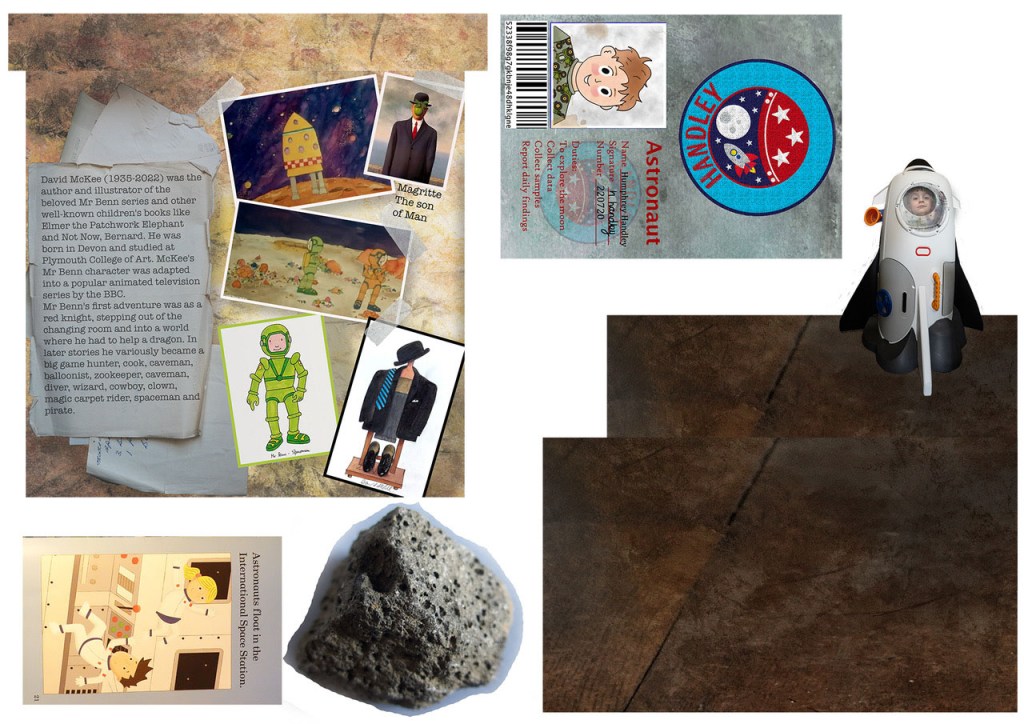
Obviously, images of Humphrey were paramount. ‘He was four at the time so persuading him to get dressed up and do all of the different poses I needed took time and a bit of bribery,’ laughs Wendy. Luckily, Humphrey enjoys being part of the creative process. ‘A few years ago, I made a composite featuring him in a tin bath,’ she recalls. ‘I added a seagull, a fishing rod and a few fish jumping out of the water, and it did really well for me.’
On the odd occasion, Wendy might use AI as a springboard. ‘If I get stuck, I type something in and just see what comes up,’ she says. ‘It makes it easier if you’ve got something to start you off.’ Alongside images of Humphrey in his spacesuit, Wendy took pictures of floors, toys, textures and details of Jerram’s moon installation to use in her composites.
Gathering images
As pop-up elements stand clear of the page, they can be seen from all angles, which presented Wendy with a problem. ‘I didn’t want people to see too much white paper, so I decided to add texture, pattern or something else on the back of each part,’ she explains. But gathering images to decorate these 3D elements proved challenging.
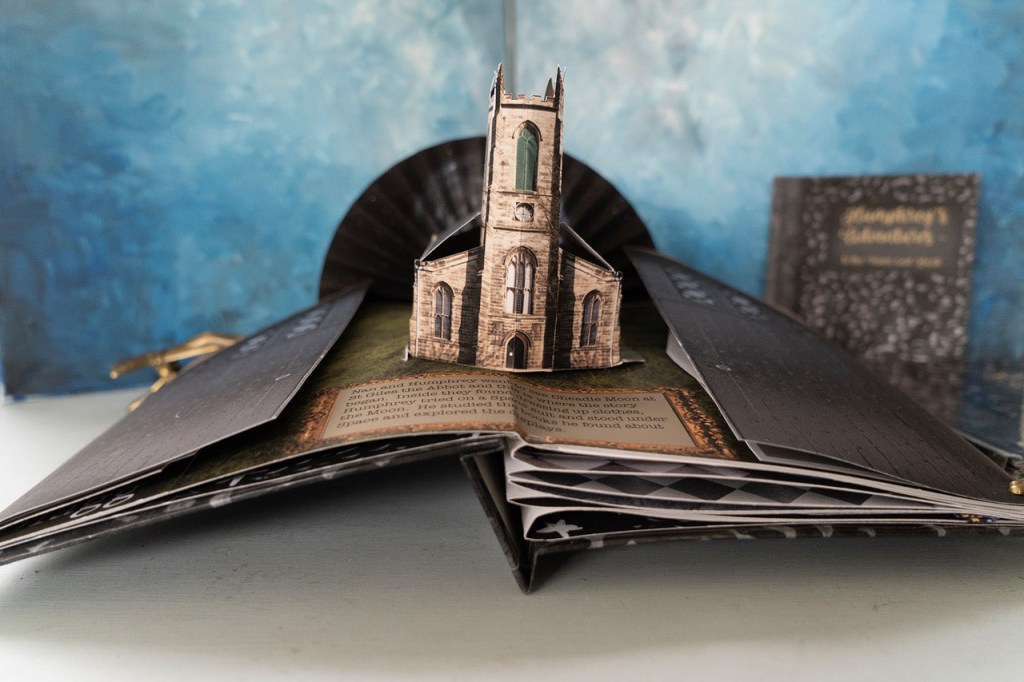
‘St Giles the Abbot church was one of the first things I tackled,’ she recalls. ‘I took pictures of the front, the sides and the tower, but as it stands on a hill, I couldn’t get a shot of the roof!’ As a result, Wendy photographed another church roof of a similar age and used that as a stand-in.
Finding inspiration
When it came to the mechanics, Wendy turned to her favourite pop-up books for inspiration. Paddington Pop-Up London is high on her list, but the work of Jan Pienkowski is hard to beat.
Her online search started with Instagram, where she found the work of pop-up artist Matthew Reinhart. ‘He does some great things with paper,’ she explains. ‘He uses a lot of doors which I took inspiration from.’ To sharpen her skills, Wendy also completed a few online courses. ‘These gave me the confidence to tackle slightly more complicated things,’ she reveals.
Making test models
Wendy made models out of old envelopes and scrap paper to check everything worked before committing herself to the final designs. ‘It’s important to give yourself time to make mistakes,’ she advises.
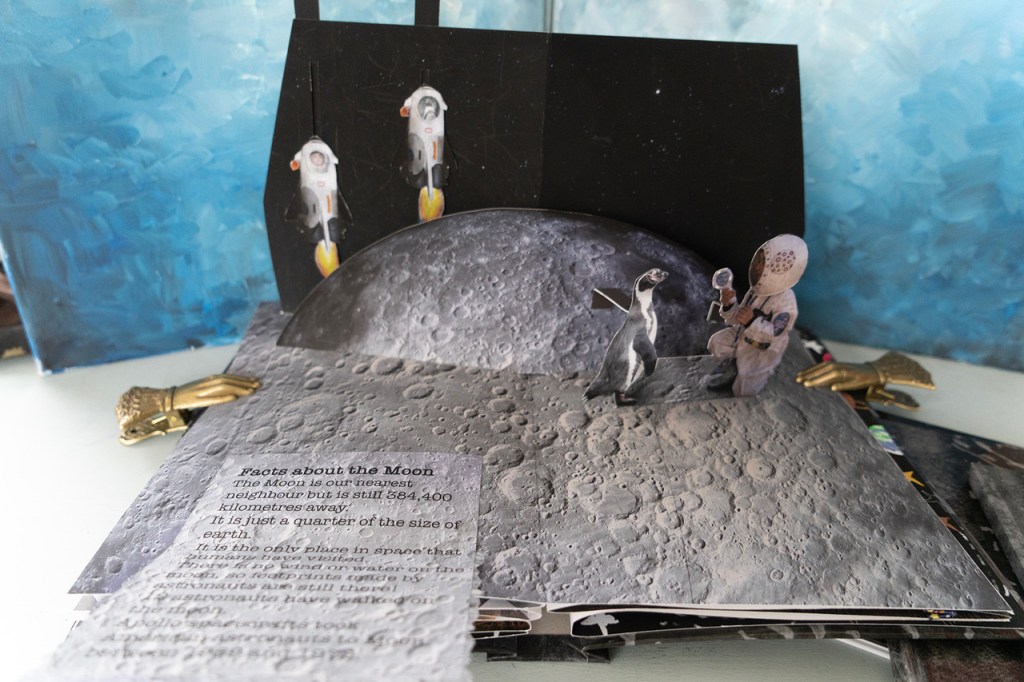
By way of an example, she turns to a spread with a concertina pop-up element, and holds it up to the camera. ‘I made the fan shape and drew a moon on it but when I opened it out the moon was an odd shape,’ she explains, ‘I had to manipulate the design to make sure it stayed circular.’ Most of the composites were created in Photoshop, but Wendy also uses Affinity Publishing for book designs.
Next steps
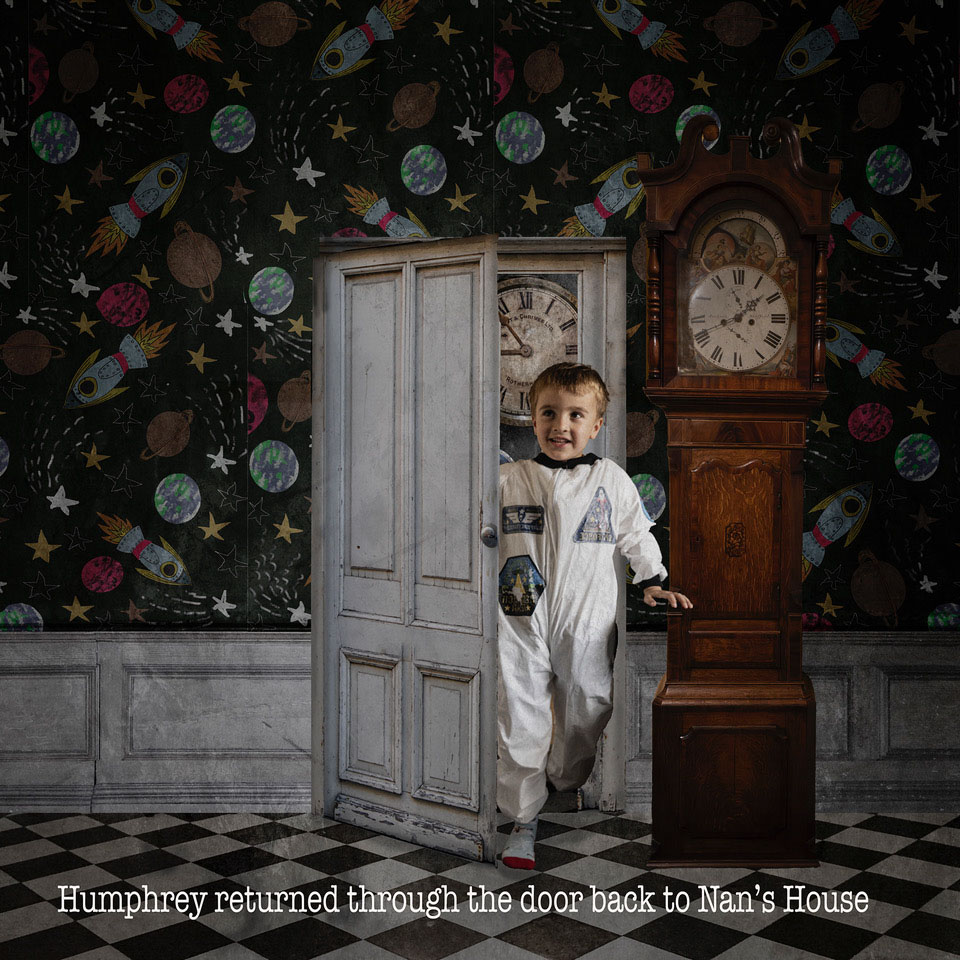
It took Wendy about a year to make both the standard and pop-up versions of Humphrey’s Adventures – to the Moon and Back, but all the cutting, folding and sticking was worth it. Humphrey is delighted that his space adventures have been recorded in 3D, and Wendy has plans for more Mr Benn style tales. ‘I’ve just made Humphrey a chef’s outfit with chequered trousers and a white double-breasted top, so he wants me to make a book with him as chef,’ she smiles. As if by magic, Wendy will make it happen.
Wendy’s tips for successful pop-up photo books
- Keep a sketchbook – Use a sketchbook to storyboard ideas. It doesn’t matter if you can draw or not, just get your ideas out of your head and onto the paper. Cross things out, add things in, experiment. These sketchbooks will develop and change over the course of your project.
- Do your research – Look at other pop-up books for inspiration – Wendy’s favourites include Paddington Pop-Up London, Jan Pienkowski’s Dinner Time and Haunted House. She also turned to Instagram for ideas, where she found the work of Matthew Reinhart, among others.
- Condense the story – For a pop-up book you need to be able to tell the story in just five or six spreads, so think carefully about what’s going to go on each page before you start. Wendy found it useful to make paper models to try things out before committing herself.
- Cover all sides – Pop-up elements can often be seen from all sides, so make sure you have plenty of pictures to cover the back, front and sides of anything you show in three-dimensions.
- Look at surfaces – You never know when you’ll need a patch of grass, piece of wallpaper or section of flooring for a composite, so take plenty of detail shots. Wendy often creates her own textured layers to use in composites.
- Give yourself time – Pop-up books require a lot of problem-solving. Remember that any pop-up elements need to fold inside the book without sticking out of the sides. If it gets too much, put the project aside for a while and come back to it.
Related Reading:
- You’ve never seen street photography like this before
- These gloriously colourful images of Route 66 celebrate 100 years of an American icon
- Family portrait photography tips
Follow AP on Facebook, Instagram, YouTube and TikTok.