Today is a special day – it’s the first time I have ever used ChatGPT. There are lots of AI-related things I haven’t tried, however, so losing my ChatGPT cherry is not that interesting in itself.
Rather, I wanted to see how it can help me as a photographer. What will I discover? Will it come back with lame, one-size-fits-all advice on improving my pictures, like ‘you need to stick to the rule of thirds,’ or will ChatGPT prove to be really useful? Let’s find out…
I went for the free version of ChatGPT, which is available for both iPhone and Android; you can get a more sophisticated version for $20 a month which will generate images for you, but this is less appealing to me.
If it’s anything like Adobe’s more sketchy AI creations, the results will either look like something from a cheap Hallmark greetings card, or my phone will suddenly be invaded by plasticky looking people with dead eyes and questionable hands (see my previous post where I compare myself to ‘replicant hunter’ Rick Deckard from Blade Runner).
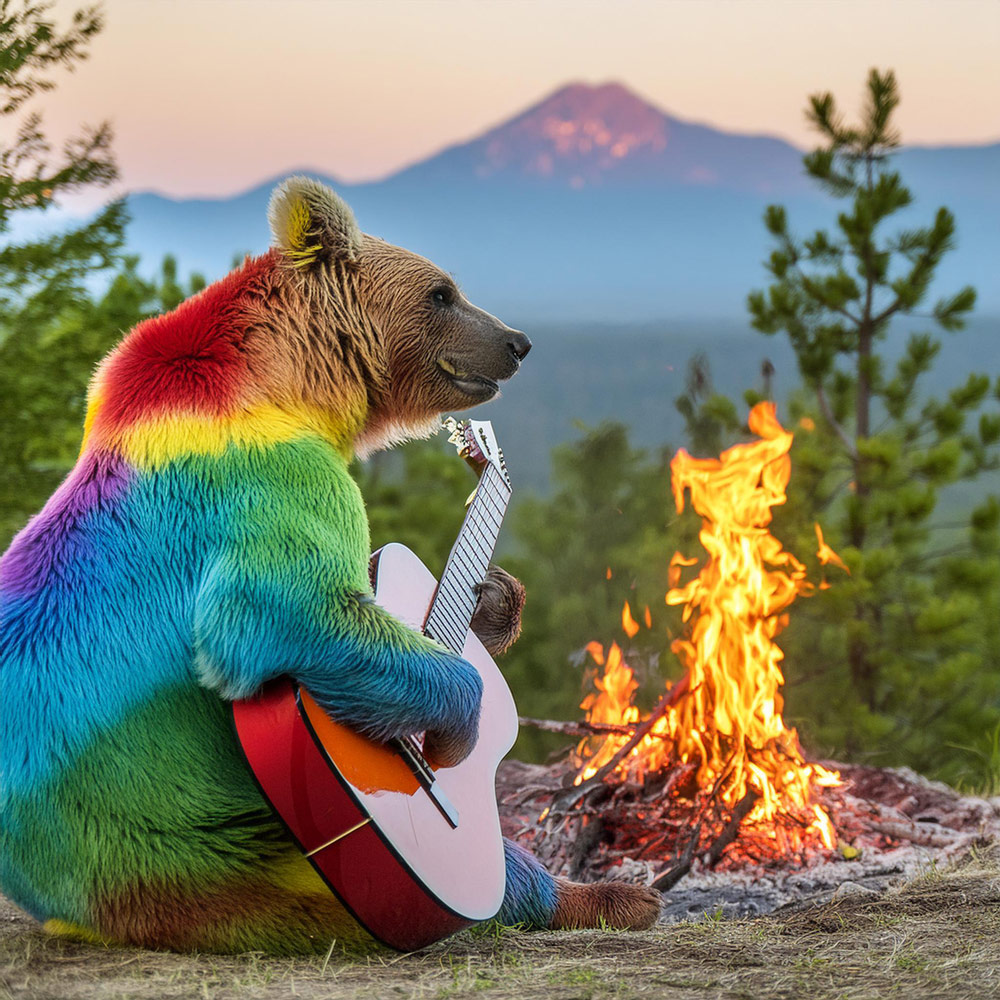
Image analysis
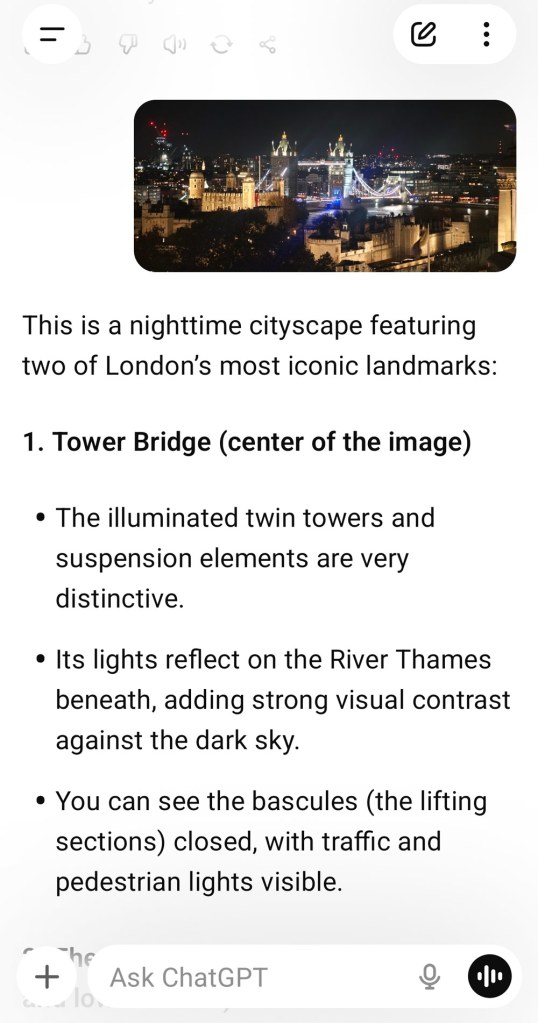
So the first thing I tried was getting Chat GPT to analyse one of my pictures, in this case a straightforward phone shot of Tower Bride in London. The first thing that surprised and impressed me was the speed of response.
I felt like a man from the 15th century seeing a train for the first time as ChatGPT rattled off a very accurate description in no time. I even learnt what bascules were. Cool!
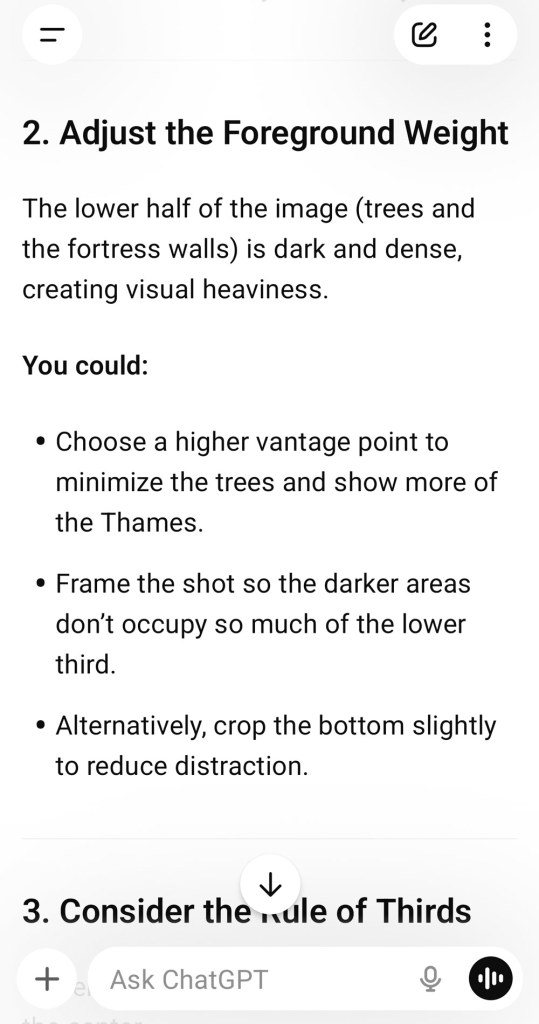
Intrigued, I then asked how the composition could be improved. ChatGPT was very polite with its suggestions – ‘none of these are necessary – your photo already has strong elements – but they can help refine it.’
It then came up with some useful advice, particularly for improving the foreground. All fair enough, but then it lost some cool points by coming up with that old chestnut, ‘Consider the rule of thirds.’ But generally impressive, and all feedback is good feedback in my book.
Now, my Tower Bridge picture was nothing special, but what would ChatGPT say about a truly iconic photograph? I decided to try it with one of my favourite images, in this case Hyères, France, by the god-like genius that was Henri Cartier Bresson. Surely, ChatGPT wouldn’t find much to improve with this masterpiece?
Actually, it found a lot to improve, as you can see below. Some of the points are kind of relevant, but the last suggestion would have HCB turning in his grave: “I can also suggest specific edit steps (eg Lightroom adjustments) or alternative compositions you could try…’ On yer bike, ChatGPT!
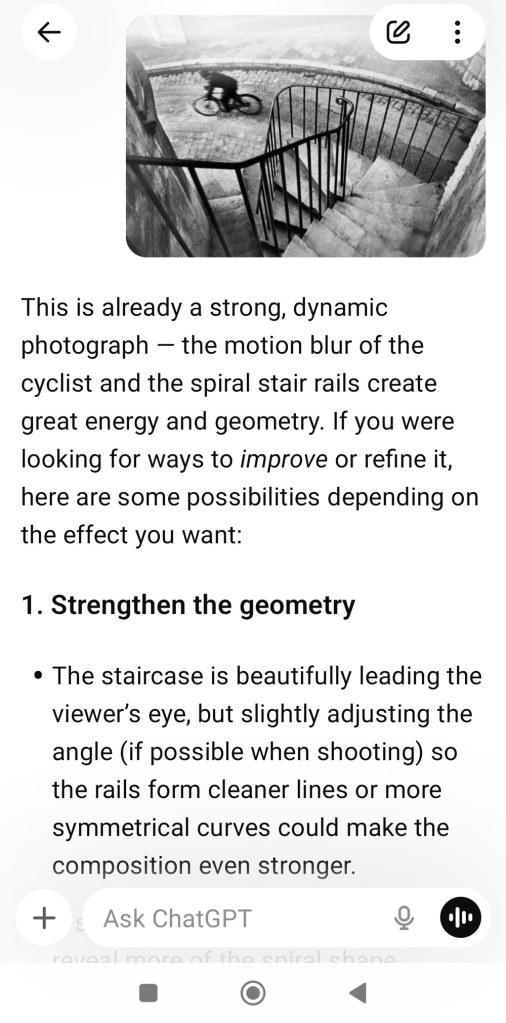
It sounded a bit sacrilegious but I decided to put ChatGPT to the test and ask it to suggest an alternative composition. Here’s where I ran into a snag. ChatGPT told me lots of people were generating images at the moment so I’d have to wait until the ‘system finished rendering it.’
After an hour of finger-drumming I gave up – i might try again at 2am in the morning or something but this appears to be quite a big drawback with the free version of the app.
Annoying waits aside, there is no doubt that ChatGPT has its uses for objective image analysis.
As Phil Broek, the chairperson of the Focus on Photography camera club in Wells, Somerset, UK notes: ‘we use AI to critique images from members, and then we discuss the critique in the meeting to decide what it got right or wrong. It’s all done with the express knowledge of the photographer and it allows us as a club to offer constructive feedback at arms length, helping to ‘depersonalise’ it somewhat.’
Wedding and landscape suggestions
Next, I tried an easier task, and one which I am very familiar with – how to prepare to photograph a wedding. As with my image critique, the answers were insightful and sensible. Some of it was pretty obvious – Meet with the Couple and Scout the Location, for example – but I was impressed with the camera gear suggestions.
A 24-70mm lens, a 70-200mm and a fast portrait prime is exactly what I use for weddings, so ChatGPT definitely came up with the goods here.
Of course there are some trade secrets that you only learn from experience – allocating a guest to help you get all the family groups together in the post-service mayhem, for instance – but ChatGPT’s broader suggestions would definitely be useful to a novice wedding photographer who needs advice quickly.
I also decide to pit myself against ChatGPT by comparing its recommendations ‘for the best places to photograph Glastonbury Tor in Somerset, England,’ with my own experience. The answer was lengthy, accurate and comprehensive and you get the added bonus of free tips for photographing the Tor.
Spot the camera
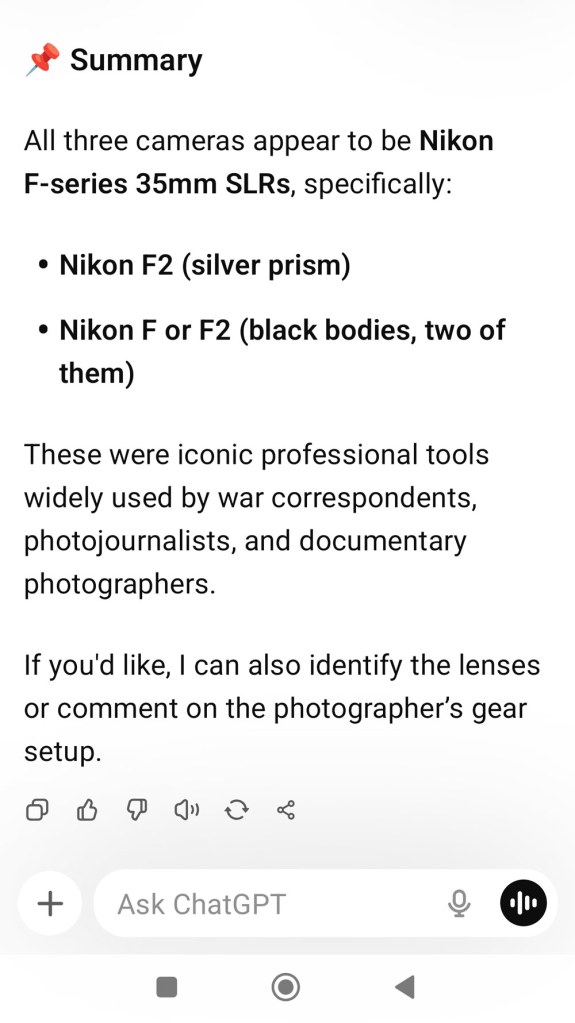
A friend mentioned that ChatGPT was useful for spotting what cameras appear in a particular photograph or video. So being a camera and movie nerd, I wanted to see if ChatGPT would be able to identify the gear hanging around the neck of Dennis Hopper’s famously wigged-out photojournalist in Apocalypse Now.
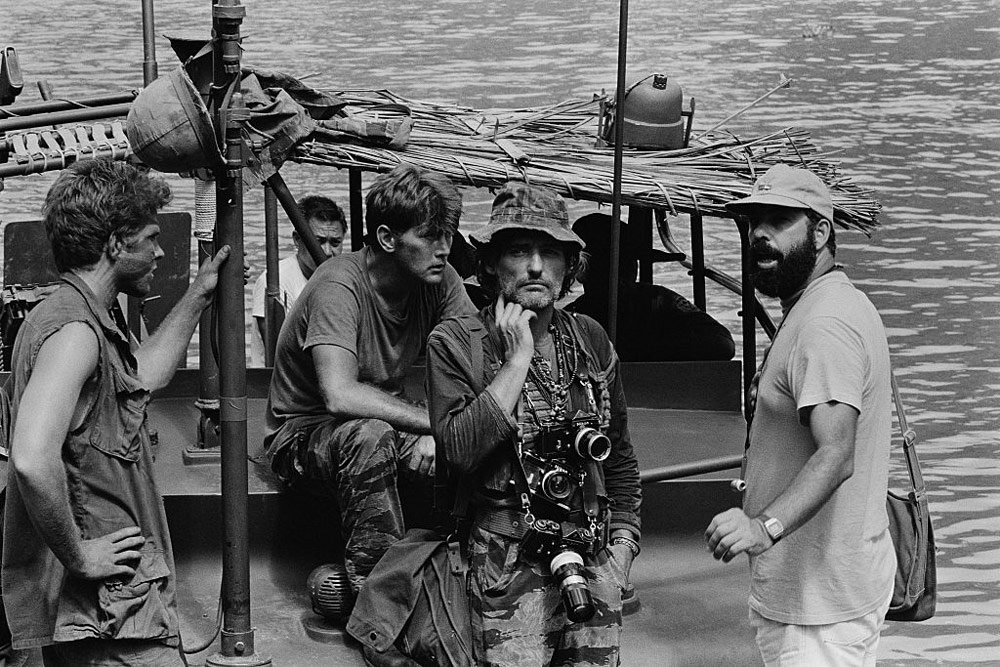
Again, the results came back quickly and were impressive in their detail.
ChatGPT – is it for me?
Well, yes, with some caveats. ChatGPT is definitely handy for coming up with suggestions for improving the composition and impact of an image, coming up with ideas for how to shoot an event or landmark, or identifying equipment used by your favourite pro photographers for example (or iconic shooters from the past).
That said, you need to remember that most photography is essentially an art form, so asking ChatGPT for feedback on an image needs to be approached with care.
Judging an image will always be a subjective process, after all. Whizz-bang computers and AI sorcery can never replace the human eye (yet), which is why no big photographic competition worth its salt would ever sack the judging panel and bring in ChatGPT instead.
Also, unless you get the timing right, asking ChatGPT for an alternative take on the composition of an image is painfully slow – comparable to spending the afternoon trying to get through to your bank’s call centre.
Really, who can be bothered when there are plenty of wise and experienced photographers out there who can comment on your image and see it in its proper context?
Generally though, I am impressed with how ChatGPT can be of service to photographers, whether you use a conventional camera or a phone. And there are lots of other possible uses too, such as asking it to help you draft a marketing plan for your new photography business, or even translate an interview with your favourite Japanese photographer.