The internet is full of people trying to find the “holy grail” of a digital camera that gives you “film like” images – but were film photos really that good? Short answer: no, not in all the ways that we judge image quality today. The internet says that for real “vintage” digital and “film look” images you should buy a camera with a CCD sensor… it seems to be a widely believed myth.
Yet when I try and find evidence of CCD cameras being “better” than CMOS cameras, I can’t find any…
I’ve watched numerous videos on YouTube, and they repeatedly say “CMOS is actually better” (E500 vs OM10-III), “the camera/brand makes more difference, rather than CCD vs CMOS” (MPB), “CMOS has lower noise” (Bill Lawson), “CMOS colours look better” (Uncertain release), but maybe if you look hard enough, you might be able to find videos saying the opposite.
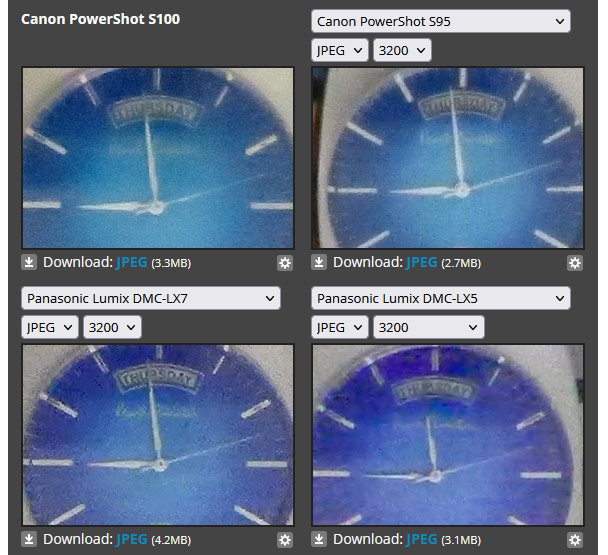
I lived through the transition from CCD cameras to CMOS cameras, reviewing almost every compact camera model, and there were clear advantages to the new generation of CMOS sensor cameras (at the time). This includes noticeably lower noise (for example, ISO3200 became usable on the Panasonic Lumix LX7 compared to unusable on the CCD based LX5 – it was the same with the switch-over from CCD to CMOS for the Canon Powershot S95 and S100 – easily compared on sites with databases like dpreview: example here and below).
Other advantages to CMOS include faster readout speeds (and better/higher resolution video, FullHD video became the norm compared to 720p or worse), improved battery life, and ever improving dynamic range year on year.
And by simple deduction, that means that CCD cameras have more noise, and worse dynamic range. This also has a knock-on effect on colour reproduction – the more noise in an image – the less accurate the colour is (all things being equal).
And this ‘all things being equal’ is where the path to madness begins…
Camera companies didn’t release the exact same cameras, one with a CMOS sensor, and another with a CCD sensor, and even if they did, they’re going to adjust and tweak the output to get the best out of the camera’s sensor.
Without going down the rabbit hole further, but ever so slightly touching on it, at high ISOs, CMOS sensors do give better results, but what if you only shoot photos in bright light at the lowest ISO speeds? Well, here the dynamic range of newer cameras will give better results, but if you’re looking for worse results, then sure buy any old camera and see for yourself what you get…
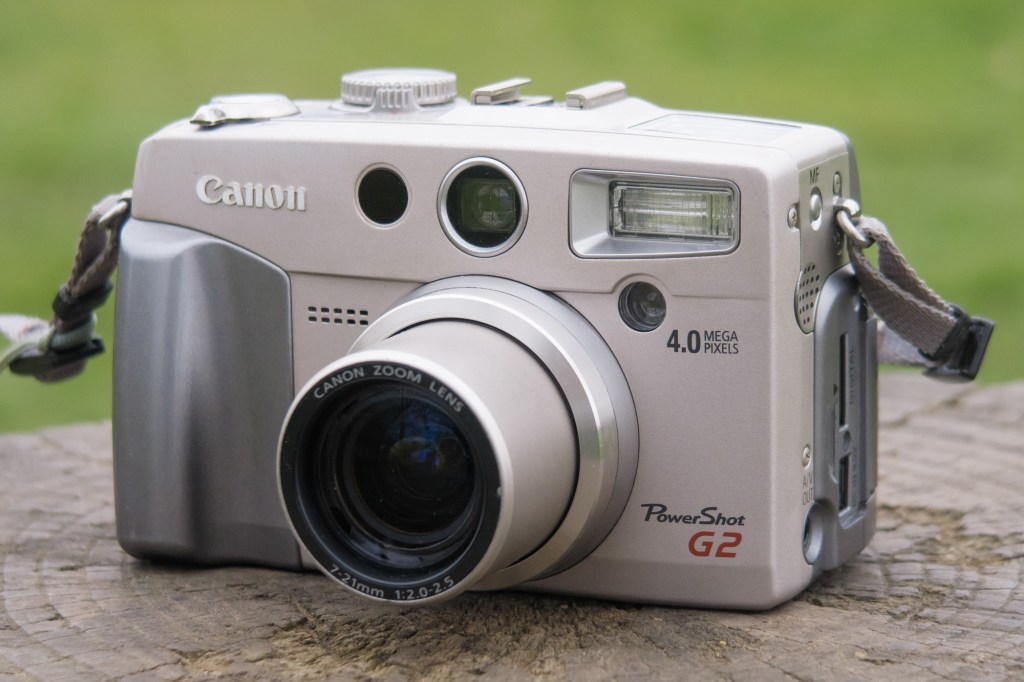
I’ve written about vintage digital cameras, and I enjoy using them as much as the next person, but within limits, there are certain situations where I wouldn’t use an old digital camera, for example for low-light shots, unless I was prepared to use flash. In fact, on a recent trip to London, I used an old Sony Cyber-shot L1, and took roughly 30 photos, only 3-4 of those would be one’s I’d be happy to share.
Rather than choose a camera based on the sensor, there’s something much more important at play… and that’s colour reproduction…
So rather than choose a CCD camera over a CMOS camera, I’d much rather choose a compact digicam based on brand, such as an Olympus, Canon, Fujifilm or Nikon camera over a Panasonic, Sony, Samsung or Casio… which is worth noting, the former companies listed have a history of making film cameras. And if you’re going to be shooting JPEG, then why not simply choose the camera with the best JPEG output?
Related reading
- Vintage digital cameras you should actually buy
- Why does everyone love CCD sensor cameras so much?
- The Worst Digital Cameras Ever Released
Also worth a watch: “CCD digicams are nothing like film” No, You Don’t Want a CCD Digicam, the REAL magic of CCD cameras (no, they don’t take film photos).
The views expressed in this column are not necessarily those of Amateur Photographer magazine or Kelsey Media Limited. If you have an opinion you’d like to share on this topic, or any other photography related subject, email: [email protected]
Follow AP on Facebook, Instagram, YouTube and TikTok