Question: What was the first 35mm single lens reflex (SLR) camera? Designed to sit at the heart of a system that included several cameras, nearly 50 lenses of varying focal lengths, two motor drives, extension rings for close-up photography, bellows for macrophotography, interchangeable focusing screens, a choice of four viewfinders and a bulk film back. If you are leaping to your buzzer and shouting ‘Nikon F’, stand aside. Because six years before the Nikon emerged from Japan, another camera whose system included all of the above and more was produced in East Germany. It was aimed at professional photographers who wanted the versatility of a 35mm SLR with the flexibility that comes with having a comprehensive system behind it. Enter the Praktina.
Kamera-Werkstätten Guthe and Thorsch, more usually known simply as KW, was founded in Dresden in 1909 by camera repairer Paul Guthe and entrepreneur Benno Thorsch. For nearly a century, the company underwent numerous changes of ownership, mergers and names culminating in its playing a major role within VEB Pentagon. During that time, production included plate and sheet film folding cameras, medium format roll film reflexes, an unusual folding twin lens reflex and several ground-breaking 35mm SLRs. Of these, the Praktica became the name destined to evolve and gain fame in the 35mm SLR world all the way through to the early 21st century. Unfortunately the Praktica name has overshadowed the now largely forgotten Praktina.
Praktina FX
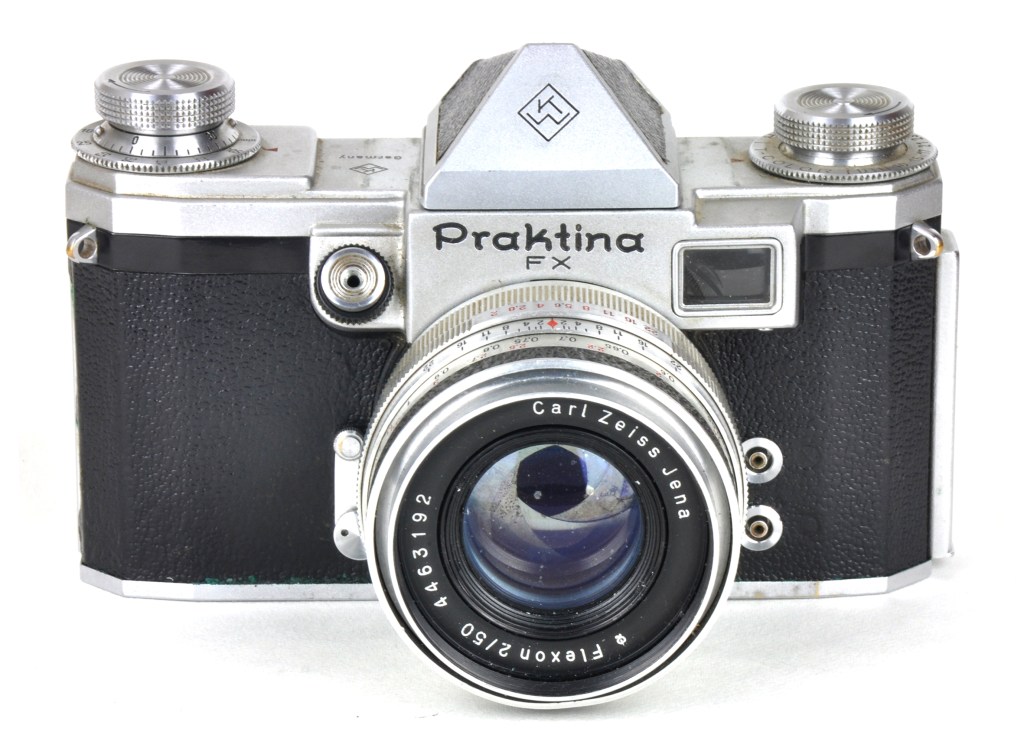
The Praktina legend began in 1946 when a young camera designer named Siegfried Böhm, aged only 24, transferred from Zeiss Ikon to KW. Initially his brief was to design an improved version of the Praktiflex, which was the company’s then current SLR. But Böhm had other ideas. He wanted to produce a completely new kind of 35mm SLR and, by 1950, he had a team of about 30 involved in the design of the camera and the numerous accessories that he also visualised. The dream became a reality when a prototype of the Praktina was shown at Photokina, the big German trade fair, in 1952. It came to the market in 1953 as the Praktina FX.
The camera is a solidly built 35mm SLR with a horizontally-moving, cloth focal plane shutter whose speeds run in a way that was common at the time, but unusual today: 1, 2, 5, 10, 25, 50, 75, 100, 200, 500, 1,000. These are set by a ring around the film advance knob and released by an angled button on the front of the body. On the opposite end of the top plate, the rewind knob is surrounded by another ring of numbers that rotates to act as a film speed reminder. Beside the lens, a lever sets a self-timer. Twin flash sockets offer electronic or flashbulb synchronisation. The reflex mirror drops into place as the film is wound but does not return automatically after exposure.
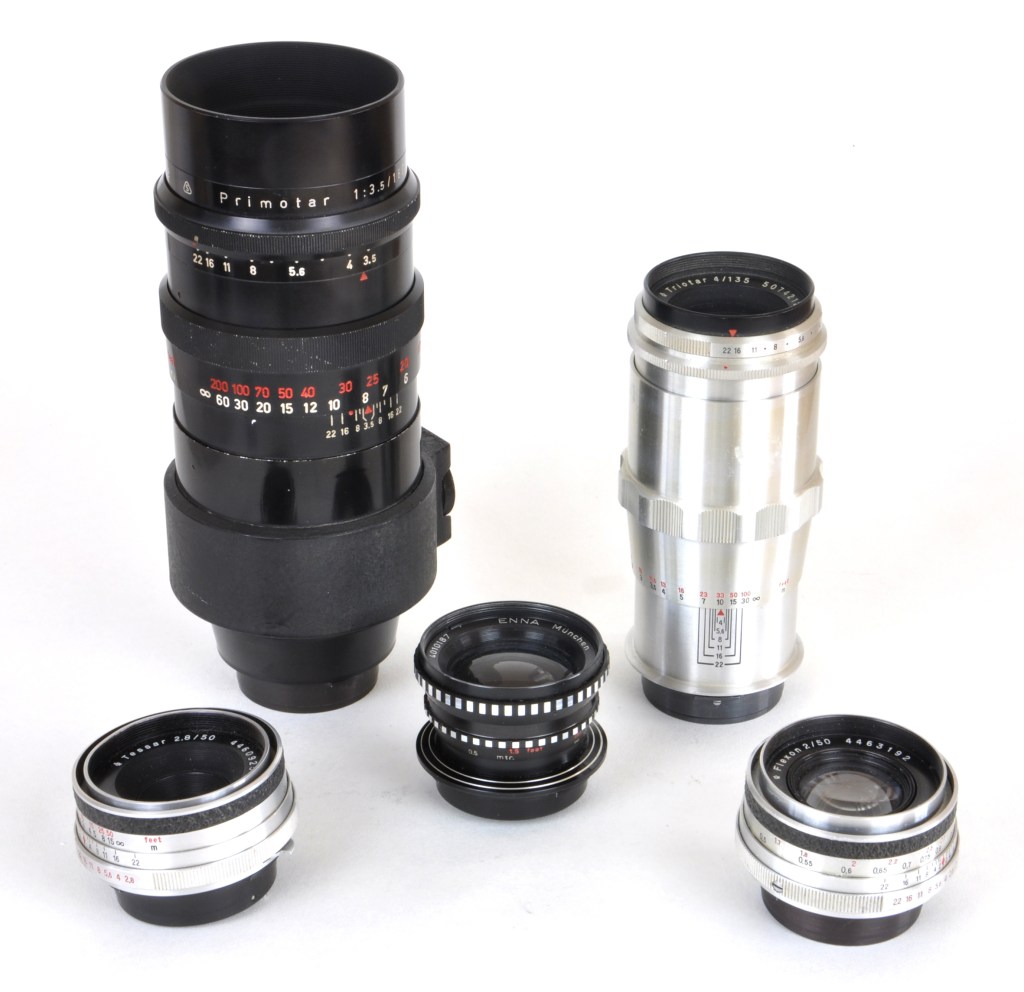
Lenses for the Praktina were made by top names that included Carl Zeiss, Meyer-Optik, Angenieux, Isco, Kilfitt, Schneider and Steinheil. Standard lenses include a 58mm f/2 Biotar, 55mm f/1.9 Steinheil Quinon and 50mm f/2.8 Tessar. Other focal lengths range from from 24mm wide-angle to 1,000mm super telephoto, and even include an Enna-Werk 85-250mm Tele-Zoom that was extremely rare for its day. Manual lenses require the aperture to be set prior to exposure, which obviously darkens the viewfinder. This contingency is catered for by a separate direct vision viewfinder that sits beside the reflex finder.
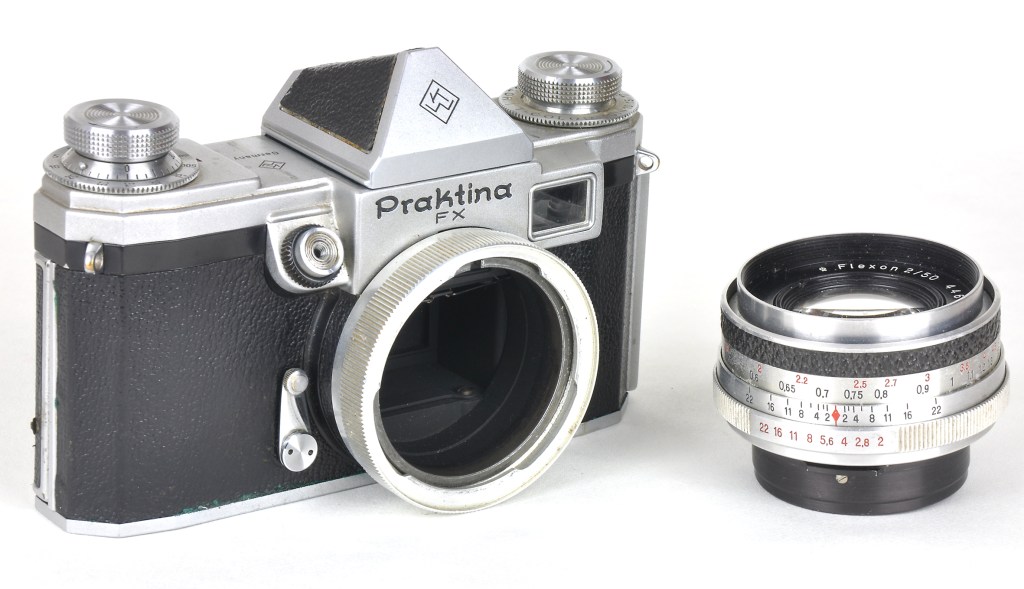
All lenses fit to the body by a breachlock system, which was unusual in its time. Instead of a screw or bayonet mount, the lens is placed in position and a ring on the camera body rotated until it is tight. The design ensures that neither body or lens become worn however many times lenses are attached or removed, as can be the case with more conventional bayonet mounts. The system was later taken up by other camera manufacturers, most notably by Canon with its FL and FD lenses.
There were a couple of variations of the Praktina FX with only minor improvements, but better was yet to come.
Praktina IIa
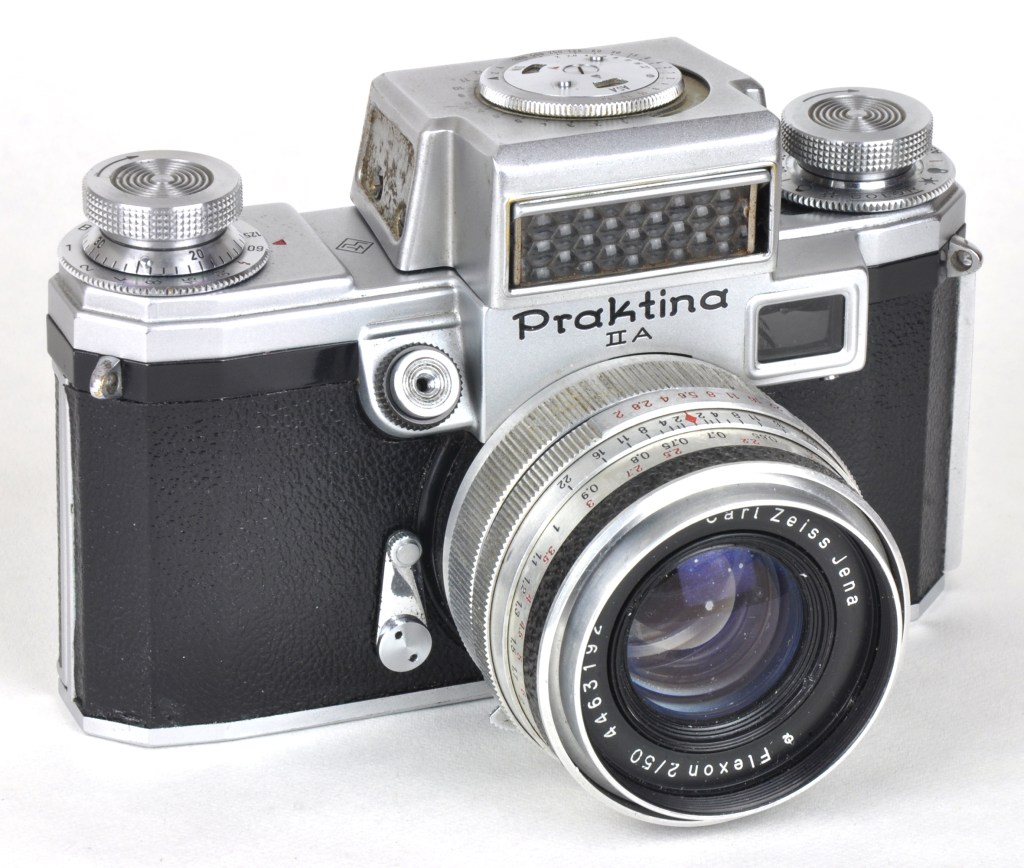
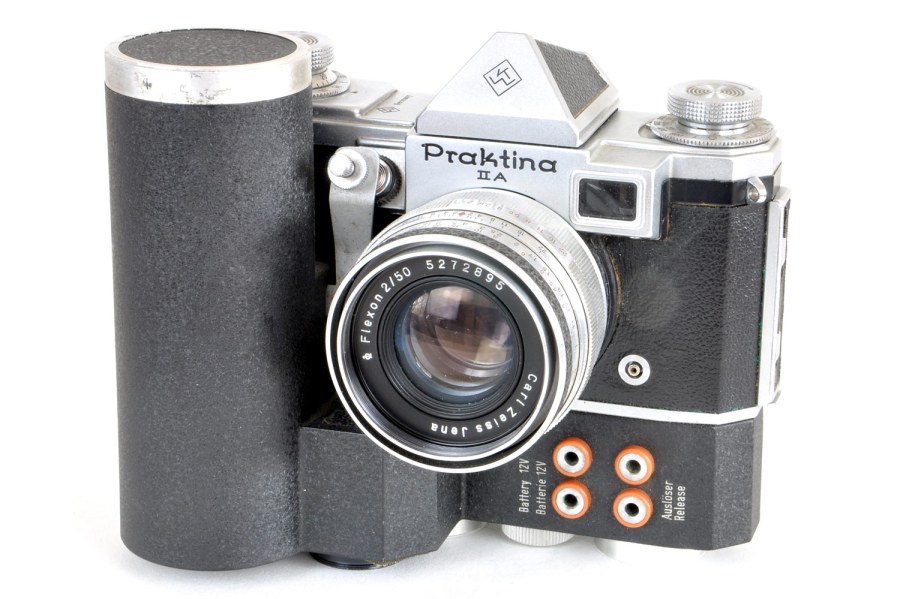
In 1958 KW introduced the Praktina IIa. Its design is very similar to the original camera, but the shutter speed range now follows the more conventional geometric pattern: 1, 2, 4, 8, 15, 30, 60, 125, 250, 500, 1,000. The IIa was launched with what was then a new range of lenses that offer fully automatic aperture control. This allows focusing at full aperture, with a mechanism that stops the iris down to the required setting as the shutter is released. Three forms of flash synchronisation from a single socket are selected by a lever beneath the rewind knob. Four versions of the camera were available with very minor differences.
Viewfinders and focusing screens
With the launch of the Praktina IIa, KW also released a full set of accessories for use with both the IIa and the FX, including an impressive metered viewfinder that sat alongside three other non-metered types.
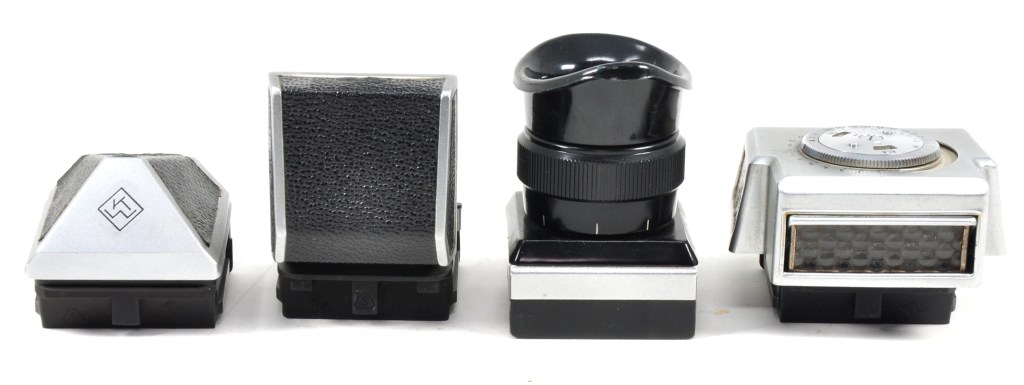
Removing and attaching the Praktina’s interchangeable viewfinders is a difficult task for the unwary because they appear to be permanently fixed with no sign of a button or lever in their vicinity to release them. In fact, it’s necessary to search beneath the lens, where a small catch is pushed sideways, at which point the finder slips easily off. The most popular viewfinder, usually supplied with the camera, is an eye-level pentaprism type. Next comes a waist-level finder with a flip-up hood and a magnifier that folds forward over the focusing screen. Also available is a high-magnification viewfinder that magnifies the image by six times when the screen is viewed with the eye close to the eyepiece of a chimney-like tube. This viewfinder is favoured for shooting close-ups with bellows or extension rings. The best of the viewfinders is the metered version incorporating an exposure meter with a selenium cell on the front to activate a needle on the top. Numbers indicated by the needle are set on a dial which then indicates the required shutter speed and aperture to be manually set on the camera. A right-angled viewing attachment also fits the eye-level finders.
The view though any of the viewfinders varies according to the focusing screen in use. Six are available: straightforward matte, matte with split-image rangefinder, matte showing vertical and horizontal lines, matte with a crosshair in a clear glass centre circle, matte with cross centre lines and millimetre scales, clear glass with cross centre vertical and horizontal lines.
Film advance and motor drives
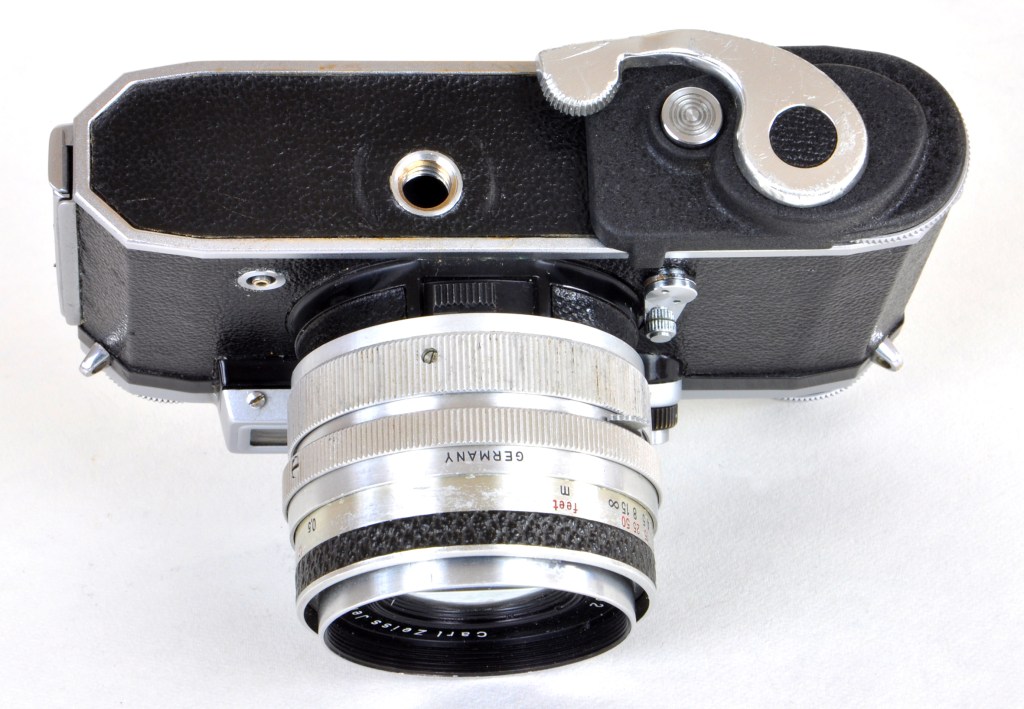
Although film is advanced on both the Praktina models with a knob on the top plate, a special coupling socket on the base of the body allows for other options. The first is a neat little lever that screws in place and converts the camera to lever film wind. Two motor drives can also be used, fitted by screwing into the coupling socket, along with a second screw into the camera’s tripod bush to keep everything tight and secure. Each one incorporates a button on an arm that hovers over the camera’s shutter release. Pressing the button on the drive fires the shutter and activates the motor to wind the film.
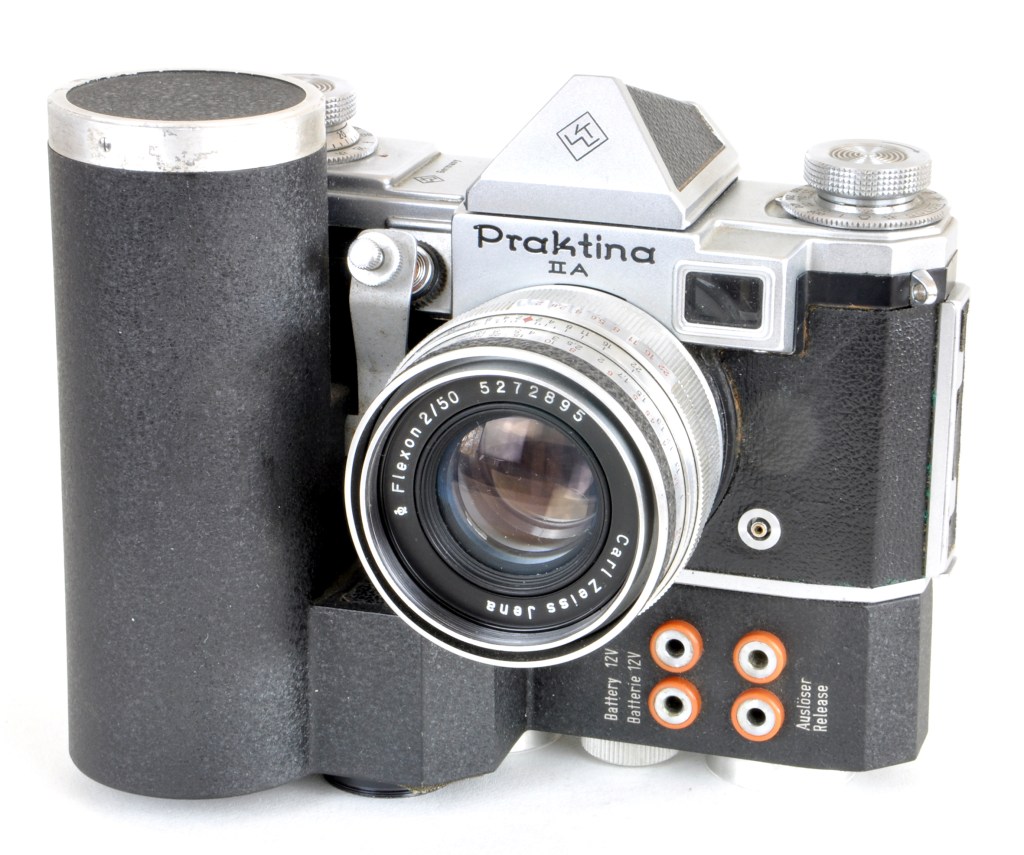
The first motor drive is clockwork, wound by a huge knob on the base. Fully wound, it allows ten pictures to be taken in succession. The second motor drive is battery driven. It can be used in conjunction with cables for remote control from up to 80 feet away.
Bulk film back
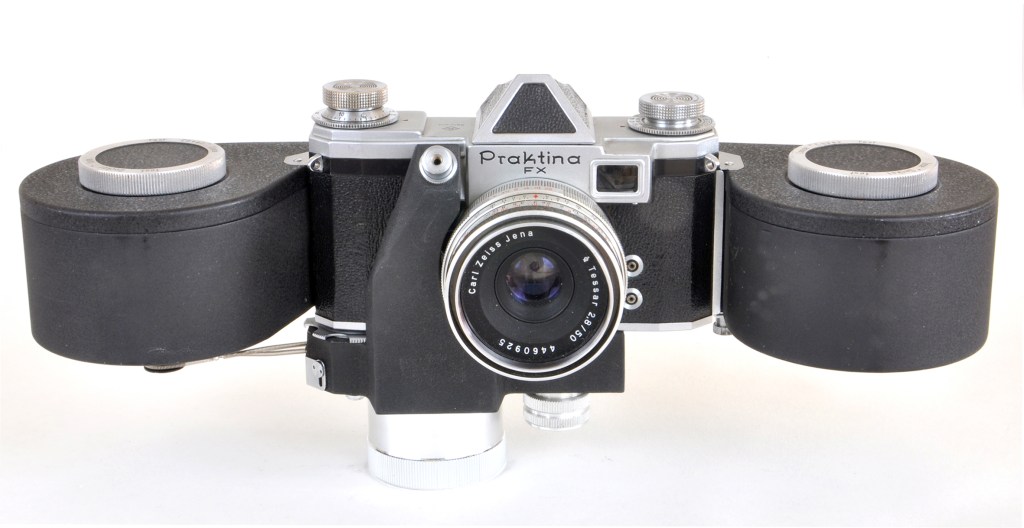
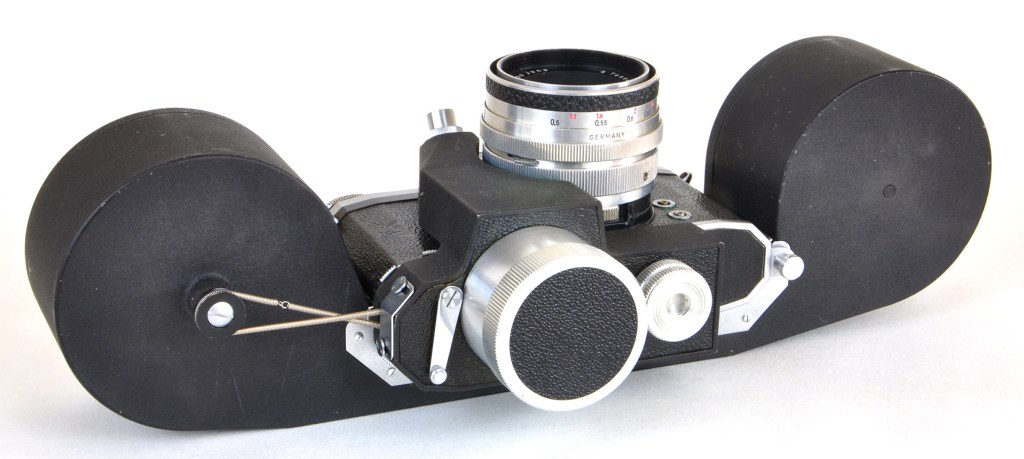
That coupling socket on the base of the body is also called into use with the camera’s bulk film back, which is attached to the camera in place of its usual removable back. Two huge film chambers, one at either end of the back, flank the body and hold approximately 17m of film to take 450 exposures at a single loading. An adapter, screwed into the coupling socket and coupled to the film back by a belt, enables the extra-long film length to be wound by the camera’s usual advance knob.
Close-up accessories
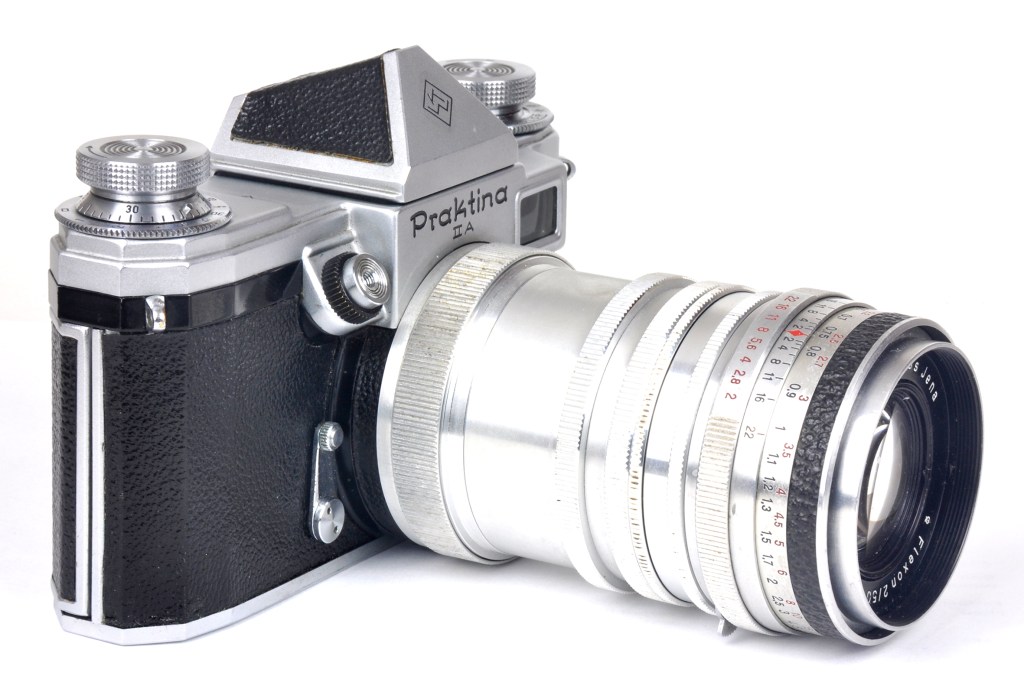
Extension rings to fit between the lens and body provide Praktina cameras with the opportunity for close-up photography. Variations include straight rings without any coupling between lens and body for manual operation of apertures; auto rings that couple the body to the stop-down mechanism in the lens; and one in which the lens stop-down movement is operated as the shutter is fired using a double cable release to the shutter button and the extension ring. Between them, the rings offer extensions between 12.5mm and 50mm.
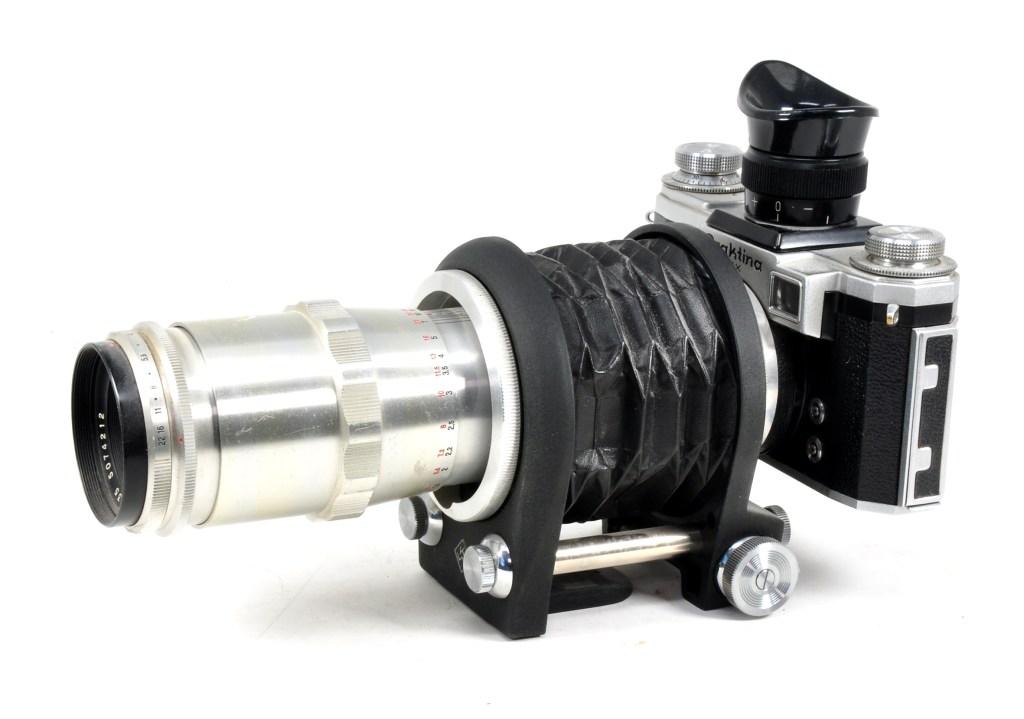
Bellows, which also fit between the body and lens give even more scope. Three types can be used with pre-set lenses only, pre-set plus semi-auto lenses and pre-set plus semi-auto and fully-auto lenses. Extensions of between 7.7mm and 55mm are possible. Special macro extension tubes can also be found for use attached to the bellows and with the lens reversed.
Stereo photography
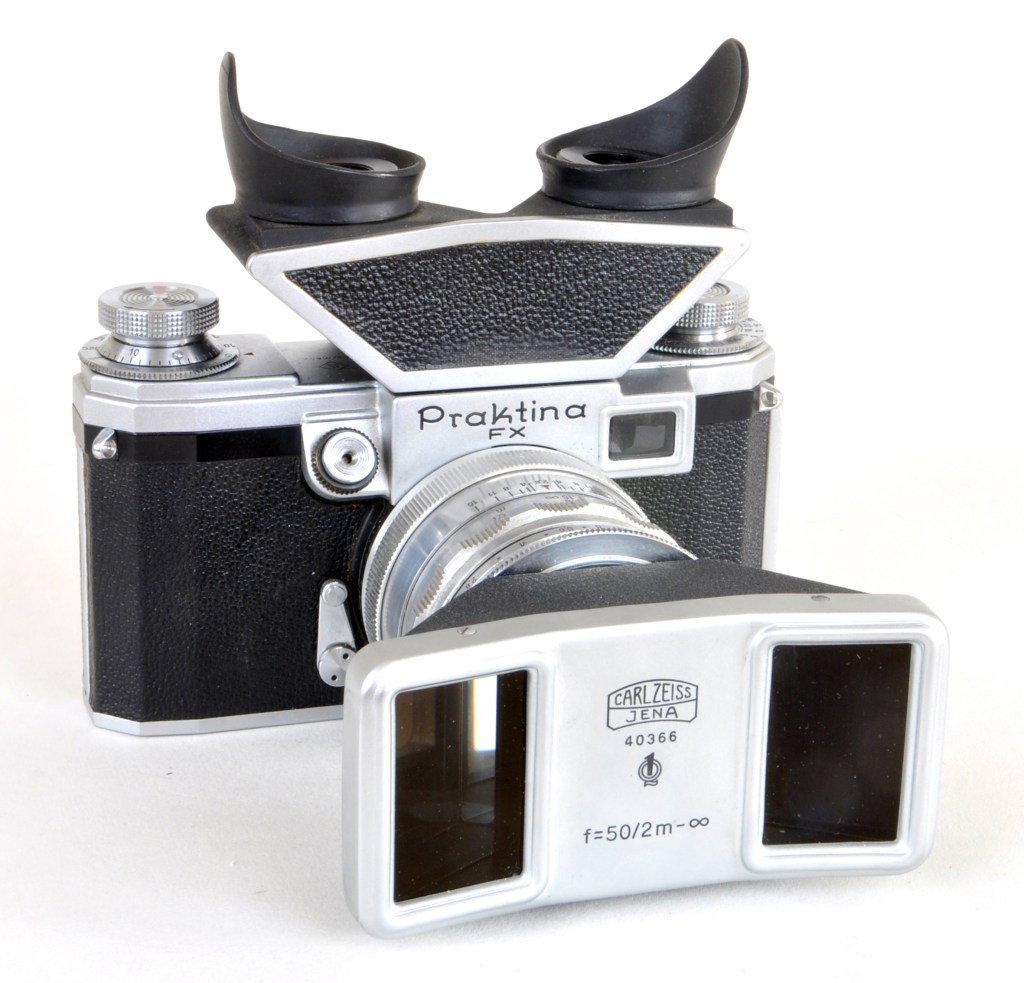
The most unusual and now very rare accessory is one designed to turn the Praktina into a stereo camera. It was made for KW by Carl Zeiss and is very similar to a stereo device made for Exakta cameras. In use, a beam splitter screws to the front of a standard 50mm lens, while a special viewfinder is slid in place of the camera’s usual eye-level or waist-level finder. The beam splitter produces twin stereo images on a single frame of film, while the twin eyepieces of the special viewfinder show the photographer just one single image.
The end of the line
Between them, the Praktina FX and IIa, along with their minor variations and the system of accessories that supported them, built into one of the most impressive 35mm SLR systems seen up to the end of the 1950s. Production of all models ended in 1960 when increasing production costs of the complex cameras and their consequently high prices failed to survive against the emergence of Japanese cameras, in particular the Nikon F. It fell to the more competitively priced, and soon to be abundant, Praktica cameras to lead the way into the following decades.
More from KW
Praktinas were far from the only cameras made by KW. The company, and the various incarnations that evolved from it, were responsible for a huge range of camera types. Here’s a quick round-up that represents just some of the cameras that were important in different fields.
1921: Patent Etui
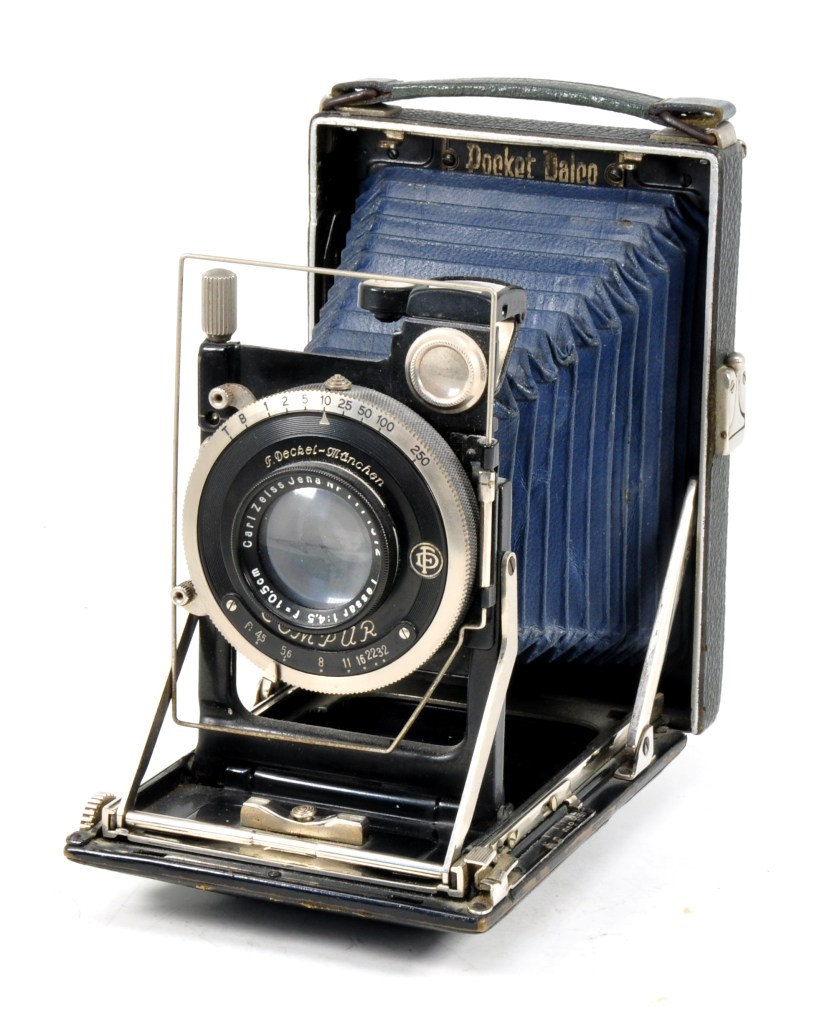
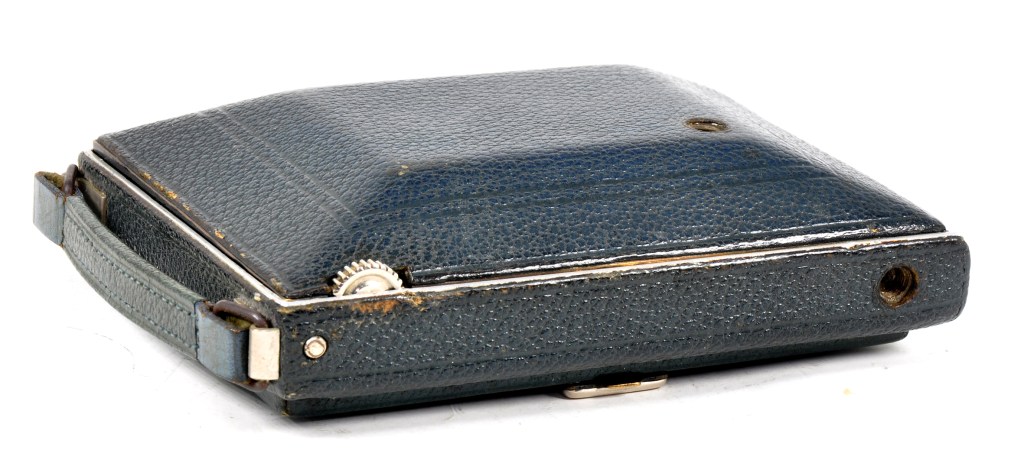
This was a masterpiece in economic design. It’s a folding camera in which a bed drops down and the lens is pulled out on bellows along rails. Unfolded, it shoots pictures 6x9cm on glass plates or cut film. The camera illustrated has a Tessar 10.5cm f/4.5 lens and a Compur shutter speeded 1–1/250sec. Other lens and shutter combinations were also sold. What sets the camera apart from similar folding models of the time is that, when folded, the body width is an ultra-slim 3.5cm. The Etui, which can sometimes be found with its variant name Pocket Dalco, was originally available in blue, red, brown, grey and black, each with matching bellows. A slightly larger version for 9x12cm images was also made.
1931: Pilot Reflex
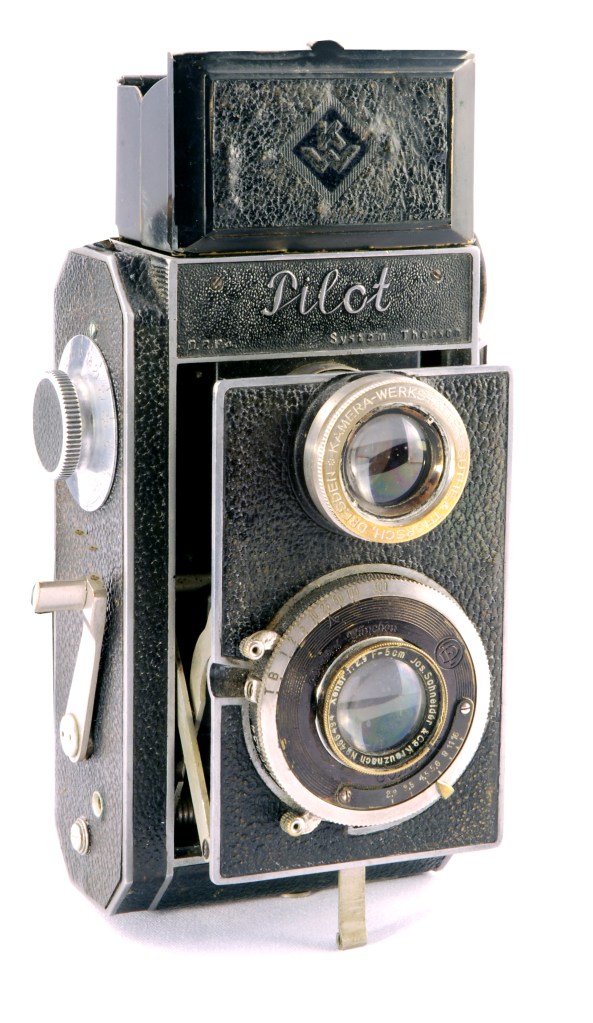
Only four folding TLRs were made by different manufacturers in the 1930s, and the Pilot Reflex is the smallest. As a catch is pressed on the side, the lens panel springs forward, the taking lens on bellows and the viewing lens on an extending tube. A knob on the side moves the two lenses back and forth to focus them simultaneously. The camera shoots 3x4cm pictures on 127 roll film running top to bottom. To load it, the film is wound until the first number appears in the red window. Thereafter, two strokes of a lever on the side of the body advances the film one frame, counted in a tiny window below the lever. The counter runs to 18. Cleverly incorporated into the mechanism is a device that compensates for the increasing thickness of the take-up spool, keeping negatives evenly spaced. A fold-up optical viewfinder on the side allows the camera to be held horizontally.
1933: Reflex Box
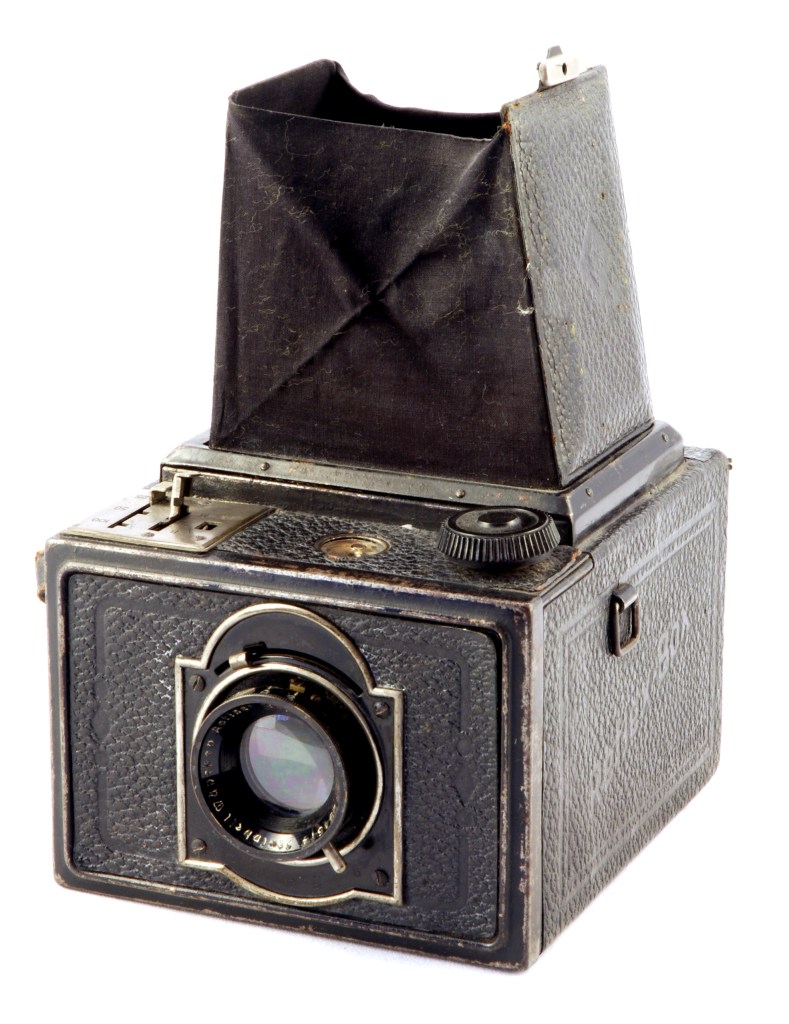
Looking more like a box camera with a focusing hood stuck on top than the traditional concept of an SLR, the Reflex Box takes 120 roll film and produces eight horizontal pictures 6x9cm. The Steinheil 105mm f/4.5 lens is rotated to focus and a lever above it changes apertures. Three shutter speeds of 1/25–1/100sec are controlled by a lever on top of the body that moves in a straight line and drops into a slot for each speed, a bit like the gear lever on an automatic car. The shutter is tensioned and the mirror lowered by a lever on the side. Today, the Reflex Box is rather rare.
1939: Pilot Super
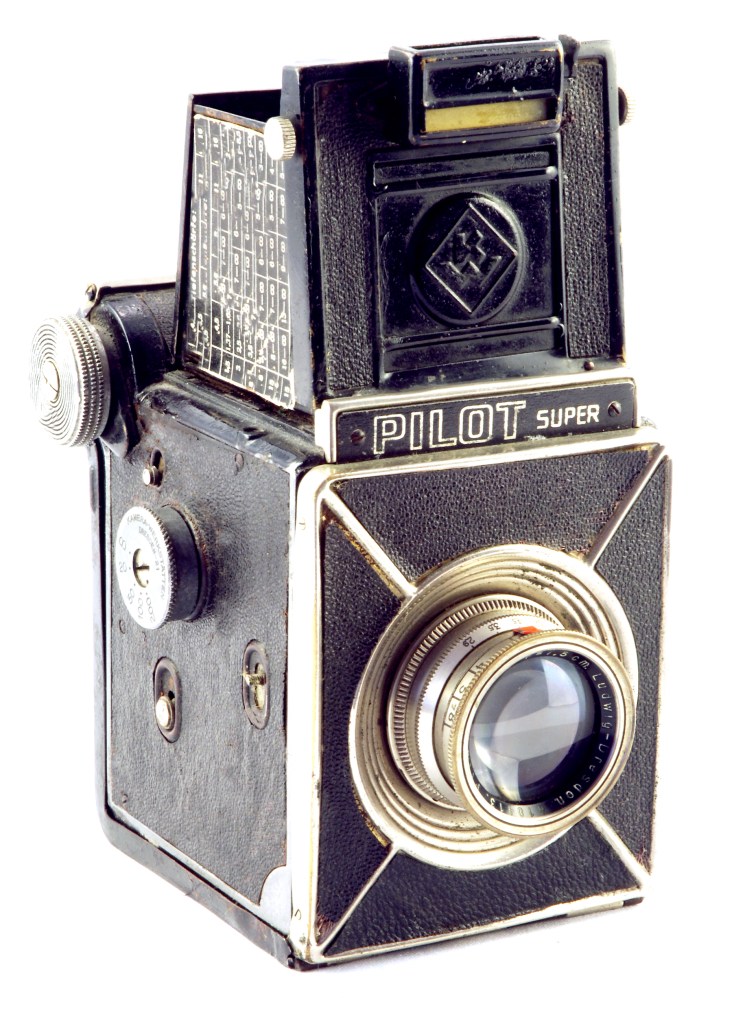
This was the third and best version of a camera originally called the Pilot 6 launched three years before. The Super version adds an extinction meter. All cameras take 12 6x6cm exposures on 120 roll film, but the Super offers the facility for also taking 16 exposures of 4.5x6cm, by use of a mask at the film plane. A sliding plate on the camera back reveals either one red window for 12 exposures, or two red windows for 16 exposures. The shutter is speeded 1/20-1/200sec and the interchangeable lens is an Ennastar Pilotar 7.5cm f/2.9.
1939: Praktiflex
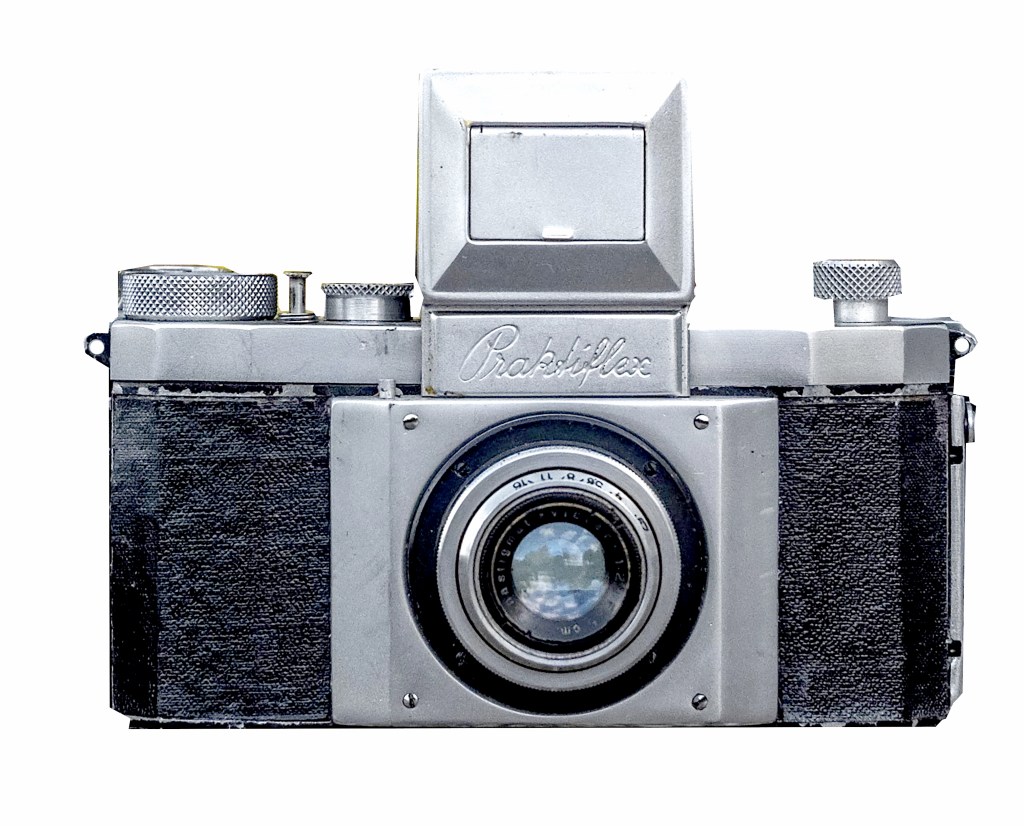
The Praktiflex was an important landmark, being only the third 35mm SLR produced by any manufacturer. (The first two were the German Kine Exakta and Russian Sport.) The first model uses a 40mm lens mount and only Praktiflex lenses can be used. But in 1947, KW initiated the M42 mount for the camera that went on to become an industry standard for subsequent 35mm SLRs from many other manufacturers. Nearly a dozen variants, all using waist-level viewfinders, were introduced before and after World War II up until 1954, when the Praktina took over the starring role in the KW 35mm SLR stable.
1956: Praktica FX2
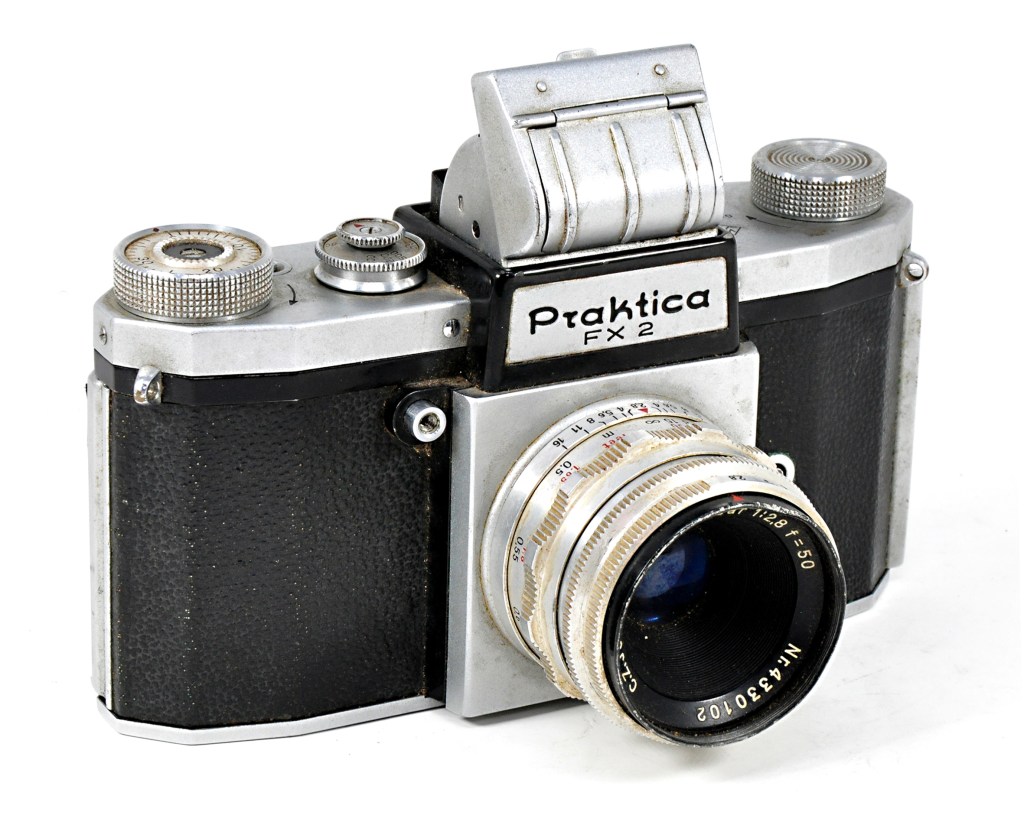
The first Praktica was introduced in 1949 as the natural successor to the Praktiflex, which it much resembled. But seven years later, with the introduction of the FX2, it was time for a major landmark because this was the first SLR with fully automatic aperture stop-down built into the body. The camera takes its name from its dual flash synch system: ‘F’ for high-speed bulbs and ‘X’ for electronic flash. It accepts M42 mount lenses and the standard lens is usually a 50mm f/2.8 Tessar. The camera also has an unusual method of producing 1/2-1/500sec speeds using two speed dials. One selects the speed, the other switches from fast to slow speeds. The mirror is not instant return. The camera’s waist-level viewfinder is not ideal for the 35mm format, but a pentaprism accessory to slot into place over the viewing screen improves its use tremendously.
1966: Pentacon Six
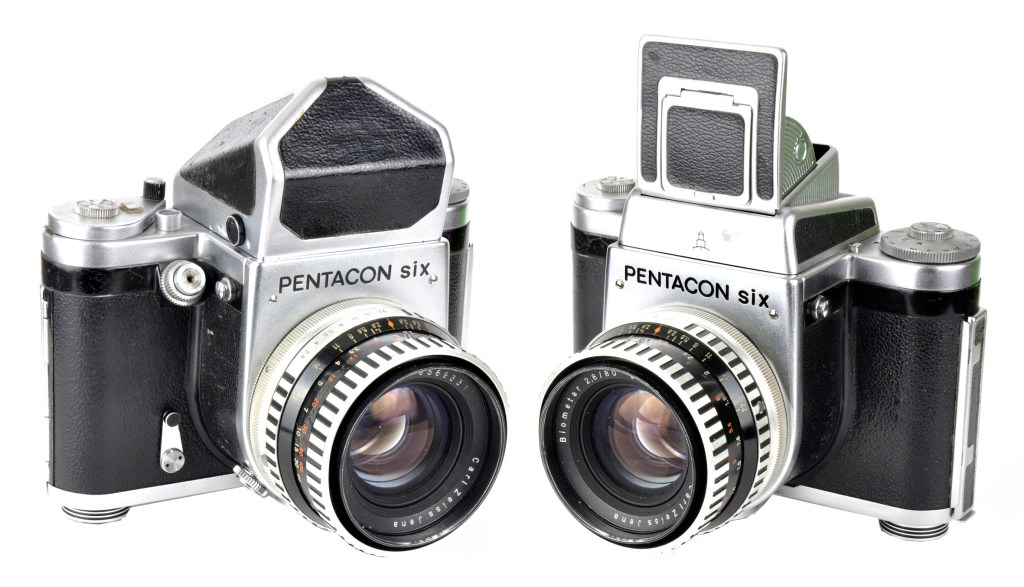
In 1957, while the company was under state ownership following World War II, the Praktisix introduced medium format film size and quality in a camera that resembled an extra-large 35mm SLR. It was followed by the Praktisix II and IIa with minor cosmetic changes and finally became the Pentacon Six. It features an eye-level pentaprism viewfinder which can be swapped for a waist-level finder. Both are non-metered, but a metered prism finder can also be used for through-the-lens metering. Seven interchangeable focusing screens offer plain viewing, rangefinder focusing and a selection of specialist types for technical photography. Carl Zeiss Jena and Schneider are among the prestigious names that made lenses for the camera, ranging from 30mm wide-angle to 1,000mm telephoto, all interchangeable via a breech-lock mount. Bellows and extension tubes offer facilities for close-up and macro photography.
1992: Noblex 135
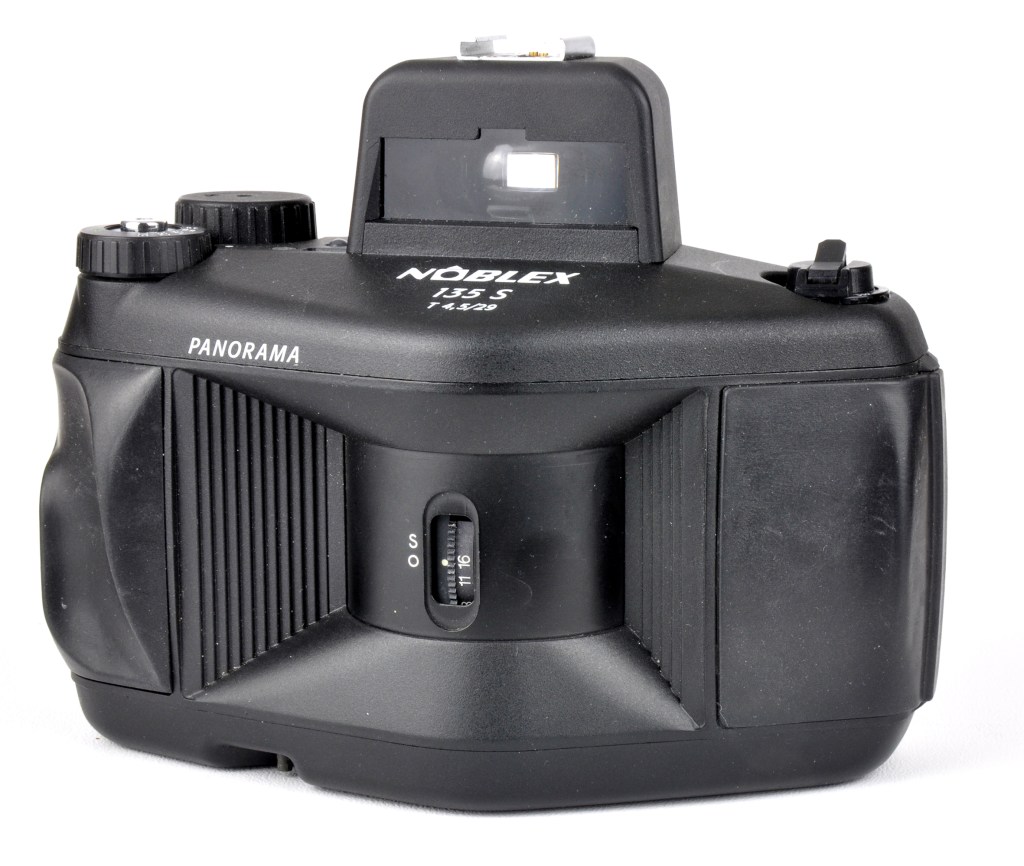
Panoramic cameras fall into several types, and the Noblex is a swing-lens model in which film is loaded around a curve and, during exposure, the lens swings in an arc, building up its image on the film as it moves. The Noblex is among the best of this type of camera. It uses a battery-driven motor to turn the lens, contained within a cylinder which rotates 360 degrees, but with the movement beginning before the start of the actual exposure. This ensures that, by the time the exposure begins, the mechanism has accelerated to its optimum speed and the resulting picture is more evenly exposed across its width. The Noblex 135 shoots 19 24x66mm images on 35mm film. A larger version was made to shoot six 5x12cm images on 120 roll film.
What to pay
Praktina FX: £30-35
Praktina IIa: £75-100
Patent Etui: £70-100
Pilot Reflex: £300-500
Reflex Box: £25-50
Pilot Super: £50-75
Praktiflex: £100-150
Praktica FX2: £30-50
Pentacon Six: £100-150
Noblex 135: £250-300
Come to Photographica
If you like classic cameras, you’ll love Photographica, Britain’s biggest camera collector’s fair where you’ll find everything from wood and brass cameras to early digital and everything in between. Organised by the Photographic Collectors’ Club of Great Britain, it happens in a few weeks’ time on May 17 at The Royal National Hotel, 38-51 Bedford Way, London WC1H 0DG. More information at pccgb.net.
Related reading:
- World Photography Day: cameras that made history
- 140 years – A lifetime of landmark cameras
- Best 35mm film cameras
Follow AP on Facebook, Instagram, YouTube and TikTok.